
The difference between healthy and codependent love can be surprisingly hard to spot—especially when you’re deeply in it. Both can feel intense, emotional, and all-consuming, but one builds you up while the other slowly wears you down.
f you’ve ever wondered whether your relationship is truly supportive or just overly dependent, you’re not alone.
Let’s explore what sets these two apart and why understanding that difference might completely change the way you love.
Difference Between Healthy and Codependent Love: Are You Loving or Losing Yourself?
Love is one of the most powerful emotions we experience as humans, but not all love is built the same.
While healthy love uplifts and empowers, codependent love often drains and traps us.
Understanding the difference between healthy and codependent love is essential for anyone seeking a relationship based on mutual respect, trust, and growth.
Often, what feels like love may be rooted in emotional patterns that are not healthy or balanced.
This will help you understand how to spot the signs, make conscious changes, and move toward deeper, more fulfilling connections.
What Does Healthy Love Look Like?
Healthy love is a relationship where both partners support each other without losing themselves.
There is freedom, balance, and a deep emotional connection that allows each person to be their full self.
In healthy relationships, both people communicate openly, listen respectfully, and maintain their individuality.
There is space for personal growth, and the relationship adds value to both lives rather than consuming them.
Example: Meera and Arjun are in a long-term relationship. Meera runs a small business and Arjun is a teacher. They both cheer each other’s successes, discuss difficult moments, and still enjoy independent time with friends or family. Their love feels steady, respectful, and secure.
Similar reads:
- Emotional Enmeshment in Relationships
- What Are Red Flags in a Relationship
- Difference Between Emotional Intimacy and Physical Intimacy
- How to Set Boundaries in a Relationship Without Being Controlling
What Is Codependent Love?
Codependent love, on the other hand, often feels intense but comes from emotional imbalance.
It’s built around one partner sacrificing their needs to keep the other person happy, often fearing rejection or abandonment.
In codependent relationships, love becomes conditional. A person may feel worthy only when they’re needed or approved by their partner.
Over time, this creates a cycle of emotional exhaustion, insecurity, and control.
Example: Tanya constantly cancels her own plans if her boyfriend feels upset. She’s afraid to say no, worried he might leave. She feels guilty for taking time for herself. That’s not love—it’s codependency shaped by fear.
Key Signs to Understand the Difference
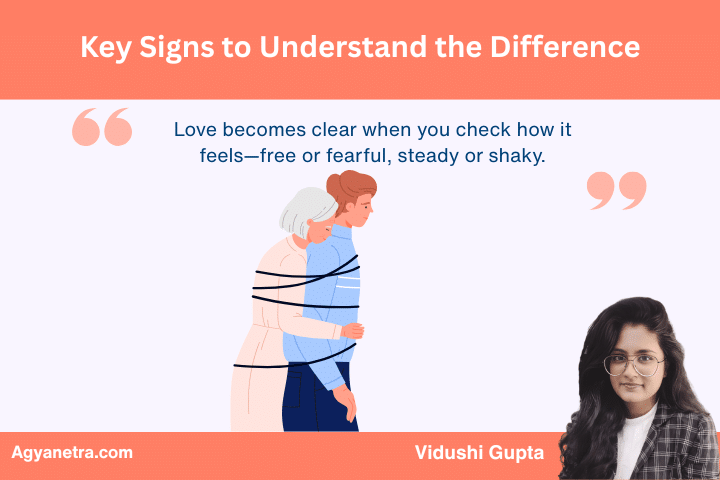
The difference between healthy and codependent love becomes clear when we look at certain behaviors, mindsets, and emotional habits. Let’s explore each aspect step-by-step.
Self-Worth and Identity
In a healthy relationship, both partners have their own identity and sense of self-worth.
They are secure in who they are and don’t rely on the relationship to feel complete.
In codependent love, self-worth is tied to the other person’s opinion.
One partner may feel they are only “good enough” if they are constantly giving or sacrificing.
Example: Rahul enjoys painting. His partner encourages it, even if they don’t share the hobby. In contrast, a codependent person might give up their passion entirely to avoid conflict or rejection.
Boundaries
Boundaries are essential in any loving relationship. Healthy love respects them—each person feels safe saying no or asking for space.
Codependent love ignores boundaries. One partner may feel smothered, and the other may feel anxious if not constantly involved in everything the other does.
Example: A partner who can’t go to dinner with friends without guilt or fear their partner will be upset is likely in a codependent pattern.
Emotional Independence
In healthy love, you can manage your own emotions and don’t depend entirely on your partner to feel okay.
There is emotional balance and personal responsibility.
In codependent love, one person might feel anxious or incomplete when alone. They seek constant reassurance and fear being left out or rejected.
Example: Sita enjoys alone time and feels refreshed afterward. Her partner understands and respects that. In codependency, she might feel nervous or selfish for even asking for space.
Communication and Conflict
Healthy love welcomes open and honest conversations, even when difficult. Both people feel safe to express their feelings without fear.
In codependent love, conflict may be avoided or one partner may suppress their needs to keep the peace.
Example: A healthy partner can say, “That hurt me,” and be heard. In a codependent bond, one may bottle things up or cry silently, fearing it might push the other away.
Helping vs. Fixing
Healthy love involves support without taking over someone’s life.
Codependent love often turns into trying to fix, control, or rescue the other person.
Example: In a healthy dynamic, Rohan comforts his partner but doesn’t take over every decision. In codependency, he might feel he needs to manage everything just to keep the relationship going.
Why Codependent Love Feels Like Real Love?
The emotions in codependent love are real, but the foundation is shaky.
It often begins with intense connection, frequent attention, and selfless acts. That can feel romantic at first.
However, beneath that surface, codependent love is built on fear—fear of abandonment, fear of not being good enough, or fear of being alone.
Vidushi Gupta, in her reflections on relationship patterns, beautifully notes that “True love is a mirror—it reflects your wholeness.
But codependent love often reflects your wounds.” Her view reminds us that if we constantly seek to be needed rather than to be understood, we might be chasing validation, not love.
Real-Life Signs You’re in a Codependent Relationship
Here are practical signs to look out for:
- You feel guilty when doing something for yourself
- You prioritize your partner’s happiness over your own every time
- You can’t make decisions without your partner’s input
- You’re afraid of being rejected or abandoned
- You suppress your needs to avoid conflict
- You feel emotionally responsible for your partner
- Your life feels out of balance or dependent on their moods
These patterns often stem from childhood experiences or past emotional wounds, but the good news is—they can be healed.
How to Move Toward Healthy Love
Understanding is the first step. Once you recognize the patterns, you can begin to shift toward healthier ways of relating. Here are steps to begin that journey:
Reclaim Your Identity
Reconnect with your hobbies, goals, and dreams. Ask yourself what brings you joy beyond the relationship.
Example: Join a class you’ve always wanted to try, reach out to old friends, or start journaling your personal thoughts and goals.
Set Emotional Boundaries
Learn to say no without guilt. Healthy love includes respecting each other’s time, space, and emotional needs.
Example: “I need an evening to myself” is not selfish—it’s self-care.
Communicate Honestly
Start with small conversations. Express your needs in calm, respectful ways. Open communication builds emotional safety.
Example: “I feel overwhelmed when I’m the only one planning everything. Can we share that more?”
Learn to Self-Soothe
Instead of looking to your partner to fix your feelings, try grounding exercises, walks, writing, or talking to a friend.
Give Without Losing Yourself
Support your partner, but don’t make their emotional well-being your full-time job. Love should feel shared, not carried.
Consider Professional Support
Therapy or relationship counseling can help untangle deep emotional patterns and guide you toward balance. Especially if the cycle has lasted years, professional guidance offers real tools for change.
Building Interdependence Instead of Codependence
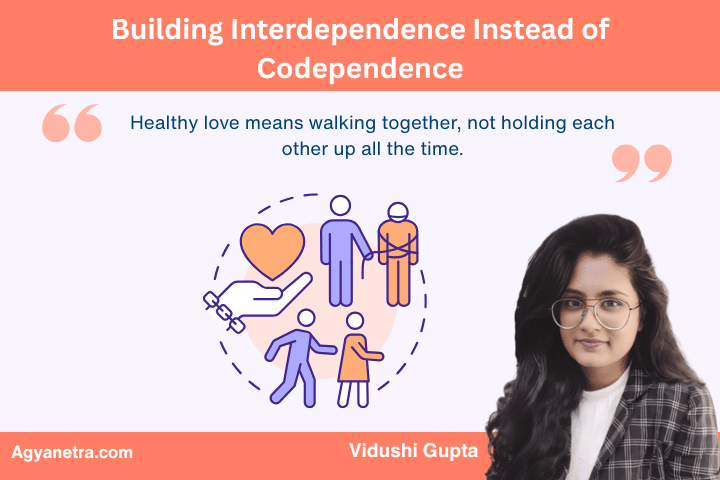
The goal isn’t to become emotionally distant or hyper-independent. It’s to build interdependence—a healthy space where love is shared, not controlled.
Interdependent relationships include:
- Supportive connection without control
- Clear communication and mutual respect
- Space for growth, rest, and personal time
- Emotional safety during disagreements
- Confidence in each other without fear of loss
Example: A couple that cheers each other on, respects time apart, and still feels secure is practicing interdependence.
Vidushi Gupta’s insights into conscious relationships often emphasize that “Partners should walk beside each other, not inside each other’s shadow.”
This beautifully describes what interdependence truly feels like—side by side, not enmeshed.
Final Thoughts
Recognizing the difference between healthy and codependent love is a life-changing step toward emotional freedom. Healthy love helps you grow, honors your boundaries, and deepens your self-worth.
Codependent love, while it may feel intense, often leads to imbalance, anxiety, and self-loss.
Whether you’re in a relationship or reflecting on a past one, take time to notice what kind of love you’re allowing or offering.
The most fulfilling partnerships are built not on dependency, but on mutual care, respect, and the freedom to be fully yourself.
By learning this difference, you’re not just protecting your heart—you’re preparing it for a love that truly reflects your wholeness.
And when love becomes a choice rather than a need, it becomes real, lasting, and beautifully free.
FAQs
What is the difference between healthy and codependent love?
Healthy love is based on balance, respect, and individuality. Both partners support each other while maintaining their independence. Codependent love, however, involves emotional dependence—one person relies heavily on the other for happiness and self-worth.
How can I tell if my relationship is codependent?
You might be in a codependent relationship if you feel responsible for your partner’s happiness, struggle to say no, or lose your sense of self. Constantly needing approval or fearing rejection are also clear signs of codependency.
Can codependent love turn into healthy love?
Yes, it can—with awareness and effort. The key is setting boundaries, communicating honestly, and building emotional independence. Therapy or self-reflection can help both partners move from control and dependency to mutual respect and trust.
Why does codependent love feel so intense?
Codependent relationships often feel intense because they’re driven by fear of loss, not genuine security. The emotional highs and lows create a feeling of passion, but it’s rooted in anxiety rather than true emotional connection.
Can codependent love turn into healthy love?
Yes, it can—with awareness and effort. The key is setting boundaries, communicating honestly, and building emotional independence. Therapy or self-reflection can help both partners move from control and dependency to mutual respect and trust.
Why does codependent love feel so intense?
Codependent relationships often feel intense because they’re driven by fear of loss, not genuine security. The emotional highs and lows create a feeling of passion, but it’s rooted in anxiety rather than true emotional connection.
How can I break free from a codependent relationship?
Start by acknowledging the pattern and focusing on self-care. Set small boundaries, reconnect with hobbies, and rebuild your confidence. Seeking guidance from a therapist or support group can make the healing process easier and more sustainable.
Is codependency the same as love addiction?
Not exactly, but they overlap. Codependency is about emotional reliance on another person, while love addiction is about chasing the feeling of being needed or wanted. Both stem from insecurity and fear of being alone.
Can healthy couples have moments of codependency?
Yes, even healthy couples may experience brief codependent behaviors during stressful times. The key difference is that in healthy relationships, these moments are temporary and addressed through honest communication and self-awareness.
What does emotional independence mean in love?
Emotional independence means being responsible for your own happiness. You can love deeply without depending entirely on your partner to feel complete. It’s about sharing life together, not depending on each other to survive.
What are common myths about codependent love?
Some believe codependency is “true devotion” or “deep love,” but it’s not. Real love uplifts both partners equally. Another myth is that codependency only happens in romantic relationships—it can also occur with family or friends.

Vidushi Gupta is a certified spiritual coach, energy healer, and emotional wellness counselor with over 10 years of experience guiding people through spiritual signs, emotional healing, and inner transformation. Her approach is grounded, fear-free, and focused on helping readers understand spiritual experiences with clarity and emotional balance.
With a background as a digital content strategist and published author of nearly ten novels, Vidushi has reached over 20 million readers worldwide through her writing. She is known for explaining complex spiritual ideas in simple, relatable language, making topics like repeating signs, intuitive shifts, and spiritual awakenings easier to understand and trust.
Through her work, she helps people connect everyday life experiences to deeper inner growth—gently, honestly, and without superstition.
Accuracy, Fact-Checking & Expert Oversight: Vidushi Gupta.