
The idea of Maya, often described as illusion, becomes important when people start questioning why life feels confusing, repetitive, or disconnected from deeper truth.
Many reach this understanding not through books, but through lived frustration, emotional patterns, or a sense that reality does not feel as solid as it once did.
In her work and observations, Vidushi Gupta has seen that Maya is not something mystical or distant, but something humans experience every day without realizing it.
This chapter explores Maya as the veil that shapes perception, explains how it forms, and shows why understanding it brings clarity rather than fear.
Instead of treating Maya as something to escape, this article explains how awareness can move through it with understanding and balance.
Understanding Maya and the Illusion of Reality: Often Feels Confusing
This section clarifies what Maya actually refers to, since the term is often misunderstood or oversimplified. Understanding the meaning of Maya helps remove confusion and unnecessary fear around it.
Maya does not mean that the world is fake or that life has no value. In spiritual philosophy, Maya refers to the way reality is perceived rather than reality itself.
It is the mental and emotional lens through which humans interpret experiences, identities, and events.
Vidushi Gupta often explains Maya as selective perception. Awareness sees only a part of the whole and mistakes that part for complete truth.
The world exists, relationships exist, and emotions are real, but the conclusions drawn from them are shaped by conditioning, memory, and belief rather than direct awareness.
How the Illusion of Reality Is Created
This section looks at how Maya forms through normal human functioning. Seeing how the illusion is built makes it easier to recognize it in daily life.
The human mind organizes reality to survive and function efficiently. The brain categorizes experiences, labels people, assigns meaning, and creates stories to make sense of the world. These processes are necessary, but they are not neutral.
Language plays a major role in Maya. Words divide experience into objects, roles, and identities, which makes reality feel fixed and separate.
Time also strengthens illusion by creating strong ideas of past and future, even though awareness only exists in the present moment.
From Vidushi’s observations, Maya is not something imposed on humans from outside. It forms naturally as the mind tries to understand life, and illusion begins when these interpretations are taken as absolute truth.
Maya and the Sense of a Separate Self
This section explains how Maya creates the feeling of being a separate individual disconnected from everything else. This is one of the strongest layers of illusion.
The idea of “me” and “my life” feels obvious and solid, yet it is largely a mental construction.
Identity is built from memories, roles, emotions, and social feedback. Over time, this identity feels permanent and unquestionable.
Maya strengthens when awareness fully identifies with this constructed self. Thoughts feel personal, emotions feel defining, and external events feel threatening or validating.
The world then appears divided into “me” and “others,” which creates fear, comparison, and attachment.
Vidushi often notes that suffering increases when identity becomes rigid. The illusion is not the self itself, but the belief that this self is the whole of who we are.
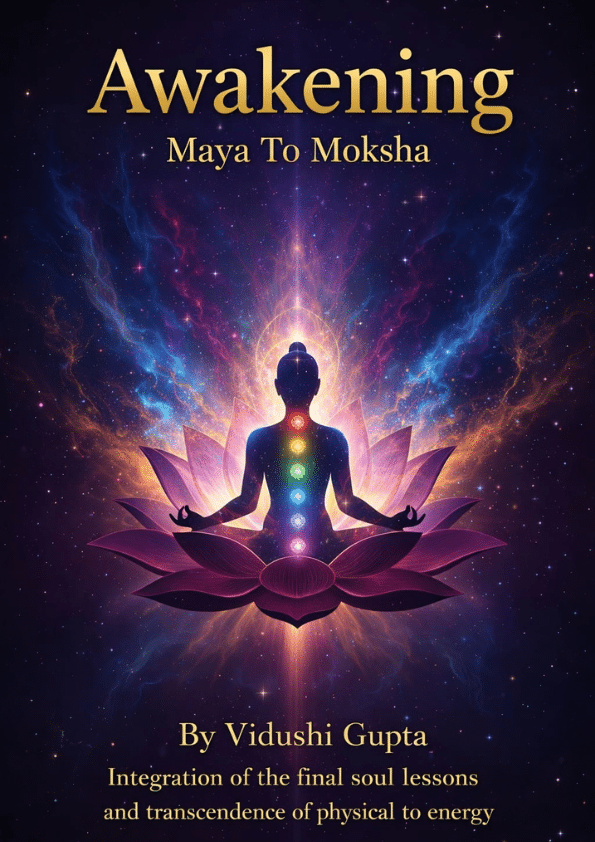
Free PDF Book
Awakening Maya To Moksha
Integration of the final soul lessons and transcendence of physical identity into pure awareness.
Why Maya Feels So Real?
This section addresses why illusion feels convincing and difficult to see through. Understanding this helps reduce self-blame.
Maya feels real because it is reinforced constantly. Social systems, education, culture, and family structures all support the idea of fixed identity and external success.
Emotional experiences further strengthen these beliefs by tying survival and belonging to them.
Neuroscience also shows that the brain prefers familiar patterns. Once a belief or identity forms, the mind looks for evidence to confirm it and ignores information that challenges it. This makes illusion feel stable and logical.
Vidushi Gupta emphasizes that people are not foolish for believing in Maya. The system is designed to feel real, and awareness only begins to question it when inner maturity develops.
The Role of Conditioning in Maya
This section explains how early experiences and social learning deepen illusion. Seeing this clearly helps loosen its grip.
From childhood, humans absorb beliefs about worth, success, love, and safety. These beliefs shape decisions, relationships, and self-image without conscious choice. Over time, conditioning becomes automatic.
Maya strengthens when these learned patterns are never questioned. People begin living according to expectations rather than inner truth. Fear of rejection or failure keeps illusion intact.
Vidushi has observed that many spiritual questions arise when conditioning no longer works. When external success or approval stops bringing peace, awareness starts looking beyond learned stories.
Maya and Emotional Suffering
This section connects Maya with emotional pain, helping readers understand why certain patterns repeat.
Suffering often arises not from events themselves, but from the meaning assigned to them. Loss feels unbearable when identity is attached to what is lost.
Fear feels overwhelming when the self feels fragile and separate.
Maya amplifies suffering by making experiences feel permanent and personal. A single failure can define self-worth, and a single rejection can feel like proof of unlovability.
According to Vidushi’s insights, pain becomes transformative when illusion is seen clearly. When awareness notices that emotions pass and identity is flexible, suffering loses its absolute power.
How Maya Influences Relationships and Life Choices
This section shows how illusion shapes everyday decisions and interactions. Recognizing this brings practical clarity.
Relationships often form through projected identities rather than true understanding. People seek validation, security, or completion from others based on unconscious beliefs. This creates dependency and conflict.
Career choices, lifestyle goals, and ambitions are also shaped by Maya. Many people chase success to feel worthy or safe, only to find emptiness even after achieving it.
Vidushi often points out that clarity arises when actions come from awareness rather than fear. Seeing Maya allows people to choose more honestly, without being driven by illusion.
You may also like:
- What Is the Spiritual Ego
- Spiritual Awakening Confusion Phase
- What Is the Purpose of a Spiritual Person
- What Are the Symptoms of Spiritual Transformation
The Difference Between Seeing Maya and Escaping Life
This section addresses a common misunderstanding about illusion and spirituality. Seeing Maya does not mean rejecting the world.
Understanding Maya does not require withdrawal from life or responsibilities. The body still lives, works, loves, and participates in society. What changes is the level of identification.
Awareness begins to engage with life without being completely defined by it. Success and failure lose their grip on identity. Relationships become more honest and less driven by need.
Vidushi emphasizes that spiritual maturity shows in grounded living, not detachment from reality. Seeing illusion clearly makes life lighter, not distant.
How Awareness Slowly Moves Beyond Maya
This section explains how illusion loosens over time, rather than disappearing suddenly. This sets realistic expectations.
Maya does not collapse all at once. Awareness gradually notices patterns, reactions, and beliefs without immediately acting on them. This observation itself weakens illusion.
Moments of clarity appear naturally. Old triggers lose intensity. Choices feel less compulsive and more conscious.
From Vidushi’s experience, patience is essential. Forcing insight often strengthens the ego, while gentle awareness allows understanding to settle naturally.
Living in the World Without Being Trapped by Maya
This section offers a balanced way of relating to illusion in daily life. The goal is clarity, not perfection.
Living with awareness means noticing thoughts and emotions without immediately believing them. It means acting responsibly while staying inwardly flexible. Life is still engaged, but not clung to.
Practical grounding, reflection, and honesty help maintain balance. Awareness learns to respond rather than react.
Vidushi encourages people to see Maya not as an enemy, but as a teacher. Illusion reveals where attachment still exists and where understanding can deepen.
The Deeper Purpose of Maya
This section brings the understanding together by showing why illusion exists at all.
Maya is not a mistake in creation. It allows experience, learning, and growth. Without illusion, awareness would not explore individuality or return with wisdom.
The veil creates contrast. Contrast creates understanding. Understanding leads to freedom.
From Vidushi Gupta’s learnings, Maya is not meant to trap awareness forever. It is meant to be seen, understood, and gently transcended through clarity rather than struggle.
Conclusion
Understanding The Veil of the Smoke, or Maya, changes how reality is experienced. Life stops feeling like a rigid structure and begins to feel more fluid and open.
The illusion does not disappear, but its power weakens when awareness recognizes it.
When Maya is seen clearly, identity softens, suffering reduces, and choices become more conscious.
Rather than escaping the world, awareness learns to live within it with clarity and balance. This understanding marks an important step in moving from confusion toward deeper truth and inner freedom.
FAQs
What does Maya mean in spiritual understanding?
Maya refers to the way reality is perceived rather than reality itself. It explains how the mind, conditioning, and beliefs shape what we see and feel. According to Vidushi Gupta’s observations, Maya does not mean life is false, but that our interpretation of life is often limited and incomplete.
Is Maya the same as saying the world is not real?
No, Maya does not mean the world is unreal or meaningless. It means that reality is filtered through the mind and senses. The spiritual understanding of Maya suggests that experiences are real, but the conclusions we draw from them are often shaped by illusion and conditioning.
How does Maya create the illusion of a separate self?
Maya creates a sense of separation by building identity from thoughts, memories, roles, and emotions. Over time, this identity feels fixed and personal. Vidushi Gupta explains that illusion strengthens when awareness believes this identity is the whole self, rather than a temporary mental structure.
Why does Maya feel so real in daily life?
Maya feels real because it is constantly reinforced by society, culture, emotions, and survival instincts. The brain also prefers familiar patterns, which makes beliefs and identities feel solid. This combination makes illusion feel logical and convincing, even when it is not the full truth.
What role does conditioning play in Maya?
Conditioning plays a major role in Maya by shaping beliefs about success, worth, love, and safety from an early age. These beliefs operate automatically and guide decisions without awareness. Maya strengthens when conditioning is never questioned and life is lived only through learned expectations.
How is Maya connected to emotional suffering?
Maya increases suffering by making experiences feel personal and permanent. Loss, failure, or rejection hurts more when identity is attached to outcomes. According to Vidushi’s learnings, suffering reduces when awareness sees emotions and roles as temporary rather than defining the self.
Does understanding Maya mean leaving worldly life?
No, understanding Maya does not mean rejecting or escaping life. It means participating in life with awareness rather than blind identification. Vidushi Gupta emphasizes that clarity brings balance, allowing people to live fully while remaining inwardly flexible and less reactive.
Can Maya completely disappear from life?
Maya usually does not disappear entirely, but its influence reduces. Life continues with thoughts, roles, and responsibilities, yet they hold less control over identity. Vidushi explains that freedom comes from seeing illusion clearly, not from eliminating everyday experience.
What is the deeper purpose of Maya in spiritual growth?
The deeper purpose of Maya is to allow experience, learning, and growth. Illusion creates contrast, and contrast leads to understanding. From Vidushi Gupta’s perspective, Maya is not meant to trap awareness forever, but to guide it toward clarity, wisdom, and inner freedom.

Vidushi Gupta is a certified spiritual coach, energy healer, and emotional wellness counselor with over 10 years of experience guiding people through spiritual signs, emotional healing, and inner transformation. Her approach is grounded, fear-free, and focused on helping readers understand spiritual experiences with clarity and emotional balance.
With a background as a digital content strategist and published author of nearly ten novels, Vidushi has reached over 20 million readers worldwide through her writing. She is known for explaining complex spiritual ideas in simple, relatable language, making topics like repeating signs, intuitive shifts, and spiritual awakenings easier to understand and trust.
Through her work, she helps people connect everyday life experiences to deeper inner growth—gently, honestly, and without superstition.
Accuracy, Fact-Checking & Expert Oversight: Vidushi Gupta.