
Is spiritual awakening real or psychological is a question many people ask quietly, especially when they start feeling emotions they can’t explain.
You may suddenly feel more aware, more emotional, or unsure about the life you used to enjoy. And it can leave you wondering—am I growing, or is something wrong?
In this article, you’ll find simple, clear answers. You’ll understand how spiritual awakening and psychological shifts are connected, how to recognize real signs, and what to do if you feel confused.
These insights are supported by the grounded learnings of Vidushi Gupta, who shares that awakening is a very human process—not something mystical or strange.
Let’s explore this journey step by step.
Is Spiritual Awakening Real or Psychological?
Spiritual awakening is not about becoming someone new or special.
It’s about waking up to the truth of who you already are. It’s a shift in how you see yourself, others, and life.
You may begin to feel tired of pretending. You may start noticing how your mind behaves. Things that once excited you may now feel empty.
Vidushi Gupta explains that awakening starts when we become more honest with ourselves. It’s not loud. It’s not always dramatic. Most of the time, it’s a quiet shift inside you.
You may not have words for it. But you know you are not the same.
What Psychology Says About Spiritual Awakening
Psychology helps us understand what’s happening in the brain and nervous system when we go through major inner change.
It explains that when we deal with stress, loss, or reflection, our thoughts become louder. Our feelings rise. We stop living on autopilot.
This moment of awareness—while natural—can feel scary or confusing.
Some people feel anxious. Some feel numb. Others may cry without knowing why.
A therapist may call it emotional processing. A spiritual teacher may call it awakening. Both are pointing to the same thing.
You are becoming more aware of your thoughts, feelings, and patterns.
Is Spiritual Awakening Real or Psychological?
This is the most important question—and the answer is not either-or.
Spiritual awakening can be both real and psychological.
The changes feel spiritual because you are questioning your purpose, your relationships, your values.
But your body and brain are also involved. Emotions get processed. Old beliefs break down.
Vidushi Gupta explains that awakening happens when life invites us to pause and look within. It’s not about escaping reality. It’s about seeing it more clearly.
If your experience leads to peace, kindness, and clarity, it’s a healthy awakening.
If it causes deep fear, loss of function, or panic, it may need professional support.
You may also like:
- Kundalini Awakening and Anxiety
- What Are the Symptoms of Spiritual Transformation?
- Can Kundalini Awakening Be Reversed?
- How Kundalini Awakening Feels in the Body
Common Spiritual Awakening Symptoms
When you begin to awaken, certain feelings and patterns are common.
You may notice yourself becoming more sensitive to people, places, or conversations.
You might suddenly want to be alone more often—not because you’re sad, but because noise starts to feel heavy.
You may feel emotions you used to avoid. Or you may question why you’re doing what you’re doing.
Vidushi Gupta encourages people to observe these changes without judging them. These are signs of deeper awareness, not signs that something is wrong.
A person working in a fast-paced job starts to feel drained even after small meetings. They begin to crave nature, silence, and simple routines. This is often the first sign of inner change.
10 Physical Symptoms of Spiritual Awakening
Spiritual awakening can sometimes bring physical symptoms. But these are usually tied to emotional stress, not something magical.
Here are ten signs people often report:
- Feeling tired or drained without reason
- Light headaches or pressure in the head
- Ups and downs in sleep patterns
- Chest tightness or fluttering
- Digestive discomfort
- Loss of appetite or sudden hunger
- Increased sensitivity to sound or light
- Body aches, especially around shoulders or neck
- Random shivers or energy surges
- Feeling hot or cold without explanation
These symptoms often pass with rest, hydration, and grounding activities.
Still, if any of these continue or feel serious, it’s wise to talk to a doctor. Awakening doesn’t mean ignoring your health.
A young woman begins meditating and reflecting daily. She starts waking up at odd hours and feeling pressure in her chest. She adds deep breathing, warm baths, and better sleep—and the discomfort fades.
Is Spiritual Awakening Dangerous?
Spiritual awakening can feel intense. But it’s not dangerous when approached with care.
Problems arise when people isolate themselves or try to figure it all out alone.
It’s also risky if someone believes they are “chosen” and start ignoring real-world responsibilities.
Vidushi Gupta often reminds seekers that real growth makes you humble, not superior. It makes you more aware, not more confused.
If your awakening brings fear, anxiety, or disconnection, reach out. Help is not a weakness. It’s wisdom.
A man starts experiencing panic and believes it’s spiritual energy. A therapist helps him calm his nervous system. He continues meditating—but now with clarity and peace.
Why Was I Chosen for a Spiritual Awakening?
This question often comes from a place of confusion or loneliness.
You’re not chosen in the way we often imagine. You are simply ready.
Awakening happens when the mind slows down enough to feel. When the heart becomes tired of hiding. When life pushes us to grow.
Vidushi Gupta shares that there is no “special group” of people who awaken. We all carry awareness. Some just begin noticing it earlier.
A teacher going through burnout starts questioning everything. Her old joys no longer work. She begins journaling, walking in nature, and choosing peace. This isn’t a reward. It’s a response to readiness.
Is Spiritual Awakening Good or Bad?
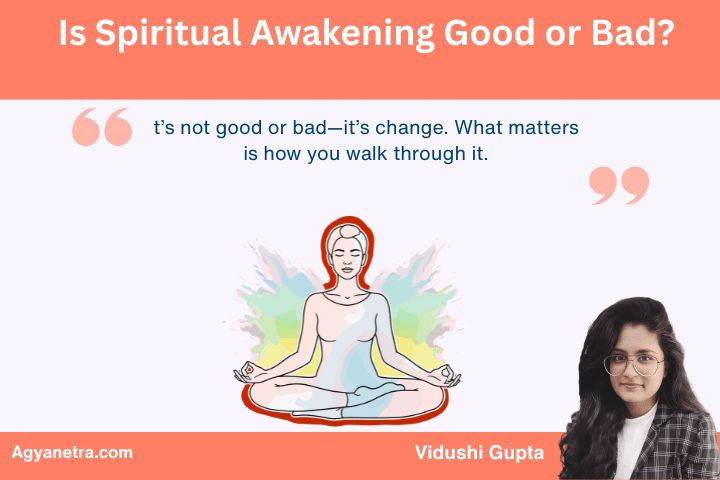
Spiritual awakening is not good or bad—it just is.
What matters is how you move through it.
It becomes a positive shift when you gain self-respect, awareness, and calm.
It becomes harmful when you resist it, panic, or isolate without support.
Growth can be messy. Some days feel confusing. But overall, if your choices are becoming healthier, you’re on the right track.
A man stops enjoying loud parties and feels empty. He thinks he’s becoming boring. Later, he realizes he now values peace, deep talks, and early mornings. His values changed—that’s growth.
Is Spiritual Awakening Biblical?
The Bible doesn’t use the term “spiritual awakening,” but the ideas are similar.
It talks about renewing the mind, walking in truth, and turning inward to seek peace.
These are the same signs many people experience when awakening.
Awareness of truth. A call to compassion. Letting go of pride.
Vidushi Gupta encourages readers of all beliefs to focus on how awakening changes your heart and actions—not just your thoughts.
A man reconnects with his faith during personal loss. He starts reading scripture with new eyes, feeling more open and gentle. That’s spiritual awakening through a biblical path.
Should You Take a Spiritual Awakening Test?
You may find many tests online—but none of them can truly measure your awakening.
Awareness is not a score. It’s a way of living.
Instead of tests, ask yourself:
- Am I reacting less and reflecting more?
- Am I letting go of things that once controlled me?
- Am I seeking truth over comfort?
If the answer is yes, you’re growing.
A woman feels drawn to take a test but instead journals her recent changes. She sees she’s been setting boundaries, speaking gently, and simplifying her life. That’s proof of awakening—without any quiz.
When to Get Psychological Help
It’s important to know when you need support.
If you’re having panic attacks, insomnia, intense fear, or feel disconnected from reality—please speak to a mental health professional.
Spiritual awakening does not replace therapy.
Vidushi Gupta believes both can work together. Seeking help is not blocking your path. It’s building it on safe ground.
A young man starts seeing repeating numbers and feels paranoid. He avoids sleep and feels unsafe. With therapy and grounding, he calms down and continues his growth in a stable, healthy way.
How to Stay Grounded During Awakening
Awakening can make you feel out of balance. Grounding keeps you safe and steady.
Here are simple ways to stay grounded:
- Sleep at regular times
- Eat nourishing food
- Drink enough water
- Walk in nature
- Journal every evening
- Talk to someone you trust
- Limit social media
- Do breathing exercises
- Avoid spiritual overload
Vidushi Gupta shares that gentle, daily habits are more powerful than chasing deep truths. Healing happens slowly—and simply.
A person overwhelmed by spiritual content takes a break. They start cooking, walking in the park, and calling old friends. Within days, they feel lighter and clearer.
Conclusion
Is spiritual awakening real or psychological is not just a question—it’s a doorway.
A doorway into knowing yourself better.
For most people, the awakening feels real and is also tied to the mind and emotions. It brings clarity, shifts in purpose, and changes in how you live.
When you walk this path with awareness, grounding, and support, it becomes a beautiful journey of emotional healing and spiritual understanding.
By recognizing spiritual awakening symptoms, staying calm during physical or emotional changes, and seeking help when needed, you allow yourself to grow in a safe and steady way.
And as Vidushi Gupta gently reminds us, the deepest awakening is not loud—it’s when you begin to live more honestly, more peacefully, and more like yourself.
FAQs

Vidushi Gupta is a spiritual coach, energy healer, and emotional wellness counselor with over 10 years of experience guiding people through spiritual signs, emotional healing, and inner transformation. She is the founder of Agyanetra and a published author of nearly ten novels, reaching over 20 million readers worldwide. Her approach is grounded, fear-free, and focused on helping readers understand spiritual experiences with clarity and emotional balance.