
I still remember a conversation with someone who told me, “I keep changing my job, my relationships, even the city I live in, but the same emotional struggles always find me.” I have heard different versions of that sentence many times over the years. The names change, the stories change, yet the pattern remains. That was one of the moments that led me to appreciate the quiet wisdom behind archetypal healing in Jungian psychology.
My name is Vidushi Gupta, and through years of working with people seeking emotional and spiritual clarity, I have noticed that healing often begins when we stop fighting the hidden parts of ourselves. Carl Jung described these hidden patterns as archetypes—universal forces that quietly shape our thoughts, fears, dreams, and relationships. When I combine Jung’s insights with contemplative traditions such as Advaita Vedanta, Buddhism, and the Yoga Sutras, I find a common invitation: know yourself before trying to change yourself.
If you have ever wondered why certain emotions repeat, why particular relationships feel strangely familiar, or why some dreams stay with you for years, this journey may offer answers. More importantly, it may help you develop a kinder relationship with yourself.
Healing rarely begins by becoming someone new. It begins when I become willing to meet the parts of myself I have spent years avoiding.
What Is Archetypal Healing in Jungian Psychology?
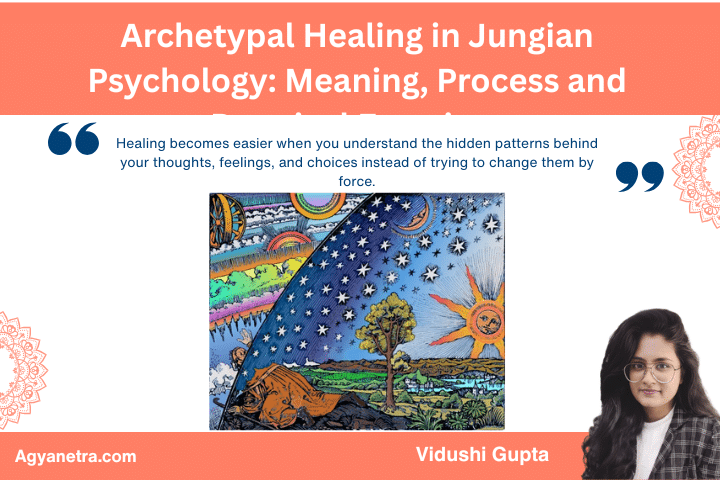
When I first encountered Jung’s work, I expected a collection of psychological theories. Instead, I found a language for experiences that many people quietly carry without understanding.
Jung believed that beneath our personal memories lies what he called the collective unconscious. This deeper layer contains universal patterns shared across humanity.
These patterns are known as archetypes. They are not fixed personalities or labels. I see them as living energies that influence how we respond to life.
The Hero, the Caregiver, the Sage, the Shadow, the Innocent, and the Self are all examples of archetypes. Every one of us carries aspects of several archetypes, although some become more active during different stages of life.
Archetypal healing is the process of recognizing these unconscious patterns and bringing them into awareness. Once I become conscious of a pattern, I am no longer completely controlled by it. Awareness creates choice, and choice creates freedom.
This idea reminds me of the Upanishadic teaching that ignorance is not simply the absence of knowledge. It is forgetting our own nature. Healing, then, is less about becoming complete and more about remembering the wholeness that has always existed beneath fear.
Understanding Archetypes Beyond Personality
One misunderstanding I often encounter is the belief that archetypes are personality types. They are much deeper than that.
A personality describes how I usually behave. An archetype reflects an inner force that shapes my emotional world.
Two people may both appear confident, yet one is driven by the Hero archetype while another is guided by the Ruler. Their outer behavior may seem similar, but their inner motivations are very different.
I often compare archetypes to rivers flowing beneath the earth. Most of the time we only see the landscape above.
Yet those hidden rivers quietly shape everything growing on the surface. Our thoughts, relationships, ambitions, and fears often grow from invisible psychological streams.
When I began recognizing these patterns in my own life, I noticed how often I tried to solve external problems while ignoring the inner forces creating them. The more I listened inwardly, the less confusing many situations became.
The Shadow: Where Healing Often Begins
If there is one archetype that changes people most deeply, it is the Shadow.
The Shadow contains everything I have rejected, hidden, or judged within myself. Sometimes it includes anger. Sometimes vulnerability. Sometimes creativity that never found expression because it felt unsafe.
Many people imagine the Shadow contains only darkness. I have found the opposite to be equally true. Hidden talents, compassion, confidence, and joy can also live in the Shadow simply because they were never encouraged.
Buddhist teachings often remind us that suffering grows through resistance. I have watched this truth unfold repeatedly. The more I reject certain emotions, the louder they become. The moment I become curious instead of fearful, something softens.
One client came to me after years of struggling with perfectionism. She believed discipline was her greatest strength. As we explored her emotional patterns, she realized her perfectionism was protecting a frightened inner child who believed mistakes would lead to rejection.
Nothing changed overnight. Yet once she stopped fighting that vulnerable part of herself, her anxiety slowly became easier to hold. She did not eliminate fear. She learned to listen to it without obeying it.
That shift marked the beginning of genuine healing.
The Shadow does not ask me to become darker. It asks me to become more honest.
You may also like:
- Shadow Work for Beginners: A Practical Guide
- Understanding Individuation and the Inner Marriage of Self
- Anima and Animus Meaning in Jungian Psychology
- Signs of Inner Child Wounds and How to Heal Them
- Spiritual Death and Rebirth Meaning Explained
Individuation: The Journey Toward Wholeness
Jung described the lifelong process of becoming fully oneself as individuation.
I have always appreciated this idea because it removes the pressure to become perfect. Instead, it encourages integration.
In Sufism, there is a beautiful understanding that the heart becomes polished through sincere self-observation. Jung expressed something similar through psychology rather than mysticism. Both point toward inner unity.
Individuation is not about collecting spiritual experiences. It is about gradually reducing the distance between who I appear to be and who I truly am.
Whenever those two selves begin to align, I notice an unexpected sense of peace. Decisions become clearer. Relationships become less dramatic. Even uncertainty feels easier to hold.
Dreams as Conversations With the Unconscious
Dreams fascinated Jung because they often reveal what conscious thinking overlooks.
I have kept a dream journal for years, not because every dream predicts something, but because dreams speak in symbols rather than explanations.
A recurring house may represent the inner self.
A locked room may symbolize forgotten emotions.
Water often reflects emotional life.
Animals frequently express instinctive wisdom.
Rather than searching for universal meanings, I encourage people to ask gentle questions.
What emotion stayed with me after waking?
Which symbol keeps returning?
What part of my life feels similar to this dream?
The answers usually emerge slowly.
Just as Taoism teaches that clarity appears when we stop forcing it, dream understanding often arrives quietly rather than dramatically.
A Practical Exercise for Archetypal Healing
One exercise I often return to is simple enough to practice without special knowledge.
Find a quiet place where you will not be interrupted. Sit comfortably and breathe naturally for a few moments.
Think about a situation that repeatedly causes emotional pain.
Instead of asking, “Why does this keep happening?” ask a different question.
“What part of me is trying to speak through this experience?”
Write whatever comes without judging it.
Then continue with these reflections:
What emotion do I keep avoiding?
Which role do I always play?
What quality do I secretly admire in others?
What quality do I criticize most quickly?
I have found that the qualities I strongly reject in others often reveal hidden aspects of my own Shadow.
Do not rush to change anything after writing. Simply observe with compassion. Awareness itself begins reshaping unconscious patterns.
The Spiritual Dimension of Archetypal Healing
Although Jung approached these ideas through psychology, I often experience archetypal healing as deeply spiritual.
Advaita Vedanta teaches that beneath changing thoughts and identities lies pure awareness.
Jung never used exactly the same language, yet his idea of the Self carries a similar feeling. Beyond the ego’s endless stories exists a deeper center that quietly holds everything together.
I do not believe spirituality asks me to escape my humanity.
It asks me to experience it more honestly.
Many people search for extraordinary mystical experiences while overlooking everyday awareness.
Watching irritation arise without reacting.
Recognizing fear without becoming fear.
Listening before defending myself.
These moments often become the real practice.
Common Misunderstandings About Archetypal Healing
I often hear people say that identifying an archetype will solve all their problems.
That has never matched my experience.
Archetypes offer understanding, not shortcuts.
Another misunderstanding is believing one archetype is better than another.
The Hero cannot replace the Caregiver.
The Sage still needs vulnerability.
Even the Shadow serves an important purpose because it protects parts of us that once felt unsafe.
Some also expect healing to move in a straight line.
It rarely does.
I have experienced periods where months of steady growth were followed by unexpected emotional setbacks. Looking back, those setbacks often revealed deeper layers that were finally ready to be seen.
Healing moves more like the changing seasons than climbing a staircase.
Bringing Archetypal Healing Into Everyday Life
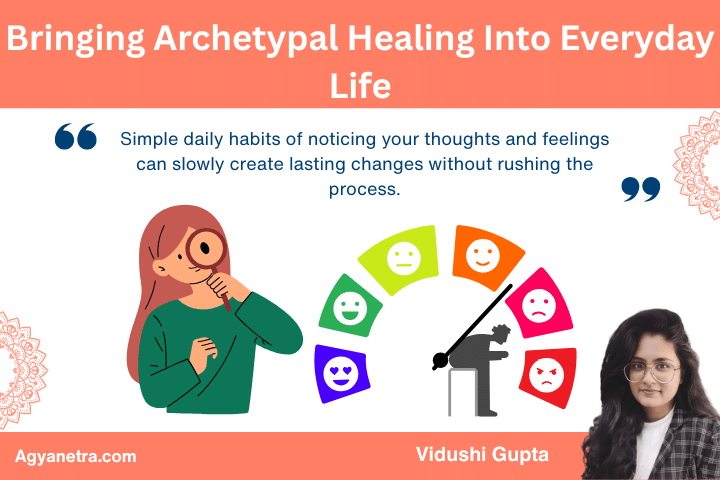
Real change happens through ordinary moments.
When I feel defensive during a conversation, I pause before responding.
When jealousy appears, I become curious instead of ashamed.
When fear tells me I am not enough, I ask whether that voice belongs to my present reality or an older story.
Small moments of awareness gradually reshape larger patterns.
One simple daily practice I recommend is ending the day with three gentle questions.
What surprised me today?
What emotion visited me most often?
What did I learn about myself?
Over time these reflections become conversations with the unconscious rather than exercises to complete.
The Yoga Sutras describe practice as steady effort maintained with sincerity over time. Archetypal healing follows the same rhythm. Small, consistent awareness usually creates deeper change than dramatic breakthroughs.
Every time I choose awareness over automatic reaction, I take one quiet step toward becoming whole.
Final Thoughts
Whenever people ask me how long archetypal healing takes, I smile because I honestly do not know. I have watched profound shifts happen within weeks, and I have also seen certain lessons unfold over many years.
Each person’s path carries its own rhythm.
What gives me hope is not the promise of becoming flawless but the possibility of becoming more authentic.
Carl Jung’s insights remind me that the parts of myself I fear most often carry the wisdom I need next. Ancient spiritual traditions echo the same message in different words: wholeness is discovered through awareness rather than avoidance.
If you begin this journey with patience and honest curiosity, you may notice something subtle. Life may not immediately become easier, but you may find yourself meeting it with greater clarity, compassion, and quiet confidence.
From my experience, that is where lasting healing truly begins.
FAQs
What is archetypal healing in Jungian psychology?
Archetypal healing in Jungian psychology is a process of understanding the unconscious patterns that influence your thoughts, emotions, and behavior. By recognizing these inner archetypes, you can gain greater self-awareness, improve emotional balance, and respond to life’s challenges with more clarity instead of repeating old habits.
What are Jungian archetypes?
Jungian archetypes are universal patterns or symbolic roles that exist in the human mind. Examples include the Shadow, Hero, Caregiver, and Sage. These archetypes shape how you think, feel, and relate to others, often without your conscious awareness.
How does archetypal healing work?
Archetypal healing works by helping you identify unconscious emotional patterns and understand how they affect your daily life. Through self-reflection, dream exploration, journaling, and mindful awareness, you gradually develop healthier responses and a stronger connection with your authentic self.
Is archetypal healing based on Carl Jung’s theories?
Yes, archetypal healing is rooted in Carl Jung’s analytical psychology. It builds on his ideas about the collective unconscious, archetypes, and individuation. Many modern therapists and spiritual practitioners also combine these concepts with mindfulness and personal growth practices.
What is the difference between archetypal healing and shadow work?
Archetypal healing explores many inner patterns, while shadow work focuses mainly on the hidden or rejected parts of yourself. Shadow work is often one important part of archetypal healing, but the broader process also includes understanding positive archetypes and developing emotional wholeness.

Vidushi Gupta is a spiritual coach, energy healer, and emotional wellness counselor with over 10 years of experience guiding people through spiritual signs, emotional healing, and inner transformation. She is the founder of Agyanetra and a published author of nearly ten novels, reaching over 20 million readers worldwide. Her approach is grounded, fear-free, and focused on helping readers understand spiritual experiences with clarity and emotional balance.