How Divine Masculine and Divine Feminine Shape Inner Healing? There comes a point in healing when effort alone stops working. You journal, reflect, meditate, and still feel split inside.
One part of you wants softness, rest, and surrender. Another part wants structure, clarity, and forward movement.
That inner tension is not random. It usually points to an imbalance between the divine masculine and divine feminine within.
When I work with seekers, I see this again and again. People think healing is only about releasing pain. It is also about restoring inner balance.
The divine masculine and divine feminine are not about gender roles. They are deeper archetypal forces within consciousness. One gives direction. The other gives depth. One protects. The other receives.
Inner healing becomes steady when both begin working together instead of against each other.
So, I want to show you how these two energies shape emotional healing, spiritual maturity, and daily life. Not as abstract ideas, but as living forces you can recognize in yourself.
How Divine Masculine and Divine Feminine Shape Inner Healing: Complete Guide
The language of divine masculine and divine feminine may sound modern, but the essence of it is ancient. In Taoism, this appears as yin and yang.

Yin is receptive, intuitive, inward, and fluid. Yang is active, structured, outward, and directed. Neither is superior. Health comes through harmony.
In Tantric philosophy, especially within Kashmir Shaivism, consciousness is often described through Shiva and Shakti. Shiva represents stillness, awareness, and witnessing presence.
Shakti represents movement, power, creativity, and living expression. Healing happens when stillness and movement are not split apart.
I also see this reflected in Advaita Vedanta, though the terms are different. Pure awareness and manifest life are not truly separate.
One is the silent ground. The other is its expression. When seekers understand this deeply, they stop trying to heal by becoming only peaceful or only powerful. They begin learning balance.
The mistake people make is simple. They think softness is weakness or that discipline is harshness. That is not spiritual truth.
The divine feminine is not emotional chaos. The divine masculine is not domination. In their healthy form, both are sacred.
This matters because emotional pain often grows when one side is overdeveloped and the other is neglected. I have seen gentle, loving people who cannot hold boundaries.
I have also seen highly disciplined people who have lost tenderness toward themselves. Both are wounded imbalances.
Inner healing deepens when strength learns to be tender and tenderness learns to be strong.
What the divine masculine heals in the wounded inner world
The divine masculine brings form to healing. It creates the container in which healing can happen safely.
When this energy is healthy, it gives inner stability. It says: sit with the truth, stay present, keep your word, hold the boundary, return to the practice. It is not loud. It is reliable.
In my experience, people with a wounded masculine pattern often struggle with consistency. They want healing, but they do not stay with it. They start and stop. They avoid discomfort. They confuse freedom with lack of discipline. Then they wonder why healing feels incomplete.
The divine masculine repairs this by offering direction. It helps a person say no when needed. It helps them leave unhealthy cycles.
It helps them build structure around rest, prayer, meditation, and self-respect. In Karma Yoga, right action matters. Healing is not only feeling. It is also what I repeatedly choose.
I often describe the divine masculine as the riverbank. Without the bank, water spreads everywhere and loses direction. The water is still sacred, but it needs a form that helps it move.
This is why boundaries are a healing act. Clear decisions are a healing act. Honest speech is a healing act.
The masculine within does not crush emotion. It protects the space where truth can be felt without drowning in it.
A seeker once told me, “I thought healing meant being softer with everyone. But I kept betraying myself.” That was her turning point. She did not need less love. She needed stronger inner masculine energy to protect that love.
Read More:
- Spiritual Evolution and Source Consciousness
- Higher Dimensions in Spirituality
- From Individual Self to Universal Consciousness
What the divine feminine heals that the mind cannot fix
The divine feminine brings depth, receptivity, intuition, and emotional truth. It heals the parts of us that cannot be repaired through control.
I have watched many sincere people try to think their way into healing.
They analyze the wound, explain the pattern, understand the childhood root, and still do not feel free. Why? Because some pain does not dissolve through analysis. It softens through presence.
That is the work of the divine feminine.
In Bhakti Yoga, devotion opens the heart beyond mental effort. In Sufi teaching, especially in the poetry of Rumi, love becomes a force that breaks inner hardness.
The feminine current does something similar. It teaches surrender, trust, and the wisdom of feeling fully without becoming lost.
This energy allows grief to move. It allows intuition to speak. It allows the body to release what the mind has been carrying for too long. It says: stop forcing, soften, listen, receive.
One thing I learned the hard way is that reading about compassion and actually becoming compassionate toward my own inner wounds are two very different things.
The feminine within teaches that difference. She does not argue. She opens.
When seekers are cut off from this energy, they become dry inside. They may function well, succeed outwardly, and still feel emotionally starved.
Their healing becomes efficient but not alive.
The feminine within is like fertile earth. Nothing grows without it. You cannot force a garden open with logic. You prepare the ground. You water it. You wait. Inner healing works the same way.
The divine feminine heals what control cannot touch.

Free PDF Book
Awakening Maya To Moksha
Integration of the final soul lessons and transcendence of physical identity into pure awareness.
A practice to restore balance between these two inner forces
Healing becomes real when it enters practice. So I want to give you a simple exercise I use often with students and sometimes with myself when I feel split between effort and exhaustion.
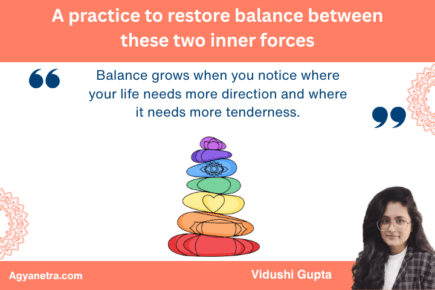
Sit quietly with a journal. Take a few slow breaths and ask these two questions:
Where in my life do I need stronger structure, truth, or boundaries?
Where in my life do I need more softness, trust, or emotional permission?
Do not answer quickly. Let the body respond too.
Then divide a page into two columns. On one side write “masculine healing.” On the other write “feminine healing.” Under masculine healing, note one action that brings steadiness.
It could be ending a draining habit, creating a morning practice, or speaking one honest truth. Under feminine healing, note one act of inward care.
It could be crying without suppression, resting without guilt, or sitting in silence without trying to improve yourself.
Do this for seven days.
I have found that most people know what they need. They just do not trust it long enough to follow through.
This little exercise helps reveal where energy is leaking and what balance actually looks like in lived experience.
In Yoga Sutras of Patanjali, discipline and surrender are both present. Abhyasa means steady practice.
Vairagya means release of grasping. That pairing mirrors divine masculine and divine feminine beautifully. One keeps showing up. The other stops forcing.
What I have seen in seekers who carry wounds in one polarity
This is where the teaching becomes very human.
In my years of spiritual counseling, I have noticed two repeating patterns. Some seekers are overidentified with wounded feminine energy.
They feel deeply but cannot direct their life. They stay too long in confusion, wait for signs instead of making decisions, and mistake emotional intensity for spiritual depth Others are overidentified with wounded masculine energy.
They control everything, distrust softness, and secretly fear what will happen if they stop holding themselves so tightly.
Neither pattern is peace.
I once worked with a woman who had a beautiful heart and strong intuition. She could sense the truth in people almost instantly.
But she had almost no boundaries. She kept reopening doors that life had already closed for her.
Her healing changed not when she became more loving, but when she developed inner masculine clarity. She learned to honor what she already knew.
I also worked with a man who was disciplined, successful, and deeply sincere in his spiritual practice.
But he could not access grief. Every feeling became a problem to solve. His real shift came not through more discipline, but through allowing tenderness.
He needed the feminine within to teach him how to receive his own humanity.
These stories matter because they show something simple. Healing is not about becoming more of what we already overuse. It is about welcoming what is missing.
In Awakening Maya to Moksha, I wrote that many seekers do not need more spiritual information. They need inner reconciliation. I still believe that.
The misconception that divine masculine and feminine are only about relationships
One of the biggest misunderstandings around this topic is the idea that divine masculine and divine feminine exist mainly for romantic dynamics. That view keeps the teaching shallow.
Yes, these energies shape relationships. But their first and deepest work happens within the self.
If my inner masculine is wounded, I may struggle with commitment, truth, protection, and grounded action.
If my inner feminine is wounded, I may struggle with receptivity, trust, self-worth, and emotional flow. A relationship can expose this, but it does not create it.
Another misunderstanding is treating these energies as fixed by gender. That is too narrow. A woman may need stronger masculine healing around structure and boundaries.
A man may need deeper feminine healing around feeling and receptivity. The soul is not interested in social stereotypes. It is interested in wholeness.
I also think people romanticize polarity too much. They talk about sacred union while remaining deeply fragmented inside. Inner healing asks for honesty first.
Before I seek cosmic union, can I hold my own truth without collapsing? Can I receive love without suspicion? Can I act with firmness without becoming hard?
These are not glamorous questions. But they are the ones that actually change a life.
How I bring sacred inner balance into ordinary life
This teaching becomes trustworthy only when it enters ordinary moments.
For me, sacred inner balance looks practical. It looks like resting before I burn out instead of glorifying pressure.
It looks like speaking clearly when something is not right instead of hiding behind politeness. It looks like creating spiritual structure without becoming rigid. It looks like allowing intuition to guide me without losing discernment.
You can live this in small ways too.
If your life feels emotionally flooded, bring in masculine steadiness. Make one clear choice. Keep one promise to yourself. End one draining pattern.
If your life feels dry, overcontrolled, or disconnected, bring in feminine restoration. Sit with music. Let yourself cry. Walk slowly. Pray without asking for anything.
Some days I need more Shiva. Some days I need more Shakti. Wisdom is knowing the difference.
The goal is not perfect balance every hour. The goal is a growing inner relationship where both energies are respected.
Over time, this changes the nervous system, the emotional body, and the way life is lived. Healing becomes less dramatic and more embodied.
And that, in my experience, is where real sacred union begins.
Conclusion
Inner healing becomes deeper and more stable when the divine masculine and divine feminine are no longer treated as opposites.
They are partners. One offers truth, direction, and protection. The other offers softness, intuition, and emotional depth. Together they create wholeness.
When I see seekers truly begin to heal, I notice the same shift. They stop trying to become only strong or only soft. They learn how to be both.
They create boundaries without closing the heart. They feel deeply without losing center. That is sacred balance. Not performance. Not theory. A lived inner union that slowly reshapes everything.
FAQs
What is the difference between divine masculine and divine feminine in healing?
In healing, the divine masculine gives structure, clarity, boundaries, and direction. The divine feminine gives softness, receptivity, emotional truth, and intuitive wisdom. I see healing become more stable when both are present. If one is missing, the person usually becomes either too rigid or too ungrounded.
How can I tell if my divine masculine energy is wounded?
A wounded divine masculine often shows up as poor boundaries, fear of commitment, avoidance of truth, or lack of consistency. In some people it appears as control, harshness, or emotional shutdown. In my experience, the key sign is imbalance around strength. Either it is missing, or it is being used without heart.
How can I tell if my divine feminine energy is wounded?
A wounded divine feminine often appears as emotional overwhelm, difficulty receiving, lack of self-trust, or staying too long in confusion. Sometimes it looks like over-giving, people-pleasing, or depending too much on emotional validation. I have found that when the feminine is wounded, the person usually feels deeply but struggles to feel safe inside those feelings.
How can I begin balancing divine masculine and divine feminine within myself?
I always suggest starting with honest observation. Notice where your life needs more steadiness, truth, and boundaries, and where it needs more softness, rest, and emotional permission. Then support both in small daily ways. Real balance does not happen through ideas alone. It grows through repeated inner choices.
Is divine masculine and divine feminine only about romantic relationships?
No, this is one of the biggest misunderstandings. These energies first shape your inner world long before they shape your love life. They influence how you act, receive, feel, decide, protect, trust, and heal. Relationships may expose the imbalance, but the real work begins within.
Can men and women both carry divine masculine and divine feminine energy?
Yes, absolutely. These energies are not limited by gender. A man may need more feminine healing around feeling and receptivity, while a woman may need more masculine healing around bounda
What is one simple practice to support inner healing through these energies?
A simple practice is to journal with two questions: Where do I need stronger boundaries or direction? Where do I need more softness or emotional honesty? I have seen this reveal a lot very quickly. Once the answer becomes clear, choose one practical action for each side and follow it for a week.
Why does inner healing feel incomplete when one polarity is missing?
Healing feels incomplete because one side cannot do the work of both. Structure without softness becomes hard and exhausting. Softness without structure becomes scattered and unstable. Inner healing becomes whole when the divine masculine holds the space and the divine feminine fills it with life, truth, and feeling.

Vidushi Gupta is a spiritual coach, energy healer, and emotional wellness counselor with over 10 years of experience guiding people through spiritual signs, emotional healing, and inner transformation. She is the founder of Agyanetra and a published author of nearly ten novels, reaching over 20 million readers worldwide. Her approach is grounded, fear-free, and focused on helping readers understand spiritual experiences with clarity and emotional balance.