
I still remember a conversation with a woman who had achieved everything many people dream of. She had a successful career, a loving family, and a life that looked complete from the outside. The manifestation of low and high self-esteem is not simply about confidence or insecurity.
It is reflected in our thoughts, emotions, body language, boundaries, and the way we respond to both success and failure. Yet, as we sat together, she quietly asked me, “Why do I still feel like I am never enough?”
A few weeks later, I met another person who had very little by society’s standards, but there was a quiet steadiness in the way he spoke, smiled, and carried himself. That contrast stayed with me.
Over the years, I have realized that self-esteem rarely announces itself with loud words. It quietly shapes the choices we make, the relationships we build, and even the way we speak to ourselves when no one else is listening.
As Vidushi Gupta, I have often witnessed that healing begins the moment we stop asking, “How do I appear to others?” and begin asking, “How do I relate to myself?” My intention here is to help you recognize these patterns with honesty rather than judgment. When we understand how self-esteem expresses itself in everyday life, we become far more capable of changing it from within.
What Is the Manifestation of Low and High Self-Esteem?
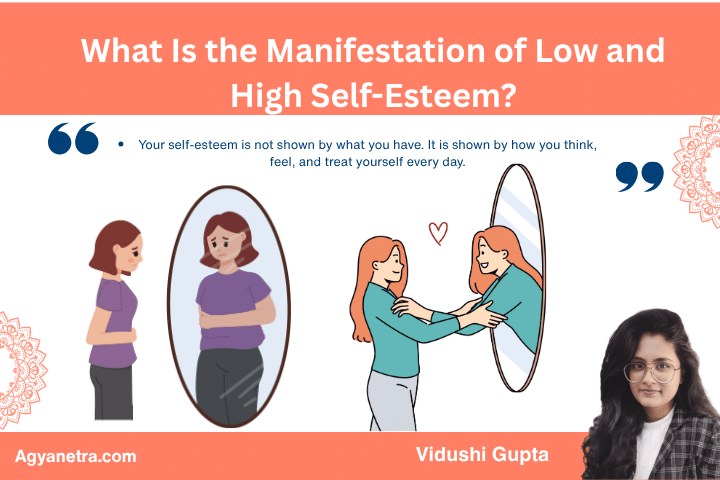
Many people confuse self-esteem with confidence, but I have found they are not the same. Confidence often depends on ability. A person may feel confident while giving a presentation yet feel deeply unworthy in personal relationships.
Self-esteem runs deeper. It reflects the value we believe we have, even when we fail, make mistakes, or disappoint ourselves. It influences whether we see ourselves as worthy of love, respect, and belonging.
The Upanishads repeatedly point toward the idea that our deepest nature is already whole. I have always found this perspective comforting because it reminds me that self-worth is not something we earn. It is something we gradually uncover beneath years of conditioning.
Self-esteem grows quietly when we stop measuring our worth by achievement and begin recognizing our inherent value.
How Low Self-Esteem Manifests
Low self-esteem is rarely just a feeling. It becomes a way of living.
I have noticed that people with low self-esteem often apologize excessively, even when they have done nothing wrong. They hesitate before sharing ideas because they expect rejection before anyone has responded. They seek reassurance repeatedly, yet compliments rarely stay with them for long.
Emotionally, it may appear as constant self-doubt, fear of criticism, guilt, or a persistent feeling of not being enough. Small setbacks begin to feel like proof of personal failure rather than temporary challenges.
Physically, I often observe subtle signs. Shoulders become slightly rounded, eye contact becomes uncomfortable, speech grows hesitant, and there is often visible tension in the body.
Some people neglect their appearance because they feel they do not deserve care, while others become perfectionistic in an attempt to earn acceptance.
Behaviorally, low self-esteem can lead to people-pleasing, difficulty setting boundaries, avoiding opportunities, comparing oneself constantly, and remaining in unhealthy relationships because being alone feels even more frightening.
One pattern I see repeatedly is overthinking. Every conversation is replayed. Every decision is questioned. Every mistake becomes larger than it really is.
These are not personality flaws. They are expressions of an inner belief that says, “I am not enough.”
How High Self-Esteem Manifests

Healthy self-esteem has a completely different energy.
It is surprisingly quiet.
People often imagine high self-esteem as boldness or constant positivity, but my experience tells me otherwise. Truly healthy self-esteem is calm. It does not need to prove itself.
Someone with healthy self-esteem can accept praise without arrogance and criticism without collapsing. They recognize mistakes without turning those mistakes into their identity.
They speak honestly, yet respectfully. They know when to say yes and when to say no. Their happiness does not depend entirely on external approval because they have built an inner relationship based on trust rather than fear.
I have also observed that people with healthy self-esteem recover from disappointment more quickly. They still experience sadness, frustration, and uncertainty, but they do not stay trapped there. Their inner dialogue remains compassionate.
Instead of saying, “I failed because I am worthless,” they naturally think, “That didn’t work. What can I learn?”
That small shift changes everything.
High self-esteem is not believing you are better than others. It is knowing your worth without needing comparison.
The Difference Between Healthy and Inflated Self-Esteem
This distinction is often misunderstood.
Some people appear extremely confident, yet underneath they are constantly seeking validation. They need admiration, recognition, or superiority to feel secure.
That is not healthy self-esteem.
I often compare it to a tree.
A tree with deep roots remains steady during strong winds. It does not need to prove its strength because its stability comes from within.
A tree with shallow roots may appear tall, but the first storm reveals its weakness.
Healthy self-esteem resembles deep roots. Inflated self-esteem often resembles a carefully maintained appearance that depends on outside conditions.
The Yoga Sutras teach that suffering increases when we become overly attached to the image we create of ourselves.
Whenever our identity depends completely on success, status, or praise, fear naturally follows because those things constantly change.
The Hidden Patterns Most People Miss
One of the biggest surprises in my work has been discovering how differently low self-esteem can appear.
Some people become quiet and withdrawn.
Others become perfectionists.
Some become workaholics.
Others become caregivers who forget themselves entirely.
The outward behaviors differ, but the inner message remains surprisingly similar.
“I must earn love.”
“I must never disappoint anyone.”
“I must always perform.”
These beliefs silently shape countless decisions.
This is why I rarely focus only on behavior. I try to understand the belief underneath it.
When the belief changes, the behavior naturally begins to change as well.
A Story That Changed My Perspective
Several years ago, I worked with someone who constantly described herself as confident. She spoke well, managed a successful business, and appeared fearless.
Yet every important decision depended on someone else’s approval.
She asked her parents before making financial choices.
She asked friends before changing careers.
She even questioned her own feelings unless another person confirmed them.
One day I gently asked, “If everyone stayed silent, what would your own heart say?”
She paused for a very long time.
Later she told me that no one had ever asked her that question before.
That conversation reminded me that self-esteem is not measured by how confidently we speak. It is revealed by how deeply we trust ourselves when no one is guiding us.
The Spiritual Meaning Behind Self-Esteem
Many spiritual traditions speak less about self-esteem directly and more about the illusion of separation.
Advaita Vedanta reminds us that our essential nature is complete. Buddhism encourages observing thoughts without becoming trapped by them. Taoism teaches effortless alignment instead of endless striving.
Across these traditions, I notice one shared message.
Our suffering increases when we mistake temporary thoughts for permanent truth.
If the mind repeats, “I am not enough,” it eventually begins to feel like reality.
But thoughts are habits.
Awareness creates space between the thought and the person experiencing it.
That space is where healing begins.
Every time I question an old belief instead of automatically believing it, I reclaim a small part of myself.
How Low and High Self-Esteem Shape Everyday Life
The manifestation of low and high self-esteem becomes visible in ordinary moments far more than dramatic ones.
When receiving feedback, low self-esteem often hears rejection, while healthy self-esteem hears information.
When entering a new opportunity, low self-esteem imagines failure first. Healthy self-esteem feels uncertainty too, yet moves forward anyway.
In relationships, low self-esteem may cling, withdraw, or tolerate disrespect because losing connection feels unbearable. Healthy self-esteem values closeness without abandoning personal boundaries.
Money decisions also reflect these patterns. Some people undercharge because they doubt their value. Others overspend seeking temporary validation.
Healthy self-esteem usually creates a more balanced relationship with both earning and spending.
Even rest is affected.
People with low self-esteem often believe they must constantly prove their worth through productivity.
Healthy self-esteem understands that rest is not a reward. It is part of being human.
A Reflection I Often Share
Whenever I notice self-criticism becoming louder than kindness, I return to one simple exercise.
I sit quietly for ten minutes with a notebook.
I divide the page into two columns.
In the first column, I write every harsh thought my inner critic repeats.
In the second column, I respond as I would to someone I deeply love.
Nothing complicated.
Just honesty.
“I always fail.”
“I’ve failed before, but I’ve also learned.”
“No one values me.”
“I sometimes feel unseen, but that doesn’t define my worth.”
This practice slowly changes the tone of the inner conversation.
I have watched it soften people who believed they could never change.
You may also like:
- Connection Between Self Worth and Love Life
- Law of Attraction and Manifestation Meaning Explained
- Attracting Not Chasing Meaning in Manifestation
- Desire and Attachment in Spiritual Growth
- Soul vs Ego in the Spiritual Journey
Common Misunderstandings About Self-Esteem
One misunderstanding is believing that self-esteem means never doubting yourself.
I still experience moments of uncertainty.
Everyone does.
Healthy self-esteem simply means those moments no longer control every decision.
Another misunderstanding is believing self-esteem comes only after success.
I have met highly accomplished people who secretly dislike themselves and ordinary people whose quiet self-respect fills every room they enter.
Achievement may strengthen confidence.
It cannot replace self-worth.
Finally, many believe healing self-esteem happens quickly.
My experience has been very different.
Healing usually happens through hundreds of small moments rather than one dramatic breakthrough.
Every healthy boundary.
Every kind conversation with yourself.
Every decision made from self-respect instead of fear.
These moments slowly become a new identity.
Bringing Healthy Self-Esteem Into Daily Life
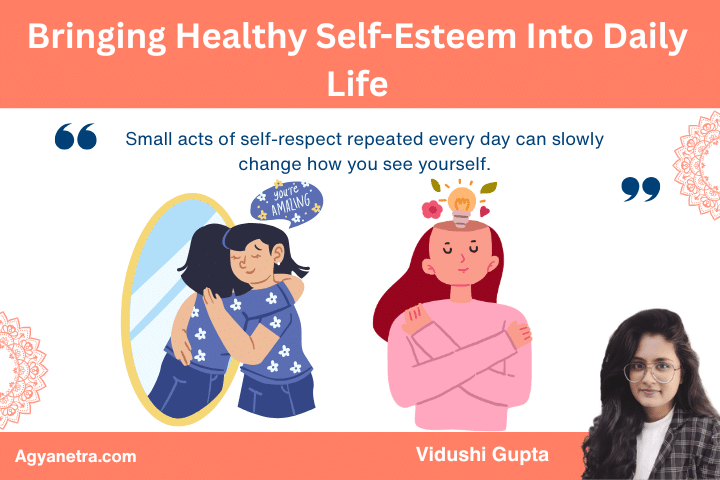
I believe lasting change begins with very ordinary practices.
Notice how you speak to yourself after making a mistake.
Pay attention to where you abandon your needs to keep everyone comfortable.
Celebrate progress instead of waiting for perfection.
Spend time with people who encourage authenticity rather than performance.
Allow yourself to receive appreciation without immediately dismissing it.
Above all, become curious instead of critical.
Whenever an old pattern appears, I no longer ask, “What is wrong with me?”
I ask, “What part of me is asking for compassion right now?”
That question has transformed many conversations I have had with myself and with others.
Final Thoughts
The manifestation of low and high self-esteem is not defined by how successful, attractive, or accomplished someone appears. It is reflected in the quiet relationship we maintain with ourselves every single day.
I have learned that genuine self-esteem does not remove every fear or guarantee constant confidence. Instead, it creates an inner steadiness that allows us to move through life with greater honesty, resilience, and kindness.
Whenever I meet someone struggling with self-worth, I never see a person who is broken. I see someone who has spent years believing a story that no longer serves them.
Those stories can change. With awareness, patience, and consistent self-compassion, we slowly return to the part of ourselves that never lost its worth in the first place.
That return is not about becoming someone new. It is about remembering who we have always been.
FAQs
What is the manifestation of low and high self-esteem?
The manifestation of low and high self-esteem refers to how your self-worth appears in your thoughts, emotions, behaviors, and relationships. Low self-esteem often shows self-doubt and fear of failure, while healthy high self-esteem is reflected in confidence, self-respect, emotional balance, and healthy boundaries.
How can low self-esteem manifest in daily life?
Low self-esteem can appear through constant self-criticism, difficulty accepting compliments, fear of making mistakes, people-pleasing, avoiding challenges, or comparing yourself with others. These patterns often affect relationships, work, and personal growth without you realizing their connection to self-esteem.
What are the signs of high self-esteem?
High self-esteem is often seen in people who trust their decisions, accept feedback without feeling defeated, set healthy boundaries, and treat themselves with kindness. They understand their strengths and weaknesses without feeling the need to prove their worth to others.
What is the difference between low and high self-esteem?
The main difference is how you value yourself. Low self-esteem is often driven by self-doubt and external approval, while high self-esteem comes from self-acceptance and inner confidence. People with healthy self-esteem can handle setbacks without questioning their entire self-worth.
Can low self-esteem affect physical health?
Yes, low self-esteem can contribute to physical symptoms such as muscle tension, poor posture, sleep problems, headaches, or ongoing stress. While these symptoms may have many causes, long-term emotional stress linked to low self-esteem can influence overall well-being.

Vidushi Gupta is a spiritual coach, energy healer, and emotional wellness counselor with over 10 years of experience guiding people through spiritual signs, emotional healing, and inner transformation. She is the founder of Agyanetra and a published author of nearly ten novels, reaching over 20 million readers worldwide. Her approach is grounded, fear-free, and focused on helping readers understand spiritual experiences with clarity and emotional balance.