
A few years ago, I noticed something strange in my own healing journey. I had read spiritual books, practiced meditation, repeated affirmations, and spent hours trying to become more peaceful. Yet certain emotional reactions still appeared with surprising intensity. A small rejection could ruin my entire day.
Someone else’s success could quietly trigger insecurity. Even silence from loved ones sometimes created anxiety I could not explain. Shadow work prompts for healing helped me see parts of myself I had avoided for years.
That was the point where I began working honestly with my shadow.
Shadow work prompts for healing helped me see parts of myself I had avoided for years. Not because I was a bad person, but because some emotions had been buried so deeply that I stopped recognizing them.
I have also seen this happen with many people I worked with over time. The pain was rarely caused only by present situations. Often, old emotional wounds were still asking to be acknowledged.
When practiced gently, shadow work becomes less about fixing yourself and more about understanding yourself. It teaches emotional honesty.
It softens inner conflict. It creates space between who you truly are and the patterns you learned to survive. That space changes everything.
Shadow Work Prompts for Healing: What Shadow Work Really Means

Many people misunderstand shadow work because the word “shadow” sounds dark or frightening. I see it differently.
The shadow is simply the part of us that has been pushed away from awareness. These can be emotions, desires, fears, memories, or traits we learned were unacceptable.
Carl Jung described the shadow as the unconscious aspect of the personality. Long before Jung, many spiritual traditions spoke about the hidden self in different ways.
In Advaita Vedanta, there is often discussion about the false identity created through conditioning. Buddhism also teaches that suffering increases when we resist seeing reality clearly.
I have noticed that the shadow is not always anger or jealousy. Sometimes it is hidden sensitivity.
Sometimes it is grief that never had permission to exist. Some people hide their sadness so deeply that they become emotionally numb without realizing it.
“The emotions we avoid do not disappear. They wait quietly beneath our reactions.”
Shadow work prompts create a doorway into these hidden spaces. A simple question can reveal an entire emotional pattern.
That is why journaling works so powerfully when done with honesty rather than performance.
Why Healing Requires Emotional Honesty
Healing becomes difficult when we only focus on becoming “better.” Real healing often begins when we stop trying to appear healed.
I remember working with a woman who constantly described herself as positive and spiritually aware.
Yet every relationship in her life carried resentment underneath the surface. During one session, she admitted something she had never spoken aloud before.
She was deeply angry at how emotionally unsupported she felt growing up.
The moment she said it, her entire body relaxed.
That experience stayed with me because it reminded me that the shadow is often exhausted from hiding.
Emotional suppression takes enormous energy. Many people think they are protecting themselves by avoiding uncomfortable feelings, but avoidance quietly shapes behavior from behind the scenes.
This is why shadow work prompts for healing can feel emotional at times. They interrupt automatic patterns. They bring unconscious thoughts into awareness.
Some questions I personally found powerful were:
- What emotion do I judge most harshly in others?
- When do I feel emotionally unsafe?
- What part of myself do I hide to feel accepted?
- What kind of love am I still trying to earn?
- What childhood experience still affects my reactions today?
These are not questions to rush through. I often sit with one prompt for days before understanding what is truly beneath it.
The Hidden Link Between Triggers and Old Wounds
One of the biggest shifts in my own healing happened when I stopped viewing emotional triggers as enemies. I began seeing them as messengers.
A trigger is rarely about the present moment alone. It usually activates something older. The mind reacts quickly, but the body remembers deeply.
I once reacted strongly when someone dismissed my work during a conversation. My emotional response felt much larger than the situation itself.
Later, while journaling, I realized the pain was connected to years of feeling unseen as a child.
That realization changed how I approached healing.
The Yoga Sutras speak about samskaras, which are deep mental and emotional impressions formed through past experiences.
Shadow work often brings these hidden impressions into awareness. Once seen clearly, they slowly lose their control over us.
“A trigger is often an old wound wearing a new face.”
I have noticed that people frequently confuse healing with emotional control. But true healing is not becoming emotionless. It is understanding where emotions come from without becoming trapped inside them.
Shadow Work Prompts for Inner Child Healing
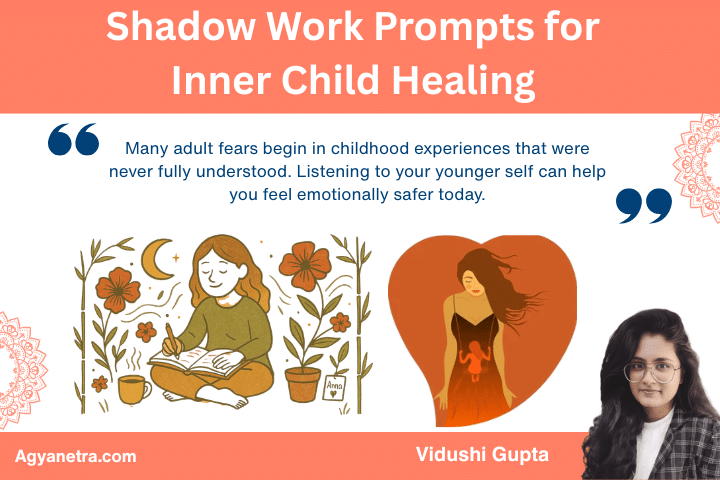
Many emotional patterns begin early in life. Childhood experiences shape how safe we feel in relationships, how we express emotions, and even how we speak to ourselves internally.
Inner child healing became an important part of my shadow work because I realized many adult fears were rooted in younger unmet needs.
These prompts can help uncover those patterns gently:
- What did I need most as a child that I rarely received?
- When did I first feel emotionally rejected?
- What emotions were unsafe to express in my family?
- What kind of approval did I constantly seek growing up?
- When do I still behave like a hurt child instead of a grounded adult?
- What did I learn about love from my caregivers?
- What childhood memory still carries emotional weight?
I often suggest writing these answers slowly rather than analyzing them immediately. Sometimes the body responds before the mind fully understands.
Tears, heaviness, or even unexpected silence can reveal more than logical explanations.
There is also a quiet grief many people experience during shadow work.
Not because they are weak, but because they finally see how long they have been carrying emotional survival patterns alone.
Shadow Work Prompts for Self-Love and Self-Worth
Self-love is often spoken about in very surface-level ways. Real self-love is not constant confidence. It is the ability to stay emotionally present with yourself even during discomfort.
I learned this slowly.
For years, I only felt worthy when I was productive, helpful, or emotionally strong for others. Rest made me uncomfortable.
Receiving support felt unnatural. Shadow work revealed how deeply my self-worth was connected to performance.
These prompts helped me uncover that pattern:
- When do I feel “not enough”?
- What part of myself do I believe must change to deserve love?
- What compliments do I struggle to accept?
- How do I abandon myself in relationships?
- What beliefs about worthiness did I inherit from my family?
- What am I afraid people would discover about me?
- Where do I ignore my own emotional needs?
In Taoism, there is a natural understanding that forcing creates imbalance. I see the same truth emotionally.
Many people force positivity while silently carrying shame underneath. Shadow work helps dissolve that split.
You may also like:
- Shadow Work for Beginners: A Practical Guide
- Signs of Inner Child Wounds and How to Heal Them
- Emotional Triggers and Separation for Healing
- Understanding Individuation and the Inner Marriage of Self
Healing Relationship Trauma Through Shadow Work
Relationships reveal our hidden emotional patterns very quickly. I have rarely seen deeper healing happen without relationships acting as mirrors at some point.
Some people fear abandonment so intensely that they become emotionally dependent.
Others fear vulnerability and create distance whenever intimacy appears. These patterns are not signs of failure. They are protective strategies formed through past pain.
One client I worked with repeatedly attracted emotionally unavailable partners. She believed she was unlucky in love.
During deeper reflection, she realized emotional inconsistency felt familiar because it mirrored her childhood environment.
Awareness changed everything for her.
These shadow work prompts can help uncover relationship patterns:
- What behavior hurts me most in relationships?
- What am I secretly afraid of during intimacy?
- Do I confuse love with emotional intensity?
- When do I stop expressing my real needs?
- What relationship dynamic feels strangely familiar?
- What boundaries am I afraid to set?
- What emotional pain am I still carrying from past relationships?
“Sometimes we do not seek what is healthy. We seek what feels familiar.”
That realization can feel uncomfortable, but it also creates freedom.
The Spiritual Side of Shadow Work
I do not see shadow work as separate from spirituality. In my experience, authentic spirituality naturally leads toward self-honesty.
Some people use spiritual practices to avoid emotional pain. This is sometimes called spiritual bypassing.
Meditation, affirmations, or spiritual teachings become ways to escape uncomfortable feelings instead of understanding them.
I went through this phase myself years ago. I focused heavily on staying peaceful while quietly suppressing grief and anger. Outwardly I appeared calm, but internally I felt disconnected.
Real spiritual growth became possible only after I allowed hidden emotions into awareness.
Sufism often speaks about polishing the mirror of the heart. I love this analogy because shadow work feels similar.
We are not becoming someone new. We are clearing what blocks us from seeing ourselves clearly.
The Upanishads also point toward the illusion of false identity. Much of shadow work involves recognizing the conditioned self we unconsciously perform.
This does not happen overnight. Healing moves in layers.
A Practical Shadow Work Exercise I Often Recommend
One practice I return to repeatedly is simple but surprisingly revealing.
At the end of the day, I write down one emotional reaction that stayed with me. Then I ask myself four questions:
- What exactly triggered me?
- What emotion appeared beneath the reaction?
- When have I felt this emotion before?
- What part of me needed compassion in that moment?
I sit quietly after answering. No rushing. No fixing.
Sometimes nothing profound happens immediately. Other times an old memory surfaces naturally.
Over time, this practice creates emotional awareness without forcing anything.
I have learned that healing is less about dramatic breakthroughs and more about consistent self-honesty.
Common Mistakes People Make During Shadow Work
One mistake I often see is trying to heal too quickly. People want immediate answers for emotions that developed over decades.
The shadow does not respond well to force.
Another mistake is turning shadow work into self-criticism. Awareness should create compassion, not shame.
If every journal session becomes evidence that you are broken, healing becomes difficult.
I also notice people intellectualize emotions instead of feeling them. They analyze endlessly but never allow the emotional experience itself to move through the body.
Buddhist teachings often emphasize observing emotions without attachment or resistance.
That balance matters deeply in shadow work. We do not drown in emotions, but we also do not run from them.
Some days healing feels clear and expansive. Other days it feels confusing and uncomfortable. Both are part of the process.
Integrating Shadow Work Into Daily Life
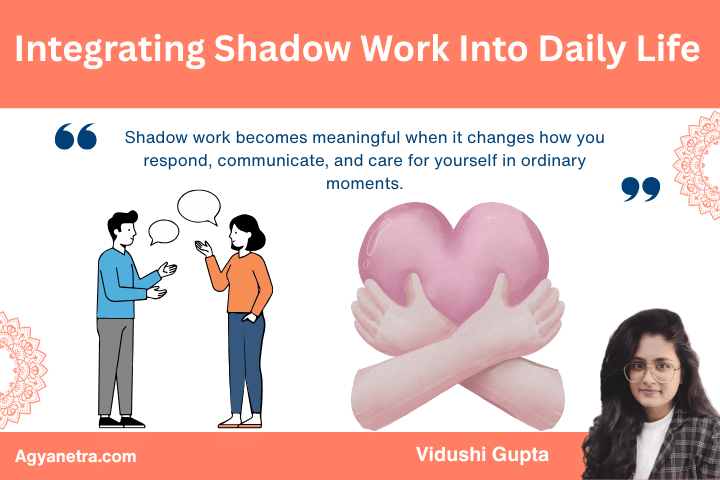
Shadow work becomes meaningful when it changes daily awareness. Journaling alone is not enough if old patterns continue unconsciously.
I try to notice my emotional reactions during ordinary moments now. A conversation, a disagreement, or even silence can reveal hidden beliefs. Awareness begins showing up naturally after enough reflection.
A few gentle ways to integrate shadow work into daily life are:
- Pause before reacting emotionally
- Notice recurring relationship patterns
- Observe what creates defensiveness
- Practice honest communication
- Spend time alone without distractions
- Write regularly without censoring emotions
- Allow rest without guilt
I have found that emotional healing often looks very ordinary from the outside. It may simply mean reacting with less fear. Speaking more honestly. Feeling safer inside your own mind.
That quiet shift matters more than dramatic spiritual experiences.
Final Thoughts
Shadow work prompts for healing are not about becoming perfect or endlessly analyzing yourself.
They are invitations into deeper awareness. The goal is not to erase difficult emotions but to understand them with honesty and compassion.
I have seen people spend years fighting parts of themselves that only needed acknowledgment.
Once those hidden emotions are finally seen clearly, something softens inside. The inner conflict begins to loosen.
Healing rarely happens in a straight line. Some layers return more than once. Some answers arrive slowly. But every moment of honest self-awareness creates a little more freedom.
The shadow loses its power when it is met with presence instead of fear. And often, beneath the emotions we tried hardest to hide, there is simply a human being asking to be understood with kindness.
FAQs
What are shadow work prompts for healing?
Shadow work prompts for healing are journal questions that help you explore hidden emotions, fears, and emotional patterns. They encourage honest self-reflection so you can better understand triggers, past experiences, and behaviors that may affect your mental and emotional well-being.
How do shadow work prompts help emotional healing?
Shadow work prompts help emotional healing by bringing unconscious thoughts and unresolved feelings into awareness. Writing honestly about emotions can help you process past pain, improve self-awareness, and reduce repeating patterns in relationships, self-worth, and emotional reactions.
What are some beginner shadow work prompts?
Beginner shadow work prompts usually focus on emotions, triggers, and childhood experiences. Common examples include:
What makes me feel emotionally unsafe?
What do I hide from others?
What criticism affects me the most?
These simple questions help beginners start self-reflection without feeling overwhelmed.
Can shadow work prompts help with inner child healing?
Yes, shadow work prompts for healing inner child wounds can help you understand emotional needs formed during childhood. They often focus on rejection, abandonment, validation, and emotional safety, helping you recognize how early experiences still influence your thoughts and relationships today.
Are shadow work prompts safe for trauma healing?
Shadow work prompts can support trauma healing when practiced gently and with emotional awareness. However, people with deep trauma may benefit from guidance from a therapist or emotional wellness professional, especially if journaling brings up intense memories or emotional distress.
How often should you do shadow work journaling?
Most people benefit from shadow work journaling one to three times a week. Consistency matters more than frequency. Regular reflection gives your mind time to process emotions naturally without becoming emotionally exhausted or overwhelmed.

Vidushi Gupta is a spiritual coach, energy healer, and emotional wellness counselor with over 10 years of experience guiding people through spiritual signs, emotional healing, and inner transformation. She is the founder of Agyanetra and a published author of nearly ten novels, reaching over 20 million readers worldwide. Her approach is grounded, fear-free, and focused on helping readers understand spiritual experiences with clarity and emotional balance.