
I remember sitting across from a client who kept asking me the same question in different ways. She felt deeply connected to someone who hurt her repeatedly, yet she couldn’t walk away. She called it a soul connection.
The line between a soul connection vs trauma bond can feel invisible when you are inside it.
Something in her voice carried both devotion and exhaustion. That moment stayed with me because I have seen this confusion many times, and I have lived through a version of it myself.
Over the years, I have come to understand that not every intense bond is sacred, and not every painful connection is meant to be endured. But once you begin to see clearly, the difference becomes unmistakable.
In this sharing, I want to help you understand that difference not as a concept, but as something you can feel in your body, your thoughts, and your daily life.
Soul Connection vs Trauma Bond: Explained By Vidushi Gupta
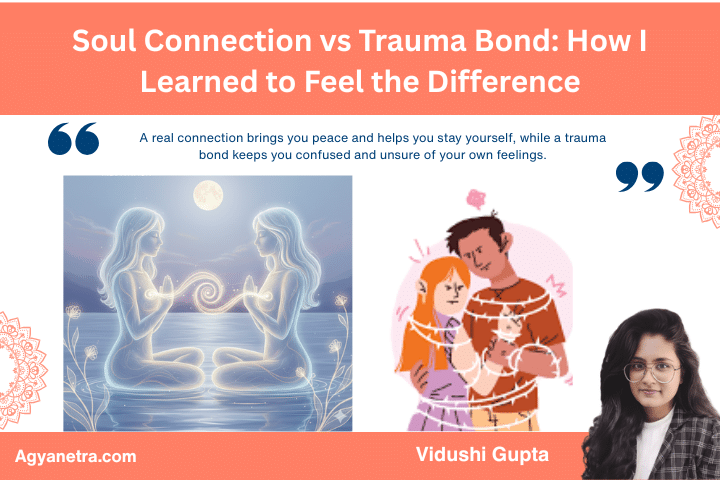
Many people search for clarity around soul connection vs trauma bond because both can feel deeply emotional and intense. The confusion usually comes from how strong the attachment feels, even when the experience is painful.
Understanding the difference helps you see whether your connection is supporting your growth or keeping you stuck in unhealthy patterns.
The following section answers common doubts in simple terms so you can recognize what you are truly experiencing and make clearer, more confident decisions.
What I Understand as a Soul Connection
When I speak about a soul connection, I don’t mean something dramatic or overwhelming. In my experience, it is often quiet, steady, and deeply grounding. It feels like being seen without having to perform.
There is a sense of ease that doesn’t depend on constant reassurance. In Advaita Vedanta, there is a recognition that the self is already whole. A true connection reflects that wholeness rather than trying to fill a void.
When I have experienced or witnessed a genuine soul connection, it didn’t feel like losing myself. It felt like coming back to myself more fully.
There is respect, even in disagreement. There is space, even in closeness. Growth happens naturally, without force.
A real connection does not pull you away from yourself. It brings you closer to who you already are.
What a Trauma Bond Really Feels Like
A trauma bond is very different, though at first it can feel more intense, even more “real.” I have seen how it creates a cycle of emotional highs and lows. One moment you feel deeply loved, the next you feel abandoned or confused.
From a psychological perspective, this is often linked to intermittent reinforcement. The brain starts associating pain with reward. In simple terms, the unpredictability keeps you attached.
In the Yoga Sutras, there is a concept of attachment rooted in pleasure and fear. A trauma bond feeds both. You fear losing the person, and you crave the moments when they give you affection.
I have noticed that people in trauma bonds often feel anxious when things are calm. They are used to chaos, so peace feels unfamiliar, even uncomfortable.
Intensity is not the same as depth. Sometimes it is just instability wearing the mask of love.
The Hidden Layer Most People Miss
One of the biggest misunderstandings I see is this: people assume that pain means the connection is meaningful. That if something is hard, it must be important.
But I have learned to look at it differently.
A soul connection is like a steady flame. It gives warmth without burning you. A trauma bond is like a flickering fire. It pulls you closer, then suddenly scorches you.
The analogy I often share is this: imagine you are thirsty. A soul connection is like clean water that nourishes you quietly. A trauma bond is like salt water. You keep drinking because you are desperate, but it only increases your thirst.
This is where many people get stuck. They mistake emotional dependency for spiritual depth.
How This Shows Up in Daily Life
In real life, the difference becomes very practical. When I observe someone in a soul connection, their life feels more balanced. They are able to focus on work, friendships, and their own growth.
The relationship supports their life, it doesn’t consume it. With a trauma bond, the relationship becomes the center of everything. Thoughts keep circling around the other person.
There is a constant need to understand, fix, or hold on. I once worked with a client who would check her phone every few minutes, waiting for a message. Her mood depended entirely on whether she received attention or silence.
She told me she felt “deeply connected,” but her body was always tense. That tension is something I have learned to trust. The body rarely lies.
My Personal Experience With This Confusion
There was a time in my own life when I believed I had found something rare and spiritual. The connection felt intense, almost magnetic. I couldn’t explain it, and that made it feel even more special.
But slowly, I began to notice how much of myself I was losing. I was constantly trying to understand the other person’s behavior. I was adjusting my reactions, my expectations, even my sense of self.
The turning point came when I realized that I felt more anxious than peaceful. That realization was uncomfortable, but it was honest.
What I have learned from that experience is this: a true connection does not require you to abandon your inner stability.
Common Confusions Between Soul Connection and Trauma Bond
Many people believe that strong emotional pull means destiny. I have heard phrases like “I can’t let go, so it must be meant to be.”
But attachment can feel just as strong as alignment.
Another common misunderstanding is linking trauma bonds with spiritual ideas like twin flames. While some spiritual traditions speak of deep connections, they do not justify suffering or emotional harm.
In Buddhism, there is a clear emphasis on reducing suffering, not romanticizing it. If a connection consistently creates distress, it deserves to be questioned, not glorified.
Not every bond that feels fated is meant to be kept.
A Simple Reflection to Help You See Clearly
I often guide people through a simple exercise. You can try this quietly with yourself.
Close your eyes and think about the person you are connected to. Notice what arises in your body.
Do you feel expansion or contraction? Calm or tightness? Then ask yourself gently: “Who am I becoming in this connection?”
This question has helped many people see beyond the surface. Because the truth of a connection is not just in how it feels in moments, but in who you become over time.
Can a Trauma Bond Turn Into a Soul Connection?
This is a question I hear often. And I understand why people ask it. When you invest emotionally, it is natural to hope things will transform.
In my experience, a trauma bond can heal, but only when the cycle is broken. That usually requires distance, awareness, and deep inner work. The connection itself does not automatically evolve into something healthy.
A soul connection, on the other hand, does not begin with cycles of harm. It begins with respect and continues with consistency.
Trying to convert a trauma bond into a soul connection often keeps people stuck longer than they need to be.
How I Guide People to Break a Trauma Bond
Breaking a trauma bond is not just about leaving a person. It is about understanding the pattern within yourself.
I encourage people to start by noticing triggers. What makes you feel pulled back? Is it loneliness, fear, or hope?
Then, slowly, create space. Not as a punishment, but as a way to reconnect with yourself.
Support is important. Talking to someone who understands, whether a counselor or a trusted guide, can make a big difference.
I also suggest grounding practices. Simple breathing, journaling, or even spending time in silence can help you come back to your center.
The goal is not to fight the attachment, but to outgrow it.
You may like:
Integrating This Awareness Into Daily Life
Awareness alone is not enough. It needs to be lived.
I have found that small daily choices matter. Choosing rest over overthinking. Choosing clarity over confusion. Choosing self-respect over emotional chaos.
In Taoism, there is a principle of natural flow. When something is aligned, it does not require force. I often remind myself of this when I feel pulled into something intense.
If you have to constantly convince yourself that something is right, it may not be aligned.
Over time, this awareness becomes intuitive. You begin to recognize the difference without needing to analyze everything.
The Emotional Impact You May Not Expect
Letting go of a trauma bond can feel like grief. Even when you know it is unhealthy, the attachment is real.
I have seen people feel guilt, sadness, and even doubt their own decisions. This is a natural part of the process.
What helps is remembering that you are not losing love. You are releasing confusion.
There is a quiet strength that begins to emerge when you choose clarity over attachment.
Conclusion
The difference between a soul connection and a trauma bond is not just in how it starts, but in how it sustains you. One brings you back to yourself. The other slowly takes you away.
I have learned that real connection does not create fear. It does not demand that you shrink or question your worth. It allows you to stand firmly in who you are.
If you feel confused, take your time. Clarity does not come from forcing answers, but from honest observation.
FAQs
What is the difference between a soul connection and a trauma bond?
A soul connection vs trauma bond differs mainly in how it feels over time. A soul connection brings calm, trust, and growth, while a trauma bond creates confusion, emotional highs and lows, and dependency. One supports your well-being, the other keeps you stuck in a cycle of pain and attachment.
How can I tell if I’m in a trauma bond or a real soul connection?
You can tell by how you feel consistently. In a soul connection vs trauma bond situation, a healthy connection feels stable and peaceful, while a trauma bond feels addictive and stressful. If you feel anxious, drained, or unable to leave despite hurt, it may be a trauma bond.
Why does a trauma bond feel so strong like a soul connection?
A trauma bond feels strong because of emotional highs and lows that create attachment. In soul connection vs trauma bond cases, the brain gets used to reward after pain, making it feel intense. This intensity is often mistaken for deep love, even though it is rooted in instability.
Can a trauma bond turn into a soul connection?
In most cases, a trauma bond does not naturally become a soul connection. In a soul connection vs trauma bond dynamic, the unhealthy pattern must completely stop, and both people must change deeply. Without that, the cycle continues, and the bond remains emotionally harmful.
Is a trauma bond the same as a soul tie?
A trauma bond and a soul tie are not always the same, though they can overlap. In soul connection vs trauma bond discussions, a soul tie may feel deep but can be healthy or unhealthy. A trauma bond specifically involves emotional pain, dependency, and repeated hurt.
Why is it so hard to leave a trauma bond?
It is hard to leave because your mind and emotions become attached to the cycle. In a soul connection vs trauma bond situation, the trauma bond creates fear of loss and hope for change. This combination makes you stay even when you know the relationship is not healthy.
What are the signs of a real soul connection?
Signs of a soul connection include feeling calm, respected, and supported. In soul connection vs trauma bond comparisons, a real connection allows space, honest communication, and personal growth. You feel secure rather than confused, and the relationship adds stability to your life.
What are common signs of a trauma bond?
Common signs include emotional ups and downs, fear of leaving, and feeling addicted to the person. In soul connection vs trauma bond cases, trauma bonds often involve excuses for hurtful behavior and constant hope things will improve, even when patterns repeat.

Vidushi Gupta is a spiritual coach, energy healer, and emotional wellness counselor with over 10 years of experience guiding people through spiritual signs, emotional healing, and inner transformation. She is the founder of Agyanetra and a published author of nearly ten novels, reaching over 20 million readers worldwide. Her approach is grounded, fear-free, and focused on helping readers understand spiritual experiences with clarity and emotional balance.