
Spiritual awakening integration process is the quiet work that begins after an inner shift, emotional opening, deep realization, or intense spiritual experience. Many people expect awakening to feel complete once something powerful happens, but in my experience, the real change begins when life asks, can you live this truth gently every day?
I have seen people feel peaceful after meditation, lighter after healing, or deeply moved after a spiritual breakthrough, and then feel confused when old emotions return. They wonder if they have gone backward.
They have not always gone backward. Often, they have entered the integration phase.
Integration means allowing the body, mind, emotions, relationships, habits, and daily life to slowly adjust to what the soul has understood. It is where awakening becomes real, steady, and human.
I want to explain this process in a grounded way, so you can understand what integration feels like, why it takes time, and how to support yourself without forcing your growth.
Spiritual Awakening Integration Process
Spiritual awakening integration process is the stage where inner awareness becomes part of daily living. It is not only about having a spiritual experience.
It is about learning how to carry that experience into your choices, reactions, relationships, and body.
I often tell students that awakening opens the door, but integration teaches you how to live in the room.
A person may feel a deep moment of truth during meditation, prayer, grief, silence, or healing. For a while, everything feels clear. The heart opens. The mind becomes still. Old fears may feel far away.
Then life returns.
Someone says something triggering. Work pressure appears. The body feels tired. Old habits come back. This is where many people think they have lost the awakening.
In my experience, they have not lost it. They are being asked to embody it.
Integration is the process of letting truth move from insight into behavior. It is when peace becomes patience, awareness becomes honesty, and healing becomes a different way of living.
This is why integration often feels slower than awakening. A realization can arrive in one moment. A nervous system, a relationship pattern, or an old emotional wound may need much more time.
Awakening may show me the truth in one moment, but integration teaches me how to live that truth one choice at a time.
Why Integration Can Feel Hard After Spiritual Awakening
Integration can feel hard because awakening often reveals more than the mind expected. It may show old pain, hidden fear, emotional patterns, and parts of the self that were ignored for years.
I have noticed that people often expect spiritual awakening to remove difficulty. They think, now that I have seen something deeper, I should feel calm all the time.
That expectation creates suffering.
Awakening does not always erase old patterns immediately. It makes them visible. Once they are visible, life begins giving chances to respond differently.
This can feel uncomfortable.
You may feel more sensitive than before. You may notice where you have been dishonest with yourself. Certain relationships may feel heavier. Old habits may no longer feel natural, but new ways of living may not feel stable yet.
That middle space can feel lonely.
I often compare integration to moving into a new house while still carrying boxes from the old one. You are in a new place, but everything is not arranged yet. Some things belong. Some things need to be released. Some things need to be understood before they can be put down.
This is why patience is necessary.
The soul may recognize truth quickly, but the human system needs time to reorganize around it.
You may also like:
- Spiritual Integration and Embodiment
- Spiritual Transformation and Transcendence
- Spiritual Awakening and Nervous System Regulation
- How to Ground Yourself During Spiritual Awakening
Signs You Are in the Integration Phase
The integration phase often feels quieter than the awakening itself. There may be fewer dramatic experiences and more ordinary moments that reveal how much you have changed.
You may notice that old patterns still appear, but they do not feel the same. You may react, but you catch yourself faster. You may feel pain, but you do not identify with it as deeply.
This is a meaningful sign.
I have observed that integration often brings both clarity and grief. You see yourself more honestly, but you may also mourn the years you spent living from fear, people-pleasing, or self-abandonment.
Relationships may also shift.
Some people feel closer to truth and further from old dynamics. Conversations that once felt normal may feel draining. You may need more quiet, more simplicity, and more time with people who feel emotionally safe.
The body may ask for steadier care too.
Sleep, food, movement, and nervous system regulation become more important. During integration, the body is not separate from spiritual growth. It is the place where growth is trying to settle.
Another sign is less interest in chasing spiritual highs.
You may still value meditation, prayer, or healing, but you begin to care more about how you live after the practice. That is maturity beginning to form.
The clearest sign of integration is not constant peace. It is a growing ability to return to truth after losing your center.
The Body’s Role in Spiritual Awakening Integration
The body plays a very important role in the spiritual awakening integration process. Many people want to stay in the mind, the soul, or the higher states, but the body is where the change must become stable.
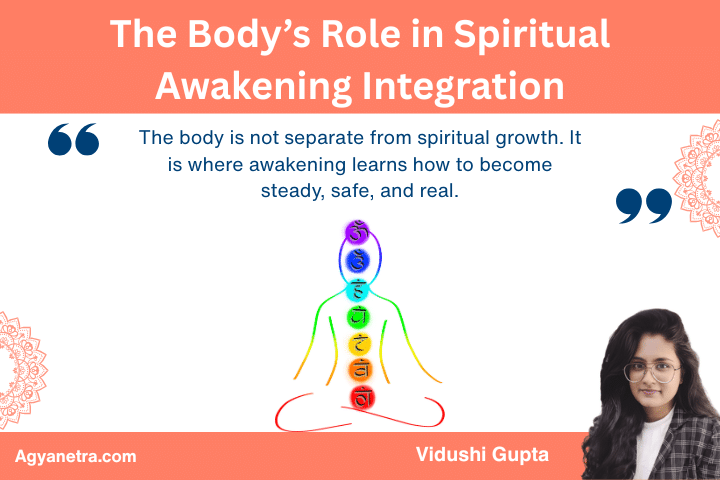
I have seen seekers touch deep awareness and then feel tired, emotional, or physically sensitive afterward. They think something is wrong, but often the body is simply adjusting.
When old emotions rise, the nervous system reacts. When identity shifts, the body may feel unsteady. When a person becomes more sensitive, sleep, digestion, energy, and emotional balance may change for some time.
This is why grounding matters.
Warm meals, steady sleep, gentle walking, sunlight, breathwork, and simple routine can help the body feel safe. These things may look ordinary, but they help the awakening become livable.
I do not see the body as an obstacle. I see it as the temple where the realization must learn to breathe.
Sometimes people ask me why they feel so human after a spiritual opening. My answer is simple. Because awakening is not asking you to escape being human. It is asking you to become more honest inside your humanity.
That truth has softened my own path.
I used to think spiritual progress meant rising above certain feelings. Now I trust the path more when it helps me feel clearly, respond wisely, and stay present in my body.
Emotional Integration After Spiritual Awakening
Emotional integration is one of the deepest parts of this process. Awakening often opens the heart, and when the heart opens, it does not release only light. It releases grief, fear, longing, shame, love, and old pain too.
I have watched people become confused when they cry more after awakening. They think they should be happier. But sometimes tears are not a setback. They are the heart finally becoming safe enough to speak.
Emotional integration means letting feelings move through awareness without letting them control your whole life.
You may feel sadness without making it your identity. You may feel anger without turning it into harm. You may feel fear without letting fear choose your next step.
This takes practice.
A simple reflection can help. Sit quietly and place one hand on your heart and one on your lower belly. Breathe gently and ask, what emotion is asking to be felt without being judged?
Let the answer come slowly.
Do not analyze it too much. If the answer is grief, let grief be there. If the answer is fear, let fear be named. If the answer is nothing, stay with the body anyway.
The aim is not to fix every emotion. The aim is to stop abandoning yourself when emotions appear.
In my experience, emotional integration begins when I can say, this feeling is here, and I do not have to run from it or become it.
A Real Experience I Have Seen With Spiritual Integration
I once worked with a student who had a powerful experience during a retreat. She felt deep silence, love, and a sense that her old identity had softened. For a few days, she felt free.
Then she returned home.
Her family patterns came back. Work felt heavy. Old self-doubt appeared. She told me, I think I lost what happened at the retreat.
I asked her what had changed in the way she saw herself. She paused and said, I cannot fully believe my old fear anymore, even though I still feel it.
That was integration beginning.
The experience had not disappeared. It had become a seed.
We stopped trying to recreate the retreat feeling. Instead, we focused on small daily choices. Speaking honestly. Resting when tired. Not returning to an old relationship pattern. Taking five minutes each morning to remember the silence without chasing it.
Over time, she became less attached to the peak experience and more connected to the wisdom it had left behind.
That taught her something important. It reminded me too.
A spiritual experience is not meant to become a memory we worship. It is meant to become a quieter truth we practice.
Common Mistakes During the Integration Process
One common mistake is trying to recreate the original awakening experience. A person keeps meditating, praying, or searching with the hidden hope of feeling exactly what they felt before.
This can create frustration.
The first experience may have opened something, but integration asks for a different kind of devotion. Less chasing. More living.
Another mistake is isolating too much. Some solitude is helpful, especially after a deep inner shift. But too much isolation can make the mind heavy and disconnected from reality.
Spiritual growth needs life contact.
Relationships, work, food, movement, and honest conversation reveal whether awareness is becoming real. Without daily life, awakening can remain an idea.
I also see people become too hard on themselves. They think old emotions should never return. They judge every trigger as failure.
That is not fair to the human process.
Old patterns may appear many times while integration is happening. The point is not instant perfection. The point is seeing sooner, choosing wiser, and returning with less shame.
A quiet mistake is using spiritual language to avoid practical change.
A person may say they have surrendered, but they still avoid boundaries. They may speak about love, but still abandon themselves. Integration asks for truth in action.
How to Integrate Spiritual Awakening Into Daily Life
Daily life is where spiritual awakening becomes trustworthy. I know this may sound simple, but I have seen it again and again.
The real test is not only what happens in meditation. It is what happens when someone misunderstands you, when plans fail, when old fear rises, or when you are tired and still choose not to betray yourself.
Start with small anchors.
Eat at regular times. Sleep with more care. Keep your space clean enough to feel peaceful. Move your body. Spend time in nature. Stay connected with people who help you feel honest and grounded.
After spiritual practice, do not rush back into noise.
Take a few minutes to walk, breathe, drink water, or sit quietly with your eyes open. Let the body understand that practice has ended and life is continuing.
Journaling can also help.
Instead of asking only what did I experience, ask, how did this experience change the way I want to live today?
That question brings awakening into action.
Maybe the answer is to speak more honestly. Maybe it is to rest. Maybe it is to stop chasing a person who keeps reopening old pain. Maybe it is to forgive yourself for learning slowly.
Integration grows through repeated small choices.
Spiritual Awakening Integration and Relationships
Relationships often become one of the strongest places where integration is tested. It is easy to feel peaceful alone. It is much harder to stay conscious when old emotional patterns are touched by another person.
During integration, some relationships may feel different.
You may notice where you were pleasing, rescuing, hiding, controlling, or staying silent to avoid conflict. You may also see where you expected others to meet needs you had not learned to honor in yourself.
This does not mean every relationship must end.
Sometimes integration asks for clearer communication. Sometimes it asks for better boundaries. Sometimes it asks for forgiveness. Sometimes it asks for distance.
I have learned not to rush these decisions when emotions are high.
A good question is, does this connection support the person I am becoming, or does it keep pulling me back into the person I am healing from?
Sit with that gently.
The answer may not come in one day. But the body often knows before the mind admits it.
When Integration Feels Empty or Quiet
There is a stage of integration that many people misunderstand. After a powerful awakening phase, life may feel strangely quiet.
The visions may reduce. The intense emotions may soften. The spiritual excitement may fade. A person may wonder if they have lost connection.
Often, they are entering a deeper stage.
Not all growth feels bright. Some growth feels plain, slow, and almost invisible.
This quiet stage can be like soil after rain. Nothing dramatic is happening on the surface, but beneath it, roots are taking hold.
I have seen many people panic in this phase and start searching for intensity again. They look for new teachers, new practices, new signs, new messages.
Sometimes the real invitation is to stay.
Stay with the simple life. Stay with the small truth. Stay with the peace that does not need to announce itself.
The sacred is not absent just because it is quiet.
When You Need Extra Support During Integration
Most integration phases can be supported with grounding, rest, honest reflection, and steady practice. Still, there are times when extra support is needed.
If you feel severely anxious, unable to sleep for long periods, disconnected from reality, deeply depressed, confused, unsafe, or unable to function, please seek qualified medical or mental health support.
Spiritual support can help, but it should not replace professional care when the body or mind is in distress.
I say this because I have seen people delay help by spiritualizing pain. That does not protect the path. It can make the path harder.
There is no shame in receiving support.
A therapist, doctor, counselor, or grounded spiritual guide can help you stabilize while your inner life is changing. Sometimes being held well is exactly what allows integration to continue safely.
Final Thoughts
Spiritual awakening integration process is where the soul’s insight becomes part of ordinary life. It is not always dramatic, and it is not always easy, but it is deeply meaningful.
You may still feel old emotions. You may still meet old patterns. You may still need rest, grounding, support, and time.
That does not mean you are failing.
It means the awakening is asking to become real in your body, your choices, your relationships, and your daily rhythm.
Go slowly. Let the insight settle. Let the body catch up. Let your life become the place where awakening learns how to stay.
FAQs
What is the spiritual awakening integration process?
The spiritual awakening integration process is the stage where inner realization starts becoming part of daily life.
It is not only about having a deep experience. It is about learning how to live with more honesty, presence, emotional balance, and grounded awareness.
Why is integration important after spiritual awakening?
Integration is important because a spiritual experience can fade if it is not lived through real choices.
In my experience, awakening becomes meaningful when it changes how I respond, rest, speak, set boundaries, and relate to myself and others.
What happens during spiritual awakening integration?
During integration, old emotions, habits, and relationship patterns may come up again.
This does not always mean you are going backward. Often, it means the body and mind are adjusting to a deeper truth that the soul has already touched.
How do I know I am in the integration phase?
You may be in the integration phase if old patterns still appear, but you notice them faster.
You may feel more honest, more sensitive, less interested in drama, and more drawn toward simple, grounded living.
Is it normal to feel old emotions after spiritual awakening?
Yes, it is very normal.
Awakening often brings buried emotions to the surface. Grief, fear, anger, sadness, or shame may rise because the heart is finally safe enough to feel what was hidden.
How long does the spiritual awakening integration process take?
There is no fixed timeline.
For some people, integration happens in waves over weeks or months. For others, it unfolds slowly over years as the body, mind, emotions, and life choices keep adjusting.
What is the main lesson of spiritual awakening integration?
The main lesson is that awakening must become livable.
Spiritual awakening integration process teaches that real growth is not only what I feel in a sacred moment, but how I carry that truth into my body, relationships, choices, and daily life.

Vidushi Gupta is a spiritual coach, energy healer, and emotional wellness counselor with over 10 years of experience guiding people through spiritual signs, emotional healing, and inner transformation. She is the founder of Agyanetra and a published author of nearly ten novels, reaching over 20 million readers worldwide. Her approach is grounded, fear-free, and focused on helping readers understand spiritual experiences with clarity and emotional balance.