
The Dissolution of Separation is the recognition that our individual lives arise within a unity that has never been divided. It does not erase personality, healthy boundaries, or practical responsibilities; it changes the deeper identity from which we relate to them.
Most of us experience ourselves as separate people moving through a world of other people, objects, and events. This perception is useful for everyday life, but it can become a source of fear when treated as the whole truth.
Vidushi Gupta’s work on integration offers a valuable frame for this inquiry: psychological healing gathers the divided parts of the personality, while spiritual insight reveals the greater wholeness in which personality exists.
What The Dissolution of Separation Really Means
The dissolution of separation is a change in perception rather than the destruction of individuality.
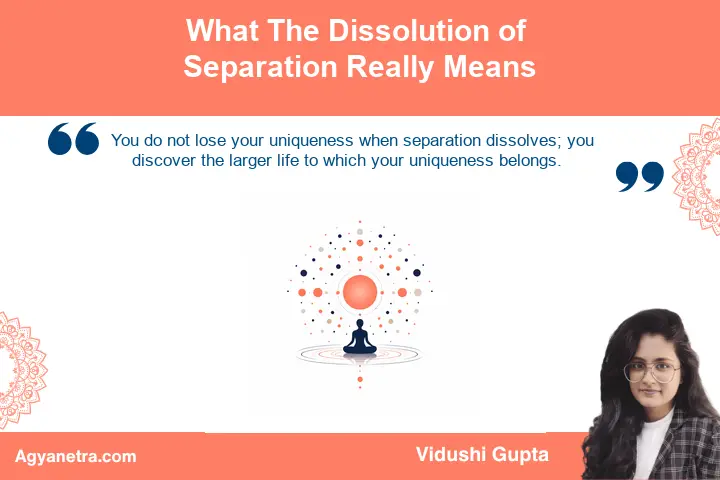
You do not lose your uniqueness when separation dissolves; you discover the larger life to which your uniqueness belongs.
Your body, memories, preferences, relationships, and responsibilities remain. What softens is the conviction that this temporary personal form exists independently from everything around it.
Consider a wave on the sea. Its shape can be identified, measured, and distinguished from nearby waves, yet it is never made of anything other than ocean.
Individuality works in a similar way. A person has a distinct expression, but that expression depends upon life, nature, community, ancestry, and consciousness at every moment.
Understanding Maya and the illusion of reality can clarify this distinction. The appearance of difference is not necessarily false; the mistake is believing that different forms possess completely independent existence.
Why a Separate Identity Is Necessary
A healthy sense of self is a stage of integration, not an obstacle that must be attacked or denied.
A child gradually learns a name, personal preferences, family roles, and social boundaries. This growing identity supports communication, choice, self-protection, and participation in the world.
Problems begin not because a functional self develops, but because we assume it is our deepest and only identity. From that assumption come comparison, defensiveness, possessiveness, and the constant pressure to prove our worth.
Psychological integration therefore matters. Unprocessed wounds, fragmented emotions, and unstable boundaries do not disappear simply because someone adopts spiritual ideas about oneness.
In fact, spiritual language can become another way to avoid pain. A person may claim that everyone is one while remaining unable to recognize anger, say no, leave a harmful situation, or take responsibility for personal choices.
Exploring the inner wholeness beneath conditioning helps establish a stable foundation. The personal self can then become more transparent without being rejected.
The Witness Behind the Changing Self
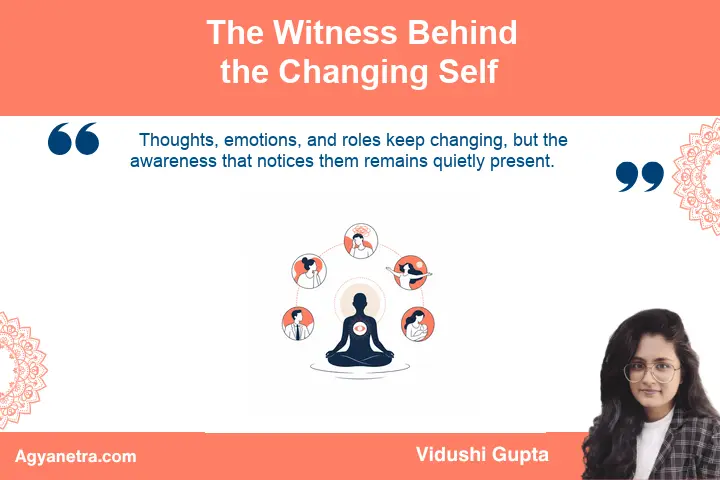
Thoughts, emotions, and roles keep changing, but the awareness that notices them remains quietly present.
One practical doorway beyond separation is the recognition of witnessing awareness. You can notice a thought, which means the thought itself cannot be the whole of what you are.
The same applies to an emotion. Fear, sadness, joy, and anger pass through experience, while something within you knows that they are present.
This witness is not another personality hidden behind the familiar one. It is the simple capacity to be aware before experience is divided into preferred and rejected parts.
Try pausing for one minute without attempting to stop the mind. Notice sounds, bodily sensations, feelings, and thoughts, then ask quietly: what is aware of all this?
Do not force an intellectual answer. The value of the question lies in turning attention toward awareness itself rather than creating another belief about it.
With practice, identity becomes less tightly attached to passing mental states. A difficult emotion can still be honored, but it no longer has to define the entire self.
Advaita and the Recognition of Unity
Oneness does not remove the many forms of life; it reveals that the many do not stand outside the One.
Advaita is a Sanskrit term meaning “not two.” It points toward a reality in which diversity continues to appear, yet the essence beneath that diversity is undivided.
Gold may be shaped into many ornaments without ceasing to be gold. In the same way, distinct beings can be understood as varied expressions of one underlying consciousness.
This is more than a theory to memorize. The mind naturally labels, compares, and separates, so intellectual agreement alone cannot produce a lived recognition of unity.
The shift becomes meaningful when the boundary between self and life starts to feel less absolute. Another person’s suffering is no longer an irrelevant event happening outside your concern.
Unity can also be approached through ordinary interdependence. The body relies on air, water, food, sunlight, soil, and countless visible and invisible forms of cooperation.
Every breath is an exchange with the living world. Even before spiritual interpretation, experience shows that no person is entirely self-contained.
The movement from the individual self to universal consciousness therefore does not require contempt for human identity. It places that identity within a wider field of belonging.

Finding Wholeness in a Fractured World
Integration explores inner fragmentation, emotional healing, shadow work, self-awareness and the journey towards inner wholeness. It is written for readers who want to understand themselves more deeply and bring spiritual awareness into everyday life.
Love Without Possession
When the feeling of isolation softens, love becomes less dependent on ownership, approval, and control.
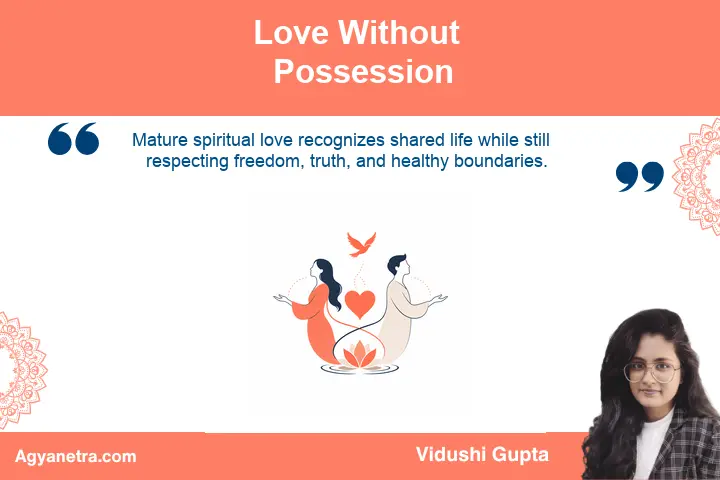
Mature spiritual love recognizes shared life while still respecting freedom, truth, and healthy boundaries.
The separate self often approaches love through need. It may ask whether another person provides enough attention, safety, agreement, or reassurance to protect a fragile identity.
Recognition-based love has a different movement. It sees that the same fundamental life appears in a partner, stranger, animal, forest, and future generation.
This does not mean accepting manipulation or remaining close to everyone. Compassion can include distance, firm limits, honest disagreement, and consequences for harmful behavior.
What changes is the inner motivation. A boundary is no longer used to prove that another person is worthless; it protects what is healthy without denying the other person’s humanity.
This understanding also expands love beyond personal preference. Caring for the environment, serving someone who cannot repay us, and listening without preparing a defense become natural expressions of connection.
When the Spiritual Seeker Becomes Quiet
Awakening is less about acquiring a special state and more about noticing what striving has prevented you from seeing.
Spiritual seeking can begin with a genuine longing for peace, truth, freedom, or closeness to the Divine. Practices and teachings may help direct attention away from habitual identification.
Yet seeking can quietly reinforce separation if truth is imagined as a distant object. The mind creates a future enlightened self and then struggles to become worthy of it.
The seeker eventually faces a subtle question: if awareness is already present to witness every stage of the search, is awareness itself truly absent?
This does not make meditation, prayer, healing, or study pointless. These practices can clear confusion and steady attention, but they do not manufacture the underlying wholeness they reveal.
Resting the seeker means releasing compulsive spiritual achievement. It is the willingness to be present without turning every experience into evidence of success or failure.
Practising Unity in Ordinary Life
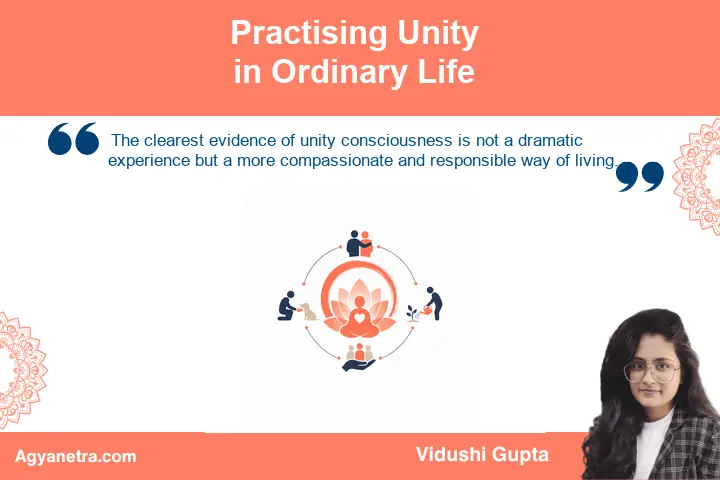
The clearest evidence of unity consciousness is not a dramatic experience but a more compassionate and responsible way of living.
Insights about oneness become trustworthy when they affect speech, work, relationships, consumption, and service. Daily life shows whether unity has reached beyond abstract belief.
Begin with listening. When another person speaks, notice the urge to defend, correct, compare, or prepare your response, then return attention to what is actually being communicated.
Bring the same awareness to conflict. Remembering shared humanity does not remove disagreement, but it can prevent disagreement from becoming dehumanization.
Use these simple practices to embody the dissolution of separation:
- Pause before reacting: Feel the body and take one conscious breath before speaking from anger or fear.
- Question fixed identities: Notice when labels prevent you from seeing a person’s complexity, including your own.
- Protect without hatred: Set necessary boundaries while refusing to make contempt your source of strength.
- Serve concretely: Offer time, attention, skills, or resources where they can reduce suffering.
- Respect interdependence: Make choices that consider their effects on other people, animals, and the natural world.
- Return to awareness: Several times a day, notice the quiet presence in which thoughts and sensations appear.
If expanded awareness begins to feel disorienting, return to physical routines, nourishing food, sleep, nature, and trusted relationships. Learning how to ground yourself during spiritual awakening helps insight remain balanced and embodied.
Unity does not require a permanent mystical state. It can be expressed whenever you choose understanding over unnecessary judgment, responsibility over indifference, or service over self-absorption.
Final Words
The dissolution of separation is not a disappearance of the person. It is the end of treating the person as an isolated entity cut off from life, nature, humanity, and the sacred.
Like a river entering the ocean, the personal form can release its imagined limits without losing its essence. What falls away is not life but the fear created by mistaken isolation.
Integration prepares us for this recognition by making the personality steadier, more honest, and less divided. The individual remains capable of unique action, while knowing that every action touches a greater whole.
Oneness is not somewhere else waiting to be reached. It is the reality quietly present beneath every breath, relationship, act of love, and moment of conscious attention.
FAQs
What is the dissolution of separation?
It is the recognition that individual identity exists within a deeper, undivided reality. Personality remains functional, but it is no longer experienced as completely isolated from life.
Does spiritual oneness mean losing individuality?
No. Your personality, gifts, relationships, and responsibilities remain. Oneness places individuality within a larger field of connection rather than erasing it.
How can I experience less separation in daily life?
Practise attentive listening, conscious breathing, compassionate boundaries, service, and awareness of interdependence. Small changes in how you relate to others are more useful than chasing dramatic experiences.
What is the difference between the ego and the witnessing awareness?
The ego is the changing identity formed through memories, roles, preferences, and self-protection. Witnessing awareness is the quiet capacity that notices these changing experiences.
Does oneness mean I should tolerate harmful behavior?
No. Unity includes truth, discernment, and healthy boundaries. You can recognize another person’s humanity while creating distance or taking action to prevent harm.
What does Advaita mean in relation to separation?
Advaita means “not two.” It teaches that diverse forms appear within one underlying reality, so difference exists without absolute separation.

Vidushi Gupta is a spiritual coach, energy healer, and emotional wellness counselor with over 10 years of experience guiding people through spiritual signs, emotional healing, and inner transformation. She is the founder of Agyanetra and a published author of nearly ten novels, reaching over 20 million readers worldwide. Her approach is grounded, fear-free, and focused on helping readers understand spiritual experiences with clarity and emotional balance.