
The Exile of the Soul describes the painful experience of feeling separated from your authentic nature, even when your outer life appears complete. It does not mean that your soul has disappeared; it means that conditioning, survival patterns and social identities have made its guidance difficult to hear.
This inner distance may appear as emptiness, anxiety, burnout or a quiet sense that you are living someone else’s life. The way forward is not to create a new personality, but to notice what has covered your deeper awareness.
What Does The Exile of the Soul Mean?
The exile of the soul is a perceived separation from the essential self that exists beneath roles, expectations and learned behaviour.
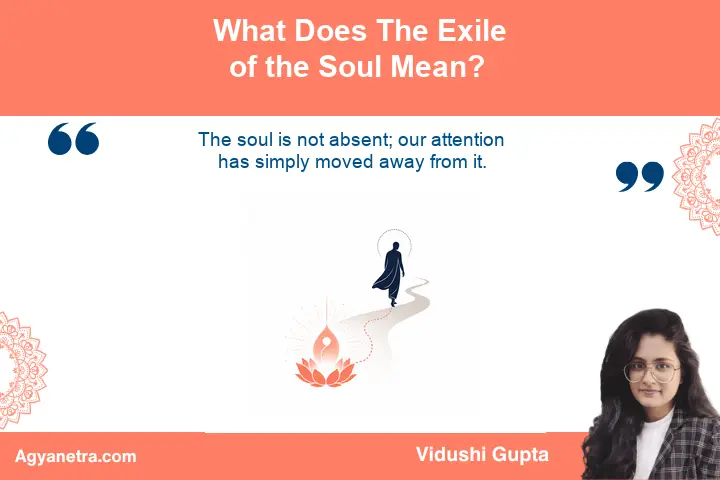
The soul is not absent; our attention has simply moved away from it.
This experience can develop when external demands repeatedly take priority over inner truth. You may learn to gain approval by being agreeable, strong, productive or successful, while natural needs and qualities are pushed out of awareness.
Over time, the adapted personality becomes the centre of life. Decisions are made according to what will preserve acceptance, safety or status rather than what feels sincere and meaningful.
This does not make the personality an enemy. It is a practical structure that helps you function in the world. Difficulty begins when you mistake that structure for the whole of who you are.
In spiritual language, this condition is sometimes understood as forgetting your true nature. Psychology may describe a similar pattern as disconnection from the authentic self. Both perspectives point toward a gap between lived identity and inner experience.
The essential insight is that the soul itself has not been destroyed. What changes is your relationship with it: you stop listening, feeling and recognising what was always present.
Signs the Soul Feels Exiled in Daily Life
Soul disconnection does not always arrive as a dramatic crisis. It often develops quietly within an outwardly stable and responsible life.
- Success feels strangely empty. You achieve an important goal but experience little lasting fulfilment.
- You perform rather than participate. Conversations, work and relationships feel like duties managed by a social version of you.
- Your choices depend heavily on approval. You know what others expect but struggle to identify what you genuinely want.
- Rest produces guilt. Worth has become tied to productivity, usefulness or constant achievement.
- Creativity and play have disappeared. Interests that once brought vitality seem impractical or difficult to justify.
- You feel homesick without wanting a physical place. The longing is for belonging, meaning and inner wholeness.
- An old identity is becoming uncomfortable. The role that once offered security now feels restrictive or false.
These experiences can also be connected with emotional strain or mental health concerns. A spiritual interpretation should not replace appropriate professional support, especially when distress is persistent, severe or affects daily functioning.
The signs are invitations to become curious rather than reasons to judge yourself. They suggest that some part of your inner life needs honest attention.
How Roles Can Hide the Authentic Self
Roles are necessary for relationships and society, but they become limiting when a function is treated as a complete identity.
A role can guide what you do without deciding who you are.
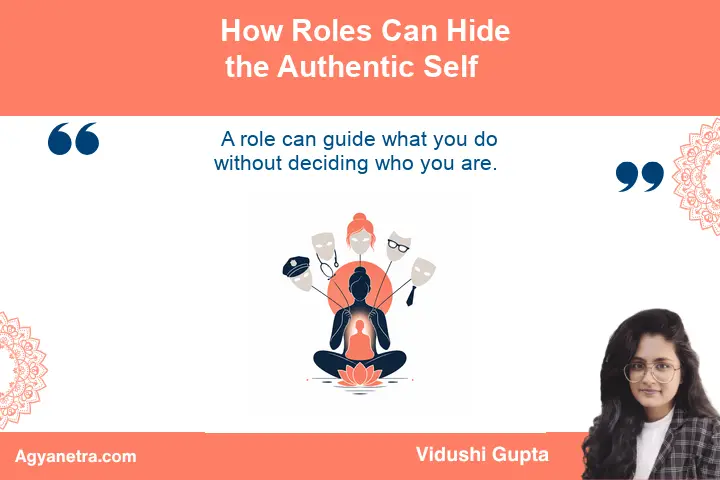
A parent, professional, partner, teacher or caregiver must meet real responsibilities. Yet no single role contains the full range of a human being.
The responsible person may forget how to ask for help. The achiever may lose the ability to rest without guilt. The strong person may hide vulnerability, while the caregiver may become uncomfortable receiving care.
Roles become especially powerful when other people reward them. If you have always been praised for staying calm, expressing anger or uncertainty may feel like a threat to belonging. The identity is then protected even after it stops serving your growth.
Understanding the difference between the soul and the protective ego can help you observe these identities without rejecting them. The aim is not to abandon your duties, but to hold every role more lightly.
Try completing this sentence without mentioning work, family position, achievements or beliefs: Beneath my roles, I notice that I am… If the answer does not come quickly, remain with the question instead of forcing a spiritual description.
Why Modern Culture Encourages Inner Forgetting
Soul exile is personal, but it also reflects a culture that often values visible performance more than inner connection.
From an early age, people may learn to compete, produce and present themselves before learning how to recognise emotions, values or intuitive signals. The repeated message is that they should become more impressive, useful or exceptional.
None of these goals is automatically harmful. Education, ambition and discipline can support a meaningful life. The imbalance begins when achievement is treated as proof of worth and stillness is treated as wasted time.
A person can then become highly skilled at managing appearances while remaining unfamiliar with their own inner world. They know how to satisfy expectations but not how to answer simple questions such as: What brings me alive? What am I protecting? What no longer feels true?
Reconnection therefore requires small spaces where performance is unnecessary. Silence, reflective writing, unstructured creativity and honest conversation can help inner experience become audible again.
Sita’s Exile as a Symbol of the Soul
Sita’s separation from Rama in the Ramayana offers a meaningful symbol for the human experience of spiritual disconnection.
Circumstances may obscure inner truth, but they cannot erase it.
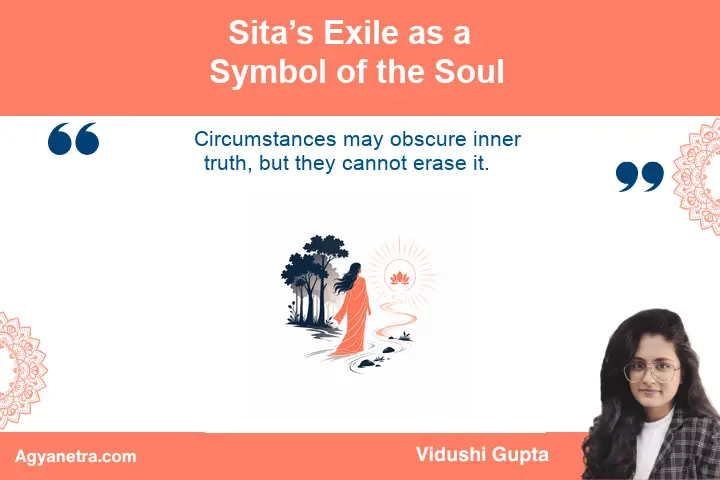
On a symbolic level, Sita may be understood as the soul, while Rama represents divine consciousness or the true Self. Their separation reflects the way human awareness can feel removed from its spiritual ground.
The value of this symbolism is not that every detail must be turned into a psychological formula. Its central insight is simpler: Sita’s surroundings and experience change, but her essential nature remains intact.
In the same way, trauma, conditioning and social roles can shape how a person thinks and behaves without becoming the deepest truth of that person. The exile is experiential rather than absolute.
This perspective also clarifies the spiritual meaning of feeling separated from Source. The Divine is not necessarily somewhere distant that must be reached. The sense of distance may arise because attention has become absorbed in fear, comparison and surface identity.
Why Longing Can Become a Spiritual Compass
The discomfort of disconnection can become constructive when it is approached as information rather than failure.
A relationship may end, a career may lose meaning or an achievement may feel unexpectedly hollow. Although such moments can initially feel like collapse, they may reveal that an old identity can no longer contain the life trying to emerge.
The longing beneath dissatisfaction often carries a clear direction. It may point toward creativity, truth, rest, contribution, intimacy or a less performative way of living.
This does not mean every uncomfortable feeling is a mystical message or that major decisions should be made impulsively. Longing becomes useful when it is observed patiently and tested through grounded action.
Some periods of identity loss may resemble a dark night of the soul and its deeper meaning. However, labels matter less than responding responsibly to what the experience is asking you to examine.
Remembering the Way Back to the Soul
Returning to the soul is a gradual practice of attention, honesty and embodiment rather than a search for a perfect spiritual identity.
Reconnection begins when inner truth is given room to speak.
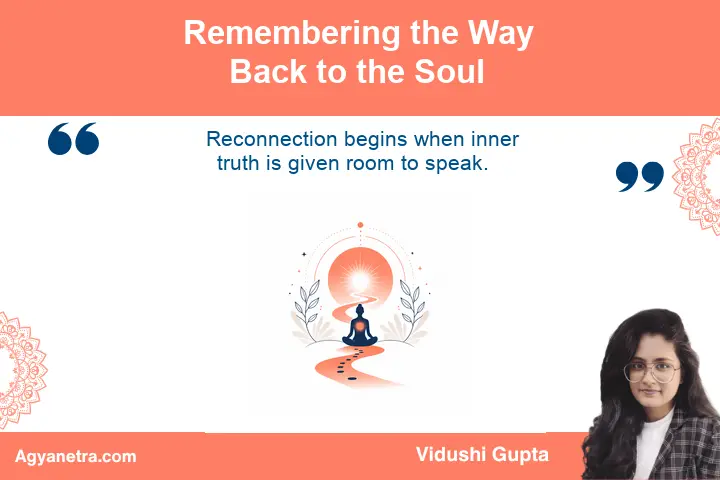
Begin by creating a short period each day in which you do not have to produce, perform or impress. Sit quietly, walk without digital distraction or write down what you are feeling before explaining it.
- Name the role you are carrying. Notice whether you are being the helper, achiever, peacemaker, rebel or strong one.
- Identify what the role protects. Ask what you fear might happen if you stopped performing it for a moment.
- Listen for the neglected quality. Perhaps play, tenderness, grief, creativity, uncertainty or the wish to receive has been excluded.
- Choose one proportionate action. Rest for an hour, express a respectful boundary, return to a creative practice or ask someone trustworthy for support.
- Observe the result without demanding certainty. Soul-aligned choices often bring quiet coherence, but they do not remove every practical difficulty.
Vidushi Gupta’s spiritually grounded view of remembrance centres on recovering connection rather than repairing a supposedly damaged essence. This distinction can reduce shame: you are not trying to manufacture worth, only to become more available to what has been covered.
Learning about intuition and soul alignment may also help you distinguish calm inner guidance from urgency, fear or wishful thinking. Genuine listening includes discernment, practical consequences and respect for other people.
A useful daily question is: What would allow me to be slightly more honest and present today? The answer does not need to transform your entire life. Repeated, modest acts of integrity can slowly shift your centre of gravity from performance toward being.
Common Misunderstandings About Soul Exile
A balanced understanding prevents spiritual language from becoming another source of pressure or avoidance.
Feeling disconnected does not mean you have failed spiritually. Adaptation often begins as an intelligent response to family expectations, criticism or the need for safety and belonging.
Reconnection does not require abandoning ordinary life. Work, family and responsibility can become places where authenticity is embodied rather than obstacles to spiritual growth.
Every strong desire is not the voice of the soul. Fear, impulse and unmet emotional needs can also feel powerful. Reflection, patience and practical accountability remain important.
The soul does not need a more impressive identity. Replacing “successful person” with “spiritual person” can preserve the same attachment to appearance. The deeper movement is toward less pretence and greater presence.
Spiritual reflection is not a substitute for care. Therapy, medical support, community and healthy routines may be essential parts of a grounded return to wholeness.
FAQs
What is the exile of the soul?
The exile of the soul is the felt experience of being disconnected from your authentic nature. It usually develops through conditioning, protective identities and repeated self-suppression rather than through an actual loss of the soul.
Your essential nature remains present, but its guidance is overshadowed by louder external and internal demands.
What are the main signs of soul disconnection?
Common signs include emptiness despite success, dependence on approval, loss of creativity, difficulty knowing what you want and feeling trapped within familiar roles.
These signs are not proof of a spiritual condition, and persistent distress should also be considered with appropriate mental health or medical support.
Is the exile of the soul the same as depression?
No, the exile of the soul is a spiritual and reflective description, while depression is a mental health condition requiring proper assessment. Some experiences may overlap, including emptiness, withdrawal or loss of meaning.
Spiritual reflection can support self-understanding, but it should not replace qualified care when symptoms are persistent or severe.
Can the soul be permanently lost or damaged?
Within the spiritual understanding of soul exile, the soul is not permanently lost or damaged. The sense of loss comes from reduced awareness of your deeper nature.
Conditioning and painful experiences can strongly affect emotions and behaviour, but reconnection remains possible through awareness, support and honest, gradual change.
How do I begin reconnecting with my soul?
Begin by creating a few quiet minutes each day without performance or distraction. Notice your emotions, the role you are carrying and any truth you habitually suppress.
Then choose one small action that supports honesty, healthy boundaries, creativity, rest or meaningful connection without making an impulsive life change.
Can social roles cause spiritual disconnection?
Roles can contribute to spiritual disconnection when you treat them as your complete identity. Being a parent, professional, helper or achiever is not the problem. The difficulty arises when maintaining the role requires you to deny vulnerability, inner needs, values or other essential parts of yourself.
Does returning to the soul require leaving ordinary life?
No, returning to the soul does not require withdrawing from work, relationships or responsibility. Reconnection is expressed through how consciously you inhabit ordinary life.
You can meet commitments while listening inwardly, setting respectful boundaries, receiving support and making choices that better reflect your values.
Final Words
The Exile of the Soul is not a permanent separation. It is the experience of losing conscious contact with the inner truth that remains beneath adaptation, achievement and identity.
You do not need to solve your whole life at once. Begin with ten quiet minutes today and ask which role has become too tight, which neglected quality needs attention and what one honest action would create more inner space.
The way home is usually not dramatic. It is built through patient listening and repeated choices that allow your outer life to express more of who you already are.

Vidushi Gupta is a spiritual coach, energy healer, and emotional wellness counselor with over 10 years of experience guiding people through spiritual signs, emotional healing, and inner transformation. She is the founder of Agyanetra and a published author of nearly ten novels, reaching over 20 million readers worldwide. Her approach is grounded, fear-free, and focused on helping readers understand spiritual experiences with clarity and emotional balance.