The Reddening: The Marriage of Spirit and Matter names a turning point where spiritual insight begins to take form in the body, relationships, choices, and responsibilities of ordinary life.
It is easy to associate awakening with elevated states, profound visions, or freedom from human struggle. Yet insight remains incomplete when it cannot enter the places where we feel fear, desire, anger, affection, uncertainty, and vulnerability.
The Reddening offers a different direction. Instead of trying to rise beyond human life, we allow consciousness to descend into it and make our way of living more honest, loving, and awake.
What the Reddening Means
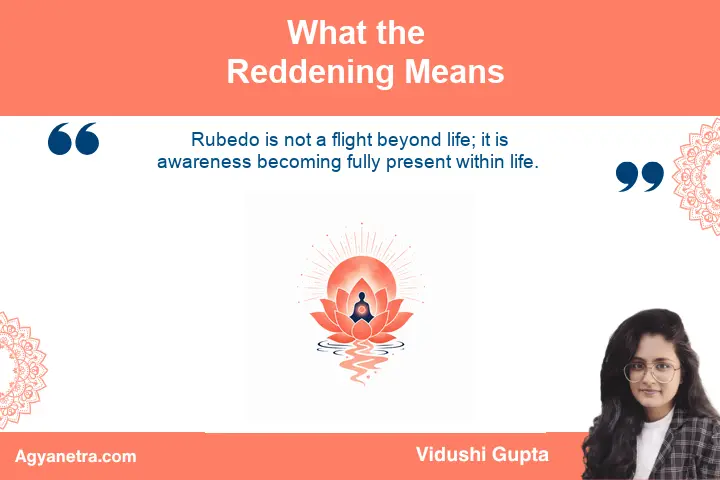
Rubedo is not a flight beyond life; it is awareness becoming fully present within life.
In symbolic alchemical language, Rubedo is the Reddening. It follows the darkness associated with Nigredo and the clarifying light associated with Albedo, but it should not be treated as a rigid formula or guaranteed sequence.
As an inner symbol, the Reddening points to integration. Darkness has revealed what cannot continue, clarity has made truth easier to see, and now that truth must become visible through action.
Seeing clearly is important, but it does not automatically change how we live. A person can understand compassion and still speak harshly, value freedom and still become possessive, or meditate deeply while avoiding difficult responsibilities.
Rubedo brings attention to this gap between realization and embodiment. It asks whether spiritual awareness can remain present when life is inconvenient, emotionally charged, or less beautiful than our ideals.
The color red carries an appropriate symbolism: blood, warmth, fire, passion, and incarnation. It suggests that awakening is not meant to remain distant or abstract; it must become alive within our actual human experience.
From Transcendence to Participation
The purpose of spiritual insight is not to remove us from life, but to help us participate in it consciously.
Many seekers begin by wanting relief from the limits of being human. Fear, conflict, attachment, sexuality, ambition, grief, and uncertainty can appear to be obstacles separating us from peace.
This can create a subtle rejection of embodiment. We may praise silence while distrusting anger, speak about love while fearing intimacy, or seek higher consciousness while treating the body as something spiritually inferior.
The Reddening challenges that division. It does not ask us to indulge every emotion or obey every desire, but it does ask us to meet them consciously rather than exile them.
Anger may carry information about a violated boundary. Desire may reveal a longing that needs examination. Fear may show where greater honesty, preparation, or self-trust is required.
Participation means listening without becoming controlled by what we hear. We remain responsible for our conduct while allowing the full range of human experience to enter awareness.
This is the shift from seeking awakening to practicing it. Life stops being an interruption to spirituality and becomes the place where spirituality is tested, refined, and expressed.
The Inner Marriage of Opposites
The marriage of spirit and matter begins as an inner reconciliation rather than an external event.
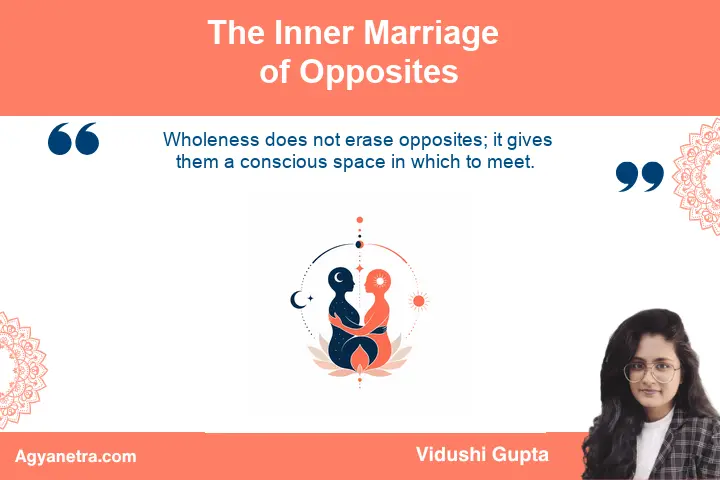
Wholeness does not erase opposites; it gives them a conscious space in which to meet.
Human beings often divide reality into competing sides: stillness or movement, strength or vulnerability, solitude or relationship, transcendence or embodiment. We then try to identify with the side that appears more spiritual.
Inner union does not require one side to defeat the other. Stillness can guide movement, while movement gives stillness a form through which it can serve life.
The symbolic relationship between Shiva and Shakti can illuminate this meeting. Shiva may represent spacious witnessing awareness, while Shakti may represent the living energy that creates, acts, relates, and transforms.
Neither principle needs to be placed above the other. Awareness without expression remains unembodied, while activity without awareness can become reactive and disconnected.
The same union can be understood through the Crown and Root. The Crown represents expanded consciousness, while the Root reminds us to inhabit the body, Earth, stability, and the realities of material existence.
These are not opposing destinations. Mature spirituality allows expanded awareness to move downward into speech, work, money, sexuality, boundaries, affection, and responsibility.
The result is not perfection. It is a growing ability to remain present while apparently contradictory experiences coexist: strong and tender, connected and independent, spiritually awake and still unfinished.
How to Practice Embodied Awakening
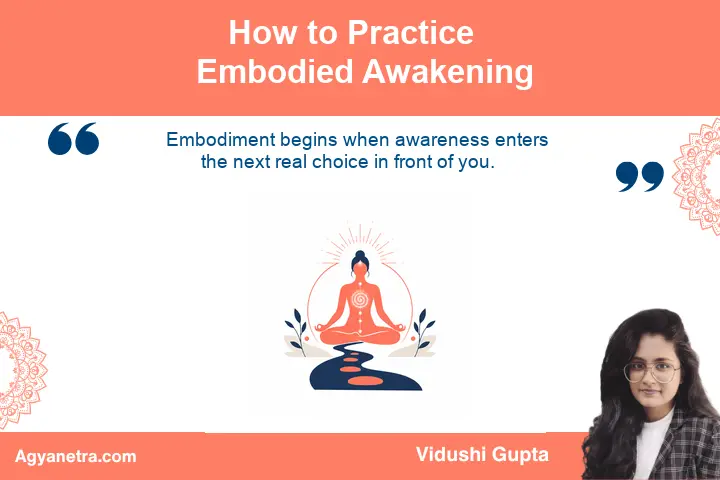
Embodiment begins when awareness enters the next real choice in front of you.
The Reddening becomes useful when it moves beyond an inspiring idea. Its practice is found in small moments where you can choose between automatic reaction and conscious participation.
Pause before turning emotion into action
When anger, fear, jealousy, or disappointment appears, pause long enough to recognize it in the body. You do not have to suppress the feeling, explain it away, or immediately act from it.
Ask what the emotion may be carrying. It might point to hurt, an unmet need, a threatened attachment, or a boundary that requires calm expression.
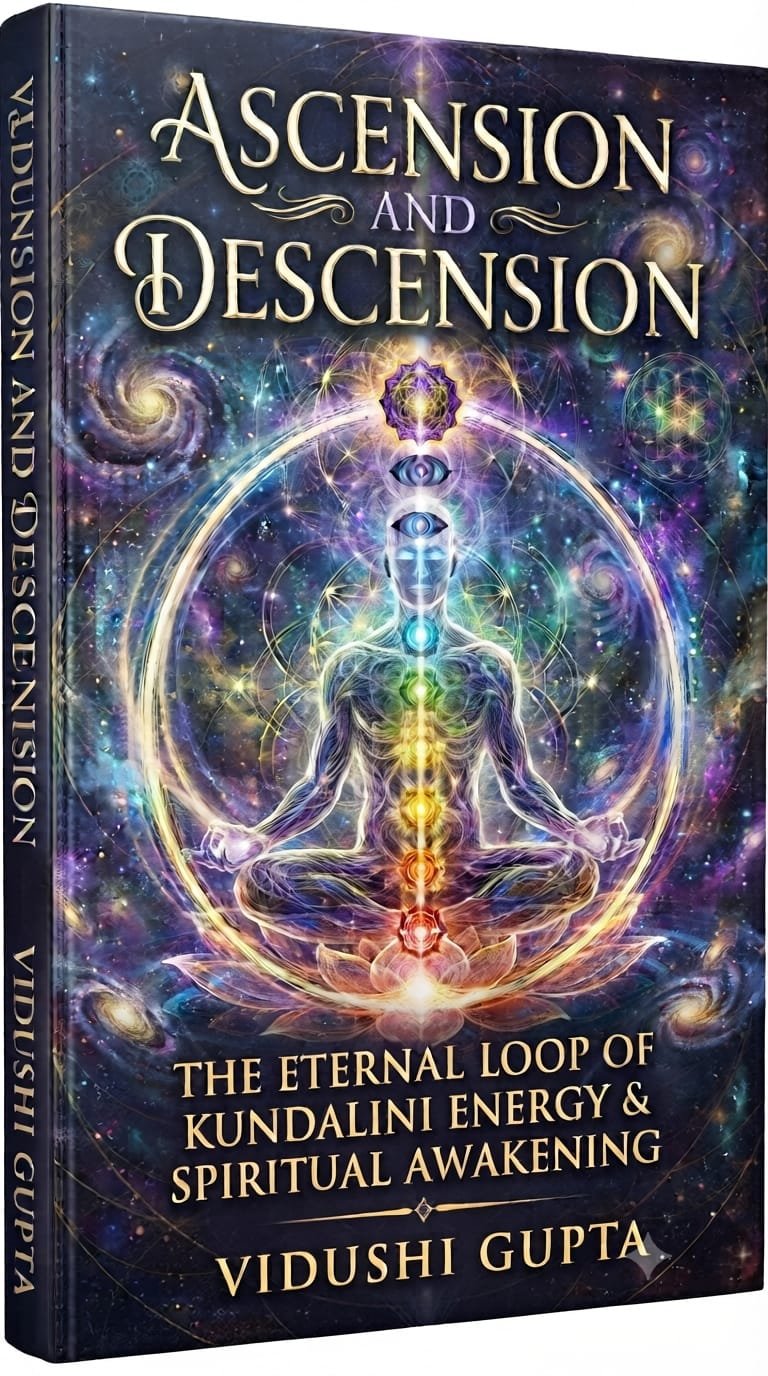
Ascension & Descension
The spiritual journey does not end when consciousness rises. It becomes complete when wisdom returns to life.
Ascension & Descension explores the movement from spiritual awakening toward embodiment. Through Kundalini, shadow work, Twin Flame experiences and the return from Crown to Root, the book explores what happens when spiritual insight enters the body, relationships, responsibility and everyday human life.
Bring awareness into the body
Notice your breathing, feet, posture, and physical tension during ordinary activities. This simple attention helps spiritual practice include the living body rather than remaining only in thought.
Embodiment is not the worship of physical experience. It is the willingness to inhabit it without treating the body as an obstacle to sacred awareness.
Let love become observable
Love becomes embodied through behavior. It may take the form of listening without preparing a defence, keeping a promise, speaking honestly, respecting a refusal, or offering care without trying to control the outcome.
Warm feelings can be meaningful, but they are not the whole practice. The marriage of spirit and matter occurs when a loving intention becomes a responsible action.
Use relationships as places of awareness
Notice what happens when another person disagrees, withdraws, changes, or chooses something you would not choose. These moments reveal whether love is being confused with possession.
Conscious relationship requires openness and boundaries together. You can care deeply without abandoning yourself, and you can protect your integrity without closing your heart.
Include work and material responsibilities
Money, schedules, commitments, and practical duties are not outside spiritual life. They reveal how awareness functions when patience, discipline, fairness, and accountability are required.
Ask one grounded question each day: What would it mean to bring consciousness into this task? The answer may be as simple as paying attention, communicating clearly, or completing what you agreed to do.
Recognize the sacred without creating drama
Not every meaningful moment needs to feel mystical. Preparing food, walking, working, grieving, laughing, and sitting quietly with someone can all become expressions of presence.
The ordinary does not have to become extraordinary before it is worthy of attention. Its sacred quality becomes visible when we stop using spiritual intensity as the only measure of depth.
Sacred Relationship Without Self-Abandonment
Sacred union is not completion by another person; it is connection between people who remain responsible for their own wholeness.
Ideas such as soulmates or Twin Flames can awaken a powerful longing for union. They can also encourage the belief that another person carries a missing piece of our identity.
A relationship may act as a mirror, awaken dormant qualities, or catalyze deep change. However, another person cannot be made responsible for completing our inner marriage.
When completion is projected onto someone else, attachment can begin to resemble spiritual destiny. Intensity may be mistaken for compatibility, and the other person’s freedom may feel like a threat.
The Reddening offers a more grounded understanding of sacred relationship. Two people can participate in something profound without becoming one identity or surrendering their individuality.
This kind of union makes room for ordinary tenderness rather than demanding permanent mystical intensity. It includes clear communication, mutual respect, personal boundaries, and the freedom to be honest.
Connection then becomes a choice instead of a claim of ownership. Love can be deep without becoming possession, and intimacy can be meaningful without requiring self-erasure.
If a relationship ends or changes, the spiritual work does not disappear. The qualities it awakened still need to be understood, integrated, and lived from within.
Signs the Reddening Is Becoming Real
Inner integration is usually revealed through daily conduct rather than dramatic spiritual experiences.
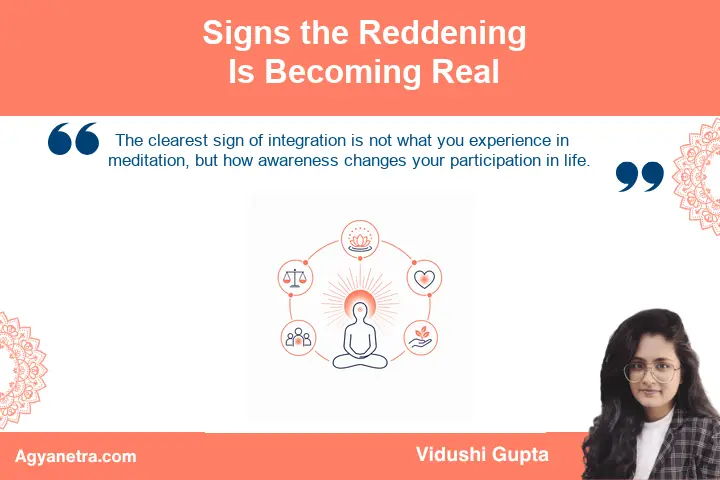
The clearest sign of integration is not what you experience in meditation, but how awareness changes your participation in life.
One sign is that you become less interested in escaping difficult emotions. You can feel discomfort, listen to its message, and still choose a response that reflects your values.
Another sign is greater respect for the body and material life. Rest, health, work, money, and practical commitments are treated as areas for consciousness rather than distractions from it.
Relationships also begin to change. You may become more able to love without controlling, remain open without ignoring boundaries, and let another person retain their freedom.
Spiritual language becomes less useful as a hiding place. Instead of explaining every conflict through destiny or energy, you become willing to apologize, clarify, make a decision, or accept a consequence.
You may also feel less dependent on extraordinary states. Quiet presence, ordinary affection, and responsible action begin to carry a depth that once seemed available only through intense experiences.
Finally, you become more comfortable with being unfinished. Wholeness no longer means eliminating every contradiction; it means meeting the whole of life with increasing honesty and participation.
Final Words
The Reddening is not a final achievement that places someone beyond human struggle. It is the ongoing meeting of awareness and embodiment, renewed whenever consciousness enters an ordinary moment.
Spirit meets matter when insight shapes a difficult conversation, when compassion reaches a wounded part, and when love becomes a free and responsible choice.
The journey is therefore not about leaving Earth for Heaven. It is about allowing what is highest in us to enter the body, heart, relationships, work, grief, joy, and imperfect circumstances of being alive.
As Vidushi Gupta’s vision of ascension and descension suggests, expanded consciousness finds its fuller meaning when it can return to lived reality. The spiritual path then stops being somewhere else and becomes the way we participate in life.
FAQs
What does the Reddening mean spiritually?
The Reddening symbolizes the integration of spiritual awareness with the body, relationships, actions, and responsibilities of everyday life. It is also known symbolically as Rubedo.
What is the marriage of spirit and matter?
It is the inner union of consciousness and embodied life. Instead of escaping human experience, a person brings awareness into emotions, choices, relationships, work, and practical responsibilities.
How is Rubedo different from Nigredo and Albedo?
Nigredo symbolizes breakdown or darkness, while Albedo represents clarity and returning light. Rubedo points toward integration, where what has been revealed is consciously lived.
How can I practice the Reddening in daily life?
Pause before reacting, notice emotions in the body, speak honestly, respect boundaries, and bring full attention to ordinary responsibilities. The practice is to turn awareness into conduct.
Does sacred union require a romantic partner?
No. Sacred union first refers to an inner reconciliation of qualities such as awareness and action, strength and vulnerability, or freedom and connection. A partner may support growth but cannot complete this work for you.
Is embodiment the same as following every desire?
No. Embodiment means becoming conscious of desires and emotions without automatically suppressing or obeying them. You listen to what they carry and then choose a responsible response.

Vidushi Gupta is a spiritual coach, energy healer, and emotional wellness counselor with over 10 years of experience guiding people through spiritual signs, emotional healing, and inner transformation. She is the founder of Agyanetra and a published author of nearly ten novels, reaching over 20 million readers worldwide. Her approach is grounded, fear-free, and focused on helping readers understand spiritual experiences with clarity and emotional balance.