
What Brahma and Saraswati Represent in Spiritual Life? I have noticed that many people meet Brahma and Saraswati first through mythology, but stay with them because something in the symbolism feels deeply personal. One creates. One gives wisdom. One brings form.
One gives meaning. And suddenly the story is no longer only about gods. It starts feeling like a map of the inner life.
Not as a dry retelling of mythology, and not as a sensational interpretation either. I want to look at what Brahma and Saraswati represent in spiritual life, and why their symbolism still matters to a sincere seeker.
In my experience, they reveal something essential about how consciousness creates, how wisdom guides creation, and how spiritual life becomes stable only when power and clarity move together.
When I sit with seekers who feel lost, scattered, or creatively blocked, I often find that this exact imbalance is present: movement without wisdom, or knowledge without living expression.
What Brahma and Saraswati Represent in Spiritual Life and How they the union of creation and wisdom
In Hindu spiritual thought, Brahma is known as the creator, and Saraswati is the goddess of wisdom, learning, music, speech, and refined intelligence.
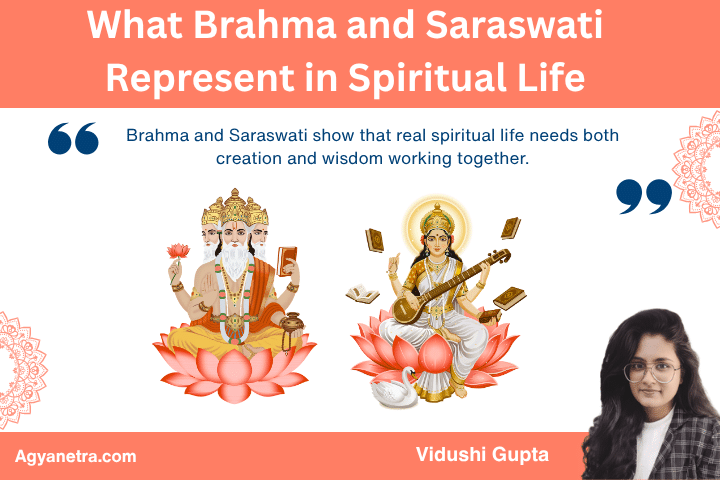
On the surface, that sounds simple. Creation and knowledge. But spiritually, the pairing carries much more depth.
Brahma represents the impulse through which form arises. In Vedantic language, I understand him as the principle through which the unmanifest begins to move toward manifestation.
Saraswati represents the intelligence that makes this movement harmonious rather than chaotic.
She is not just information. She is living wisdom. She is the current of order, beauty, rhythm, and right expression.
This is why I never see them as separate forces. Creation without wisdom becomes noise. Wisdom without expression remains unembodied. The two belong together.
In the Vedic and Puranic imagination, Saraswati is also connected with vak, sacred speech.
That matters spiritually because what is created in life is shaped not only by action, but by sound, thought, language, and intention.
The seeker who speaks carelessly creates confusion. The seeker who speaks from clarity begins creating order.
When I reflect on Brahma and Saraswati together, I do not just see divine figures from a sacred story.
I see the relationship between inner vision and right manifestation. I see the truth that life becomes sacred when creation is guided by consciousness, not impulse.
Creation becomes spiritual when wisdom sits at its center.
Why this symbolism matters beyond mythology
A lot of people stop too early with these archetypes. They either reduce them to mythology or treat them as symbols that sound beautiful but have no practical role in real life. I think that misses the whole point.
The deeper use of sacred imagery in Hinduism is not only to tell stories. It is to reveal structures of consciousness.
Brahma and Saraswati are part of that revelation. They show me that the spiritual life is not just about renunciation, silence, or transcendence.
It is also about how I create, how I think, how I speak, and what kind of inner field I am bringing into the world.
I sometimes explain it like this to students: Brahma is like the fertile field of emergence, and Saraswati is the river that knows where to flow.
A field without guidance becomes wild and tangled. A river without a field has nowhere to nourish. That is how these energies work inside us.
In the Upanishadic spirit, especially when I read teachings that point toward the subtle relation between consciousness and manifestation, I do not see divine forms as outside psychology. I see them as mirrors. They help me look inward.
One thing I learned the hard way is that being spiritually sincere does not automatically make my life well-ordered. I have gone through phases where insight was present, but expression was messy.
The heart knew something true, but speech did not reflect it. The mind had learned, but life had not organized itself around what was learned.
That is exactly where the Brahma-Saraswati symbolism becomes useful. It reminds me that awakening must become articulation, structure, beauty, and living order.
Read More:
- Spiritual Evolution and Source Consciousness
- Higher Dimensions in Spirituality
- From Individual Self to Universal Consciousness
How Brahma and Saraswati appear in inner practice
If I bring this symbolism into actual spiritual practice, the meaning becomes even clearer. Brahma represents the birth of a new inner world. Saraswati represents the refinement that keeps that inner world aligned with truth.
This shows up in meditation in a very practical way. A genuine spiritual insight is a creative event. Something new is born in consciousness. A false identity loosens. A fresh understanding enters.
That is Brahma’s movement in the inner life. But then another question appears: can I interpret this insight correctly, speak it clearly, and live it wisely? That is where Saraswati enters.
In my own practice, I have seen how easily insight can be distorted if the mind is noisy. A real opening comes, and then ego rushes in to label it, dramatize it, or use it to feel special.
Saraswati’s energy cuts through that. She brings discernment. In Sanskrit, I think of this as viveka, clear discrimination between the real and the unreal.
A simple reflection practice I sometimes give is this:
Sit quietly for ten minutes after meditation and write down one thing that feels newly alive in your awareness.
Then ask yourself three questions:
What is being created in me right now?
What truth must guide it?
How can I express it without distortion?
That small exercise can reveal a lot. It teaches the mind to respect the birth of inner truth instead of rushing past it.
In spiritual life, new consciousness is always being born. But if wisdom does not accompany it, that birth becomes unstable.
Not every inner opening is mature. Wisdom is what helps the soul carry its own light well.
What I have seen in seekers who are out of balance between creation and wisdom
In my years of working with seekers, I have seen two common imbalances again and again. One group is full of creative force.
They have ideas, visions, passion, spiritual hunger, and emotional intensity. But they lack steadiness, discrimination, and structure.
They start many things and complete very little. Their inner Brahma is active, but Saraswati is undernourished.
The other group has deep knowledge. They read scripture, understand philosophy, speak beautifully about Advaita Vedanta, Bhakti, Karma Yoga, even Buddhist emptiness and witness consciousness. But their life is dry.
Nothing fresh is being born through them. The wisdom has become mental possession, not living creation. Saraswati is present, but Brahma is asleep.
I once worked with a woman who had extraordinary devotional depth. She loved mantra, prayer, sacred music, and silence. But she constantly postponed every creative action in her life because she feared imperfection.
Over time, it became obvious that she was clinging to purity in a way that stopped manifestation itself.
She did not need more spiritual knowledge. She needed permission to create. When she finally began writing and teaching from her lived truth, her whole energy changed.
I have also worked with men and women who were overflowing with plans and spiritual ambition, but their speech was careless and their understanding was shallow.
Their energy scattered because nothing rooted it. What helped them most was not more force. It was refinement.
This is why I see Brahma and Saraswati as a living diagnostic tool in spiritual work. They show me whether a seeker needs courage to create, or humility to listen. They reveal where consciousness is fertile, and where it still needs discipline.
Free PDF Book
Awakening Maya To Moksha
Integration of the final soul lessons and transcendence of physical identity into pure awareness.
The misconception that Brahma and Saraswati only represent outer deities
One misconception I want to challenge directly is the idea that Brahma and Saraswati matter only if a person approaches Hindu spirituality in a devotional or literal way. I do not agree with that.
Devotion is a powerful path, and I respect it deeply. But these archetypal forms also speak to seekers who engage spiritually through meditation, inner inquiry, symbolic understanding, or contemplative practice.
In Bhakti Yoga, devotion to Saraswati or Brahma can become a real current of grace. But in Gyana Yoga, these forms can also be understood as principles of consciousness. That is not disrespect. It is another doorway.
Another misunderstanding is the tendency to flatten Saraswati into “education” and Brahma into “creation” in a purely worldly sense.
Their symbols go deeper than academic success or artistic productivity. Saraswati is not just learning facts. She is purified intelligence. She is clarity of speech, purity of insight, and the rhythm of truth. Brahma is not merely productivity.
He is emergence itself — the sacred mystery by which something invisible becomes visible.
I think modern spiritual seekers need this deeper reading badly. We live in a culture that produces endlessly but rarely asks whether creation is wise.
We consume information constantly but rarely ask whether knowledge has become wisdom. That split creates exhaustion.
The Hindu symbolic world heals that split by showing that manifestation must remain in relationship with sacred intelligence.
Once I understand that, these deities stop being distant. They become inwardly immediate.
How I live this teaching in ordinary spiritual life
For me, the real question is always the same: how does this change the way I live on a Tuesday afternoon, in a difficult conversation, during work, in creativity, in silence? If sacred symbolism cannot descend into ordinary life, it remains decoration.
Living this teaching means I pay attention to what I am creating through thought, word, and action.
I ask whether my energy is fertile but undirected, or informed but stagnant. I ask whether the thing I am bringing into the world is truly aligned with wisdom.
Sometimes this becomes very small and practical. I rewrite a sentence until it carries truth more cleanly. I wait before speaking when I know emotion is louder than understanding.
I allow a creative impulse to come into form instead of endlessly postponing it in the name of perfection. These are spiritual acts too.
In Karma Yoga, action becomes offering. In that spirit, every expression can become sacred when guided by awareness.
And in my own path, I have found that Saraswati’s grace often appears not in dramatic visions but in refinement — cleaner thought, truer speech, quieter intelligence.
Brahma’s current appears when something long waiting inside me is finally given form.
This is one reason I return to these symbols often. They remind me that spiritual life is not only about transcending the world.
It is also about creating within it without losing the thread of wisdom. That is a lifelong practice. And honestly, it keeps maturing. It does not finish.
Conclusion
Brahma and Saraswati represent much more than a mythological pairing. In spiritual life, they reveal the sacred relationship between creation and wisdom, emergence and guidance, expression and truth.
One shows me that consciousness is always capable of birthing new reality. The other reminds me that what is born must be shaped by clarity, beauty, and inner discipline.
When I understand them this way, they stop being distant figures and become living principles within my own path.
They teach me to create without chaos, to learn without stagnation, and to let my life become a more refined expression of the sacred intelligence already moving through it.
FAQs
What do Brahma and Saraswati represent together in spiritual life?
Together, Brahma and Saraswati represent the union of creation and wisdom. Brahma reflects the power through which new forms, ideas, and inner realities emerge. Saraswati reflects the intelligence that gives those creations clarity, harmony, and right direction. In my experience, spiritual life becomes steady only when both are active together.
Why is Saraswati important in inner spiritual growth?
Saraswati is important because she represents more than learning. She represents refined intelligence, clear speech, discernment, and inner purity. When I see her working in spiritual growth, I notice that confusion begins to reduce and expression becomes more truthful. She helps spiritual insight become something lived, not just something understood.
How can I apply the teaching of Brahma and Saraswati in daily life?
I apply this teaching by watching what I create through my words, choices, and habits. Before acting, I ask whether what I am bringing into the world is guided by clarity or by impulse. A simple way to begin is to pause before speaking, especially in emotional moments, and ask whether wisdom is shaping expression. That alone can change a lot.
Are Brahma and Saraswati only symbolic, or should they be worshipped?
They can be approached in both ways. In Bhakti Yoga, a seeker may worship Brahma and Saraswati as divine beings with devotion and reverence. In a more contemplative path, they can also be understood as archetypal forces within consciousness. I have seen both approaches help people deeply, depending on their temperament and spiritual path.
What happens when creation is strong but wisdom is weak?
When creation is strong but wisdom is weak, life becomes scattered. A person may have many ideas, much passion, and strong movement, but without clarity the energy does not stabilize. I have seen seekers start beautiful things and then lose direction because inner refinement was missing. Wisdom gives shape and continuity to what is created.
Can someone have wisdom but still feel spiritually blocked?
Yes, very easily. A person may understand many teachings and still struggle to express them in life. I have seen seekers with deep knowledge who remained inwardly stuck because nothing new was being allowed to emerge through them. In that case, the problem is not lack of wisdom but lack of embodied creation.
How do I know if I am out of balance between Brahma and Saraswati?
You can usually tell by looking at your life honestly. If you are full of movement, ideas, and emotional energy but feel messy, reactive, or unclear, creation is likely ahead of wisdom. If you are thoughtful, informed, and spiritually aware but feel dry, blocked, or unable to act, wisdom is likely ahead of creation. Balance begins when both expression and clarity support each other.
Is the connection between Brahma and Saraswati relevant for modern spiritual seekers?
Yes, very much. Modern life encourages endless output and endless information, but not necessarily wise creation. That is why this symbolism still matters. It reminds me that spiritual maturity is not just about producing more or knowing more, but about allowing what I create to come from a place of truth, refinement, and sacred intelligence.

Vidushi Gupta is a spiritual coach, energy healer, and emotional wellness counselor with over 10 years of experience guiding people through spiritual signs, emotional healing, and inner transformation. She is the founder of Agyanetra and a published author of nearly ten novels, reaching over 20 million readers worldwide. Her approach is grounded, fear-free, and focused on helping readers understand spiritual experiences with clarity and emotional balance.