
What Shiva and Shakti Represent in Spiritual Life? There are seasons in spiritual life when everything stable begins to crack. A relationship ends. A belief collapses. A version of the self that once felt solid suddenly loses its force.
In those moments, people often think something has gone wrong. My experience has been the opposite. Very often, something sacred is trying to move.
That is where Shiva and Shakti become more than mythology for me. They become a living spiritual map. When I contemplate what Shiva and Shakti represent in spiritual life, I do not see only divine figures from Hindu tradition.
I see the meeting of stillness and power, consciousness and energy, emptiness and expression. I see the mystery of how destruction clears space for truth, and how life begins again from a deeper center.
Over the years, both in my own inner work and in the seekers I have guided, I have seen the same pattern: transformation becomes possible only when awareness and energy stop fighting each other and begin moving as one. That is the real heart of this symbolism.
What Shiva and Shakti Represent in Spiritual Life: Shiva and Shakti as consciousness and power
In the deepest spiritual reading, Shiva and Shakti are not merely two separate divine beings.
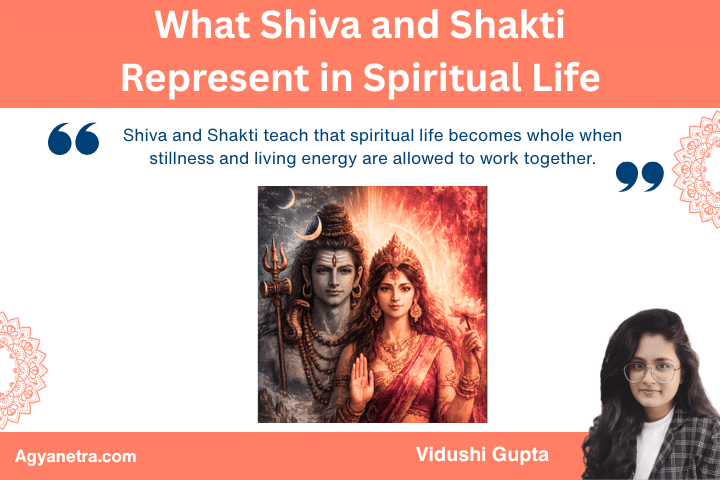
They are two inseparable aspects of reality itself. In Kashmir Shaivism, Shiva is pure consciousness, still, spacious, unchanging.
Shakti is the dynamic power of that consciousness, the force through which awareness expresses, creates, moves, feels, and manifests.
I find this one of the most elegant teachings in all spiritual philosophy. Consciousness without Shakti remains unexpressed.
Shakti without Shiva becomes ungrounded motion. Together they reveal the structure of existence.
In Tantra, this is not abstract metaphysics. It is lived reality. Every thought, desire, intuition, emotion, creative act, and awakening impulse belongs to Shakti.
The awareness that knows all of this, yet is untouched by it, belongs to Shiva. One is the dance. One is the silent witness of the dance. But even that language can mislead, because the two are not really separate.
The image I carry is simple. Shiva is like the vast sky. Shakti is like the weather moving through it — wind, thunder, rain, lightning, sunlight. The sky allows all of it. The weather makes the sky visible in experience.
When I work with seekers who are overwhelmed by emotion or inner change, this teaching helps enormously. It reminds them that movement does not mean chaos, and stillness does not mean deadness. Spiritual life ripens when both are honored.
Shiva is the silent vastness. Shakti is the living force that makes that vastness known.
Why destruction is sacred in the spiritual path
Most people resist destruction because they hear the word and think loss, pain, ending, or punishment.
I understand that reaction. I have had phases in my own life where destruction felt deeply personal. But over time I learned that in spiritual life, destruction is often the hand of truth.
The image of Shiva’s Tandava, the cosmic dance of destruction, is not about violence for its own sake.
It is about the breaking of forms that can no longer hold life. In Shaiva symbolism, destruction does not stand apart from creation.
It prepares the field for renewal. A false identity breaks. A rigid attachment falls away. An exhausted pattern ends. Something deeper becomes possible.
This is where I think many seekers suffer unnecessarily. They keep trying to preserve a structure that the soul has already outgrown.
They call it loyalty, discipline, or hope, but inside they know the life has gone out of it. Shiva’s force enters precisely there.
In Buddhist language, I would connect this to anicca, impermanence, and to the release that comes from seeing that no form is meant to be clung to forever.
In Sufi teaching, there is a related motion in fana, the dissolving of the false self in divine reality.
I have sat with seekers who thought they were failing spiritually because everything familiar was falling apart.
But what I saw was different. Their inner life was becoming too honest to continue feeding illusion. Destruction was not the problem. Resistance to necessary destruction was.
Sometimes the sacred does not arrive as comfort. Sometimes it arrives as removal.
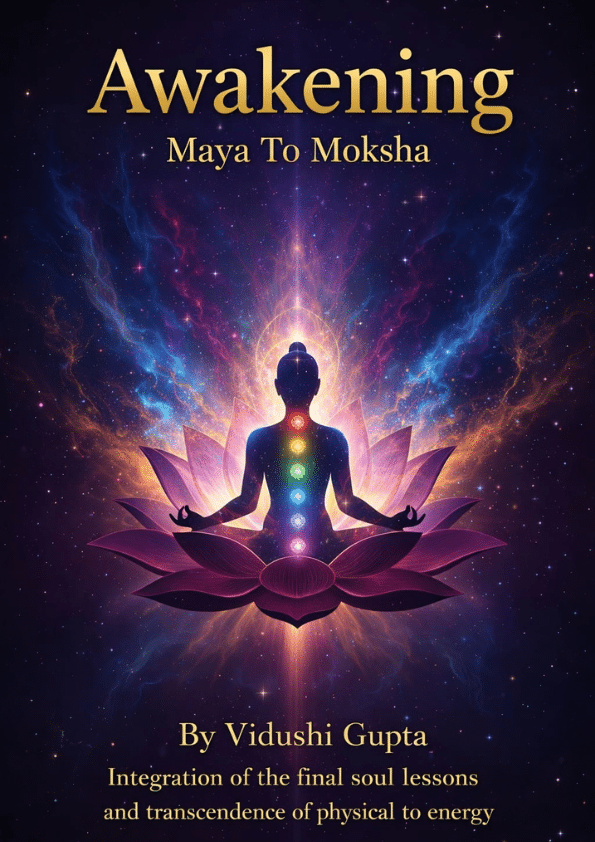
Free PDF Book
Awakening Maya To Moksha
Integration of the final soul lessons and transcendence of physical identity into pure awareness.
How this energy shows up in real inner practice
If Shiva and Shakti remain only philosophical ideas, they stay beautiful but distant. I care much more about how this teaching lives in practice.

In meditation, Shiva appears as the witnessing awareness that does not move with every thought.
Shakti appears as everything that rises within awareness — sensation, emotion, intuition, energy, memory, longing, silence becoming alive. I do not need to choose one over the other. I need to learn their relationship.
A lot of people make the mistake of trying to suppress Shakti in order to feel spiritual. They want stillness, so they reject emotion.
They want peace, so they fear intensity. That has never worked well in my experience. Suppressed energy does not become enlightened. It becomes distorted.
What I teach instead is conscious containment. Sit still. Breathe naturally. Notice whatever is moving in the body or mind.
Then ask: can I remain aware without interfering? Can I let the energy reveal itself without collapsing into it?
This is a powerful practice.
Sit for ten minutes and bring your attention to the center of the chest or the spine. Notice one living movement inside you right now — grief, restlessness, joy, irritation, desire, fatigue. Do not label it as good or bad. Then inwardly ask:
What is moving in me?
What is aware of that movement?
Can both be here without conflict?
That third question changes a lot. It allows Shiva and Shakti to be recognized together.
I have learned the hard way that spiritual maturity is not created by becoming blank. It is created by becoming spacious enough to hold energy without being ruled by it.
The goal is not to kill the fire. The goal is to become conscious enough to let the fire purify rather than consume.
What I have observed in seekers who fear their own Shakti
In my years of spiritual counseling, I have seen a pattern that repeats across very different personalities. Seekers say they want awakening, but many are actually terrified of their own life-force.
They are comfortable with spiritual ideas as long as those ideas remain calm, neat, and controlled.
The moment real energy rises — anger, grief, sexual vitality, fierce clarity, creative urgency, deep devotion — they become frightened.
I understand this fear. Shakti is not tidy. She moves. She shakes old structures. She asks for embodiment, not performance.
I once worked with a woman who had a sincere meditation practice and deep longing for truth, but every time strong energy rose in her body, she would shut it down.
She thought it meant she was becoming unstable. As we worked together, it became clear that the energy itself was not the problem.
The real problem was that she had never learned how to stay present with intensity. Once she stopped pathologizing her own aliveness, her practice deepened in a way that intellectual study alone had never given her.
I have seen the opposite pattern too. Some seekers glorify energy and ignore consciousness.
They chase sensations, altered states, and emotional highs but do not cultivate the witnessing center. That leads to imbalance just as surely.
In my own path, I went through a stage where I confused spiritual insight with energetic intensity.
It took time for me to understand that not every powerful feeling is truth, and not every quiet state is realization. What matters is integration. Is awareness present? Is the energy becoming wiser? Is life becoming truer?
These are better questions than “Did I feel something powerful today?”
The misconception that Shiva is only destruction and Shakti is only energy
One of the biggest misunderstandings I see is the flattening of these symbols. Shiva gets reduced to destruction. Shakti gets reduced to feminine energy or raw power. Both readings are too small.
Shiva is not only the destroyer. He is also stillness, transcendence, spacious awareness, renunciation of illusion, and the unchanging ground beneath all movement.
In Advaita Vedanta, I would say he reflects something close to pure witnessing consciousness. In Yoga, he mirrors the silent seer behind the fluctuations of mind.
Shakti is not merely force. She is intelligent force. She is not random charge. She is the expressive power of consciousness itself.
In many tantric traditions, she is the path, the movement, the revelation, the kundalini, the mantra, the devotion, the transformative current that turns truth into lived reality.
Another confusion comes from gendered interpretation. People think Shiva belongs to men and Shakti belongs to women. Spiritually, that is far too literal.
Every human being contains both principles. Every seeker needs the Shiva capacity to witness and the Shakti capacity to feel, move, create, and transform.
I find that this misconception weakens spiritual life. Men suppress sensitivity because they fear losing structure. Women suppress force because they fear being “too much.”
The symbolic teaching is far more liberating than that. It says consciousness and power belong together in every whole human being.
When I really understand Shiva and Shakti, I stop dividing my inner life into acceptable and unacceptable parts. I begin learning the discipline of sacred union within.
How I live this teaching in ordinary life
For me, this teaching becomes real in very practical ways. Shiva enters when I pause before reacting, when I sit in silence instead of obeying every inner storm, when I refuse to let temporary emotion define the whole truth.
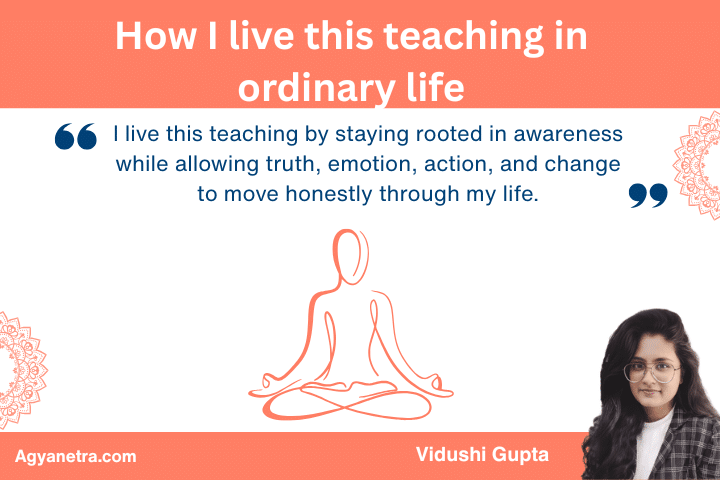
Shakti enters when I allow life to move, when I create, speak, grieve, love, dance, act, and let energy become expression rather than suppression.
Some days this is quiet. I stay steady in a difficult conversation. I notice anger rising and choose awareness instead of unconscious speech. I sit with grief without turning it into identity. That is Shiva holding Shakti.
Other days it is more active. I write when something true wants form. I clear what has become dead in my life. I let a neglected part of myself come alive again. That too is sacred.
What I have learned is that spiritual life becomes distorted when I live from only one pole. Too much Shiva without Shakti can become withdrawal, dryness, and distance from life.
Too much Shakti without Shiva becomes emotional flooding, scattered action, and spiritual exhaustion. Balance is not static. It is living relationship.
This is one reason these teachings continue to matter so much to me, and why I return to them again in my work and in Awakening Maya to Moksha.
They show me that awakening is not a flight from intensity. It is a way of becoming conscious enough to meet intensity without losing the ground of being.
Conclusion
Shiva and Shakti represent one of the most profound truths in spiritual life: consciousness and energy are not enemies.
They belong to each other. Shiva teaches me to remain still, aware, spacious, and rooted in what does not collapse. Shakti teaches me to allow life to move, create, transform, and reveal what still needs to burn away.
When I understand their union inwardly, destruction stops feeling only frightening and starts becoming meaningful. I see that what falls away is often what could no longer carry truth.
What rises afterward is not random. It is a more honest life. Spiritual growth becomes less about controlling experience and more about allowing awareness and energy to mature together. That is where real transformation begins.
FAQs
What do Shiva and Shakti represent in spiritual life?
Shiva and Shakti represent the union of consciousness and energy. Shiva reflects stillness, awareness, and the witnessing presence, while Shakti reflects movement, creation, transformation, and life force. In spiritual life, their union teaches that awakening becomes complete only when inner awareness and living energy work together instead of pulling apart.
What is the spiritual meaning of Shiva and Shakti?
The spiritual meaning of Shiva and Shakti is that reality has two inseparable aspects: pure consciousness and dynamic power. Shiva is the silent ground of being, and Shakti is the force through which that ground becomes experience, creation, and transformation. Together, they explain how spiritual growth includes both stillness and active inner change.
Is Shiva and Shakti symbolism about outer gods or inner energies?
Shiva and Shakti can be understood in both ways. In Hindu devotion, they are worshipped as divine realities. In inner spiritual practice, they also represent forces within every seeker: the capacity to remain aware and the capacity to feel, transform, create, and awaken. This deeper symbolic meaning makes the teaching highly relevant in daily life.
Why is Shiva called the destroyer in spirituality?
Shiva is called the destroyer because he removes what is false, outdated, or no longer aligned with truth. This destruction is not negative in the spiritual sense. It clears illusion, ego attachment, and exhausted patterns so deeper awareness can emerge. In spiritual life, Shiva’s destructive force makes renewal possible.
What does Shakti mean in spiritual awakening?
Shakti means the active energy of consciousness. In spiritual awakening, Shakti is the force that stirs change, raises inner intensity, exposes emotional blocks, and pushes life toward transformation. I have found that many seekers feel Shakti first as strong inner movement before they fully understand what is happening.
How can I balance Shiva and Shakti in daily life?
You balance Shiva and Shakti by practicing both awareness and expression. Meditation, silence, and self-observation strengthen Shiva. Honest emotion, meaningful action, creativity, and embodied spiritual practice strengthen Shakti. Real balance comes when you remain inwardly steady while allowing life energy to move without fear or suppression.
What is a common misunderstanding about Shiva and Shakti?
A common misunderstanding is that Shiva belongs only to men and Shakti belongs only to women. Spiritually, that is not true. Every human being carries both the witnessing principle of Shiva and the transformative force of Shakti. Another confusion is thinking Shiva means only destruction and Shakti means only emotion, when both are far deeper than that.
How does Shiva and Shakti symbolism help in inner transformation?
Shiva and Shakti symbolism helps inner transformation by giving seekers a clear spiritual map. Shiva teaches how to stay rooted in awareness, while Shakti teaches how to allow change, intensity, and emotional truth to move through life consciously. Together, they help a person transform without becoming either emotionally lost or spiritually disconnected.

Vidushi Gupta is a spiritual coach, energy healer, and emotional wellness counselor with over 10 years of experience guiding people through spiritual signs, emotional healing, and inner transformation. She is the founder of Agyanetra and a published author of nearly ten novels, reaching over 20 million readers worldwide. Her approach is grounded, fear-free, and focused on helping readers understand spiritual experiences with clarity and emotional balance.
Pingback: The Sacred Marriage Within: Balancing Masculine and Feminine Energy
Pingback: The Awakening of Shakti: A Grounded Path to Inner Aliveness