
Which Chakra Is Responsible for Fear? I have seen fear appear in many forms. Sometimes it comes as anxiety in the chest, sometimes as heaviness in the stomach, and sometimes as a quiet feeling that life is not safe enough to relax into.
When someone asks me, which chakra is responsible for fear, my answer is simple but not shallow.
The Root Chakra is most closely connected with fear because it holds our sense of safety, survival, stability, and grounding.
I am Vidushi Gupta, and through my work as a spiritual coach, energy healer, and emotional wellness counselor, I have observed that fear is rarely just a thought. It often lives in the body before the mind can explain it.
This article will help you understand why the Root Chakra is linked with fear, how anxiety can connect with other chakras too, and how you can begin working with fear in a grounded, honest, and gentle way.
Which Chakra Is Responsible for Fear? Know Main Chakra Responsible for Fear
The chakra most responsible for fear is the Root Chakra, also known as Muladhara Chakra.
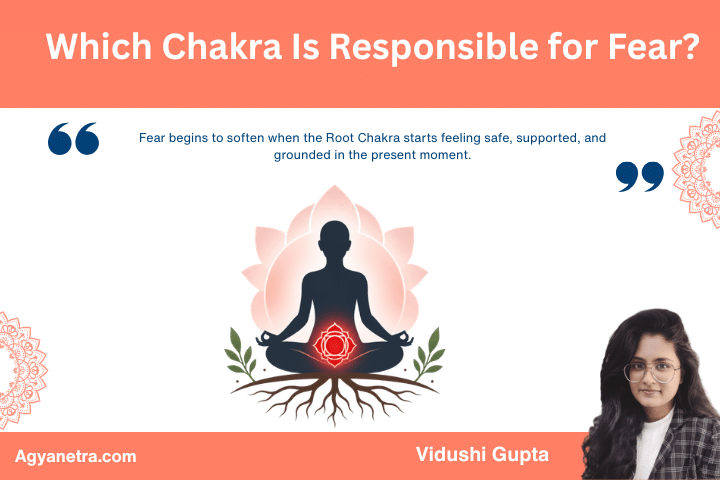
It is located at the base of the spine and is traditionally connected with survival, safety, food, shelter, money, family roots, and physical stability.
When the Root Chakra feels balanced, a person usually feels more settled in life. They may still face challenges, but they do not feel completely shaken by every uncertain situation.
When this chakra feels weak, blocked, or disturbed, fear can become stronger. A person may feel unsafe even when there is no immediate danger.
I have noticed that Root Chakra fear often sounds like this inside the mind: What if something goes wrong? What if I lose support? What if I cannot survive this change?
These thoughts may look practical on the surface, but underneath them there is often a deeper energetic message. The body is asking for safety.
Fear is often not the enemy. It is the nervous system asking to feel held, rooted, and protected again.
In yogic understanding, Muladhara is the foundation of the energy body. Just as a house cannot feel steady without a strong base, our inner life cannot feel peaceful if the foundation of safety is disturbed.
Why Fear Lives So Deeply in the Root Chakra
The Root Chakra is connected with the earth element. Earth represents steadiness, weight, patience, structure, and support.
When I work with people who carry deep fear, I often notice that their energy feels scattered upward. Their thoughts move fast, their breathing becomes shallow, and their awareness stays mostly in the head.
This is why grounding is so important. Fear pulls us away from the body, while Root Chakra healing brings us back into the body.
In the Upanishadic way of seeing life, the human being is not only a thinking mind. We are body, breath, emotion, awareness, and spirit moving together. Fear disturbs this harmony by making us feel separate from trust.
The Root Chakra does not only relate to physical survival. It also reflects whether we feel that life itself is supporting us.
A person can have money, a home, and people around them, yet still feel unsafe inside. This shows that Root Chakra fear is not always about outer conditions. Sometimes it is about old emotional memory.
Many fears begin in early life. If someone grew up with instability, criticism, emotional neglect, sudden loss, or constant pressure, the Root Chakra may learn to stay alert.
Later in life, even small changes can activate that old survival pattern. The person may not know why they feel afraid, but the body remembers.
Read More:
Which Chakra Is Responsible for Fear and Anxiety?
The Root Chakra is mainly responsible for fear and anxiety related to safety, survival, stability, money, home, health, and belonging. But anxiety can involve other chakras depending on what kind of fear is active.
This is where many people get confused. They read that fear belongs to the Root Chakra, but then they feel anxiety in the chest, throat, or stomach.
Both can be true.
If anxiety is about survival, it is usually Root Chakra related. If it is about failure or control, the Solar Plexus Chakra may be involved.
If it is about rejection or abandonment, the Heart Chakra may be active. If it is about speaking or being judged, the Throat Chakra may be connected.
I often explain it with the analogy of a tree. The Root Chakra is the root system, but fear can travel into the branches.
If the roots do not feel secure, the whole tree trembles. But the trembling may show up in different places.
This is why a deeper spiritual approach does not ask only, “Which chakra is for fear?” It also asks, “What kind of fear am I carrying?”
That one question can change everything.
Different Types of Fear and Their Chakra Connection
Fear is not always the same emotion. It has different shades, and each shade can point toward a different energetic pattern.
Fear of danger, loss, poverty, illness, instability, or being unsupported usually points toward the Root Chakra. This is survival fear.
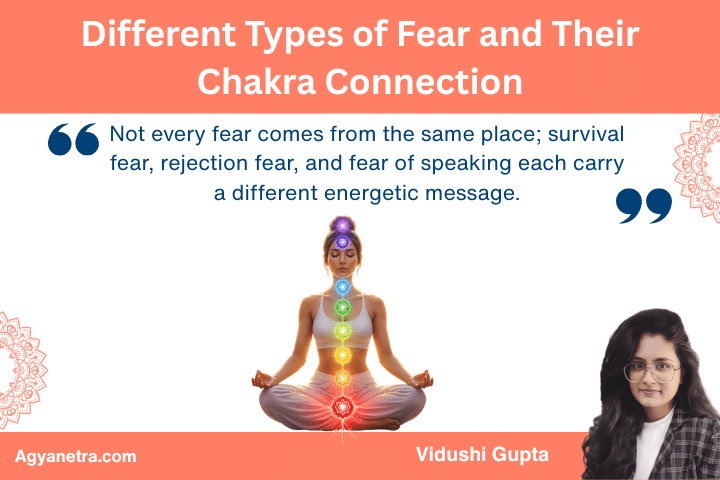
Fear of failure, humiliation, weakness, or not being good enough often relates to the Solar Plexus Chakra. This chakra is connected with confidence, self-worth, personal power, and action.
Fear of rejection, abandonment, betrayal, or emotional pain often touches the Heart Chakra. This fear can make a person close their heart even when they deeply want love.
Fear of speaking, expressing truth, saying no, or being misunderstood may connect with the Throat Chakra. I have seen many sensitive people carry fear here because they learned early that their voice was not welcome.
Fear of emotional intimacy, pleasure, or vulnerability may connect with the Sacral Chakra. This is common when someone has learned to suppress feelings or distrust closeness.
Fear of uncertainty, overthinking, or not knowing what will happen may also touch the Third Eye Chakra. In such cases, the mind tries to control life through constant analysis.
Still, the Root Chakra remains the foundation. If the Root Chakra becomes more grounded, many other fear patterns begin to soften naturally.
When the root feels safe, the heart opens more easily, the voice speaks more honestly, and the mind becomes less restless.
Signs Your Root Chakra May Be Carrying Fear
A fearful Root Chakra does not always announce itself dramatically. Sometimes it appears quietly through daily habits, body patterns, and emotional reactions.
You may notice that you worry often about money, health, home, or future security. Even when things are manageable, your mind may keep preparing for loss.
You may feel restless in your body. Sitting still may feel uncomfortable, and silence may bring hidden anxiety to the surface.
Some people with Root Chakra imbalance feel disconnected from the body. They live mostly in thoughts, plans, worries, or spiritual ideas, but they struggle to feel present in ordinary life.
Another sign is fear of change. Even positive change can feel threatening because the Root Chakra prefers familiarity when it does not feel strong.
I have also observed that Root Chakra fear can show up as control. A person may want everything planned, predictable, and secure.
This is not because they are difficult. It is because uncertainty feels unsafe in their body.
Physical patterns may include tension in the legs, lower back, hips, feet, or pelvic area. Of course, physical symptoms can have many causes, so I never reduce everything to energy alone.
A grounded spiritual path respects both body and spirit. If fear or anxiety feels intense, persistent, or disruptive, professional support from a therapist, counselor, or doctor can be very helpful.
The Hidden Layer: Fear Is Often a Search for Belonging
Most people think fear is only about danger. In my experience, fear is also about belonging.
The Root Chakra asks, “Do I have a place here? Am I supported? Can I exist as I am?”
This is why rejection, instability, and loneliness can create such deep fear. They shake the inner foundation.
In Sufism, there is a beautiful understanding that the human heart longs to return to trust. Fear appears when we feel separated from that trust.
In Advaita Vedanta, the deepest truth points toward the Self that is never truly unsafe. But this realization cannot be forced through ideas. The body must also be included with compassion.
I have met seekers who use spiritual philosophy to bypass fear. They say, “I am not the body, I am not the mind,” but their nervous system is still trembling.
True spiritual maturity does not reject the frightened part. It sits beside it.
It says, “I hear you. I will not abandon you.”
This is one of my personal insights from years of healing work: fear softens faster when it is listened to than when it is attacked.
A Real-Life Observation From My Healing Work
A woman once came to me with constant anxiety about her future. She had a stable job, a caring family, and no immediate crisis, yet she woke up every morning with fear in her stomach.
At first, she thought the problem was only overthinking. But when we explored gently, she realized that her fear became strongest whenever something in life felt uncertain.
As a child, her family had moved often. There were financial worries at home, and she had learned early that stability could disappear suddenly.
Her adult life was different, but her Root Chakra still carried the memory of instability. Her body did not trust safety yet.
We began with simple grounding practices, not complicated rituals. She placed her feet on the floor every morning, breathed slowly, and repeated, “I am here. I am safe in this moment.”
After a few weeks, she told me something that stayed with me. She said, “My problems have not vanished, but I do not feel like I am falling all the time.”
That is Root Chakra healing in a real sense. It does not promise a life without uncertainty. It helps you stand inside uncertainty with more steadiness.
How Fear Appears in Daily Life
Fear connected with the Root Chakra often appears in ordinary situations. It may arise when bills arrive, when plans change, when someone does not reply, or when the body feels tired.
You may notice fear when you have to make a decision. Instead of asking what feels right, the mind asks what could go wrong.
You may stay in situations that are no longer healthy because the unknown feels more frightening than discomfort. This is a common Root Chakra pattern.
Fear may also appear as difficulty receiving support. If the Root Chakra has learned that life is unsafe, kindness can feel unfamiliar.
Some people become overly independent because depending on anyone feels risky. Others become overly attached because separation feels unbearable.
Neither pattern should be judged. Both are attempts to feel safe.
When you begin seeing fear this way, you stop fighting yourself. You start understanding yourself.
That understanding is already healing.
A Simple Root Chakra Practice for Fear
This practice is gentle and practical. You can do it in the morning, before sleep, or whenever fear rises.
Sit on a chair with both feet touching the floor. Keep your spine comfortable, not stiff.
Place one hand on your lower abdomen and one hand on your heart. Take a slow breath in through the nose and release it gently through the mouth.
Now bring your attention to the base of your spine, your legs, and your feet. Feel the weight of your body being supported.
Imagine roots growing from your feet into the earth. Do not force the image. Just sense heaviness, warmth, and support.
Repeat quietly:
- “I am here.”
- “I am safe in this moment.”
- “I can take one step at a time.”
Continue for five minutes. If emotions come up, let them move without judging them.
This practice works best when done consistently. The Root Chakra responds to repetition, rhythm, and simplicity.
Grounding is not about escaping fear. It is about teaching the body that this moment can be safe enough to breathe.
You can also add walking, cooking, cleaning, gardening, or mindful stretching. Root Chakra healing does not always need to look mystical.
Sometimes washing dishes slowly can be spiritual when your awareness returns to the present.
Common Mistakes About Fear and Chakras
One common mistake is thinking that fear means you are spiritually weak. I do not believe this.
Fear is part of being human. Even advanced spiritual seekers experience fear. The difference is that they learn how to sit with it more consciously.
Another mistake is trying to open higher chakras while ignoring the Root Chakra. Many people want intuition, visions, deep meditation, or heart expansion, but they do not feel stable in their body.
Without grounding, spiritual practice can become airy and unbalanced. The mind may feel inspired, but daily life remains chaotic.
The Yoga Sutras speak about steadiness and ease. This balance matters deeply. Spiritual growth needs both openness and stability.
A third mistake is expecting chakra work to remove fear instantly. Healing is not a switch. It is a relationship with yourself.
Some days you may feel grounded. Some days old fear may return. This does not mean you have failed.
It means another layer is asking for attention.
The Difference Between Intuition and Fear
Many people ask me how to know whether they are feeling intuition or fear. This is a subtle but important question.
Fear usually feels tight, urgent, and repetitive. It pushes the mind into panic or control.
Intuition feels quieter. Even when it warns you, it does not usually create mental chaos. It feels clear, grounded, and direct.
Root Chakra imbalance can make fear sound like intuition. The mind may say, “I just have a bad feeling,” when actually the body is reacting from old insecurity.
This is why grounding before making decisions is helpful. When the body settles, the inner voice becomes clearer.
Buddhist practice offers a simple wisdom here. Observe what is happening without immediately becoming it.
You can say, “Fear is present,” instead of “I am afraid and everything is wrong.”
That small shift creates space. In that space, wisdom can speak.
How to Balance the Root Chakra in Daily Life
The Root Chakra grows stronger through simple, steady living. It is not impressed by dramatic promises. It trusts consistency.
Eat nourishing food with awareness. Rest when your body asks for rest. Keep your living space clean enough to feel peaceful.
Spend time with nature whenever possible. Touch the earth, sit near a tree, walk slowly, or simply notice the ground under your feet.
Create small routines. Wake up at a steady time, keep basic commitments, and complete simple tasks. Every completed action tells the Root Chakra, “I can rely on myself.”
Financial awareness can also be grounding. You do not need to have everything solved, but avoiding reality often increases fear.
Look at your needs honestly. Make practical plans. Ask for help when needed.
The Root Chakra heals through both spiritual and practical safety. Meditation helps, but so does paying attention to the real structure of your life.
This is where Taoism offers a beautiful reminder. Flow does not mean floating without roots. A river flows because its banks hold it.
Your routines are like riverbanks. They help your energy move without scattering.
Root Chakra Affirmations for Fear
Affirmations can be helpful when they feel believable and embodied. If an affirmation feels too far from your current reality, soften it.
Instead of saying, “I am completely fearless,” say, “I am learning to feel safer in my body.”
This is more honest. The body responds better to honesty than force.
You can try these affirmations during grounding practice:
- I am safe in this breath.
- I belong to this earth.
- I can move slowly and still move forward.
- I am supported in ways I am learning to receive.
- My body is my home.
- I trust myself to handle one step at a time.
- Repeat them slowly. Let the words land in the body, not only in the mind.
When Fear Needs More Than Chakra Healing
I deeply value chakra work, but I do not believe it should replace medical or psychological care when fear becomes overwhelming.
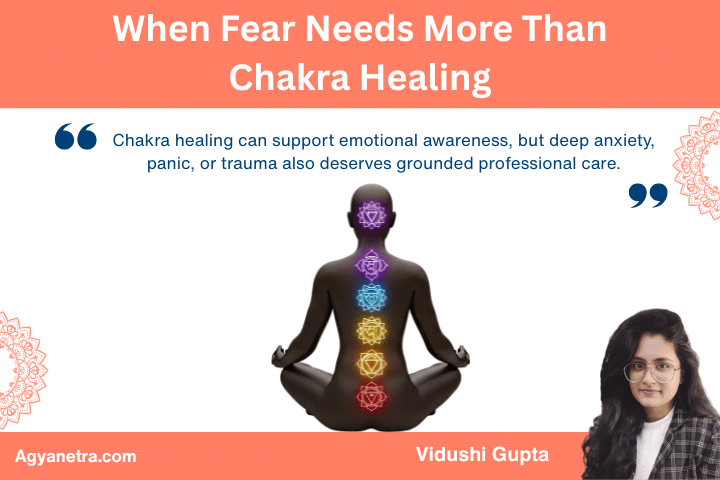
If fear creates panic attacks, sleeplessness, severe anxiety, trauma responses, or difficulty functioning, it is wise to seek support from a qualified professional.
There is no shame in this. Therapy, counseling, medical care, meditation, energy healing, and spiritual practice can support each other beautifully when used responsibly.
I have seen people heal more deeply when they stop choosing between spiritual and practical help. Both can be part of the same path.
Fear can have physical, emotional, psychological, and spiritual layers. A mature approach respects all of them.
The Root Chakra teaches us to honor reality. That includes honoring the body, the nervous system, and the human need for support.
My Personal Insight About Fear
One thing I have learned through my own inner work is that fear often becomes louder when I try to rush past it.
When I pause and ask, “What are you trying to protect me from?” something softens.
Sometimes the answer is not logical. Sometimes it is a memory, a body sensation, or a younger part of me asking for reassurance.
I no longer see fear only as something to remove. I see it as energy that needs grounding, understanding, and sometimes a new experience of safety.
This changed the way I guide others too. I do not ask people to fight fear. I help them build a stronger inner ground.
Once the ground is stronger, fear does not rule the whole inner world.
It may still visit, but it no longer becomes the master.
Final Thoughts
The Root Chakra is the main chakra responsible for fear because it carries our relationship with safety, survival, stability, and belonging.
When this foundation feels weak, fear and anxiety can rise quickly, even in situations that do not seem dangerous from the outside.
Begin with simple grounding. Feel your feet, breathe slowly, create small routines, and speak to your fearful parts with patience.
Healing does not always begin with a big spiritual experience. Often, it begins with one honest breath.
My final guidance is this: do not shame your fear. Listen to it, ground it, and support it with steady care. When your inner root begins to feel safe, the rest of your energy system naturally finds more peace.
FAQs
Which chakra is responsible for fear?
The Root Chakra is responsible for fear because it is connected with safety, survival, stability, and grounding.
Which chakra is responsible for fear and anxiety?
The Root Chakra is most commonly responsible for fear and anxiety, especially when the anxiety is connected with safety, money, health, home, family, or survival.
How do I know if my Root Chakra is blocked?
You may feel that your Root Chakra is blocked if you often feel unsafe, anxious, restless, unstable, or disconnected from your body.
What is the fastest way to calm Root Chakra fear?
The fastest way to calm Root Chakra fear is to bring attention back to the body. Place both feet on the floor, slow your breathing, relax your shoulders, and notice five things around you. Then repeat gently, “I am here. I am safe in this moment.
Disclaimer
This article is for spiritual guidance and general emotional wellness only. Chakra healing can support self-awareness, but it is not a substitute for medical advice, therapy, diagnosis, or treatment.
If fear, anxiety, panic, or emotional distress affects your daily life, please seek help from a qualified doctor, therapist, or mental health professional.

Vidushi Gupta is a spiritual coach, energy healer, and emotional wellness counselor with over 10 years of experience guiding people through spiritual signs, emotional healing, and inner transformation. She is the founder of Agyanetra and a published author of nearly ten novels, reaching over 20 million readers worldwide. Her approach is grounded, fear-free, and focused on helping readers understand spiritual experiences with clarity and emotional balance.