
Witnessing Without Judgment begins when you notice an inner experience without condemning yourself for having it. Fear, anger, jealousy, grief and longing can then be felt as passing experiences rather than treated as proof that you are weak, unspiritual or broken.
Understanding your patterns is useful, but analysis alone can become another attempt to control yourself. You may explain every emotion while remaining disconnected from the trembling hands, tight chest or aching need beneath the explanation.
Witnessing brings awareness back into the living moment. It helps you recognize what is happening, listen to what the experience may reveal and choose your next action with greater care.
What Witnessing Without Judgment Means
Witnessing is the ability to observe a thought, emotion, sensation or impulse without immediately turning it into your identity.
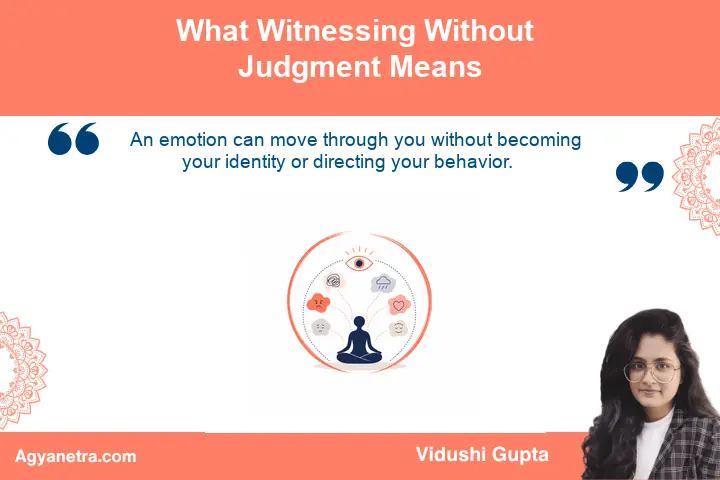
An emotion can move through you without becoming your identity or directing your behavior.
Instead of concluding that you are an angry person, you notice that anger is present. Instead of declaring that you have been abandoned, you recognize that a frightened part of you feels abandoned.
This language creates psychological space. The emotion remains real, yet you are no longer completely fused with it.
That space makes choice possible. A thought does not have to become an instruction, a fear does not have to become a prediction, and an impulse does not have to become an action.
Witnessing is therefore close enough to feel what is happening and spacious enough to respond consciously. It neither rejects the experience nor allows the experience to take over.
How Self-Judgment Creates a Second Wound
Pain becomes heavier when you also shame yourself for feeling it.
The first wound is the original fear, hurt or longing. The second wound appears when you decide that a more evolved, mature or spiritual person would not feel this way.
You may be afraid that someone will leave, then criticize yourself for still having abandonment fears. You may feel angry after being hurt, then become ashamed because you believe anger proves a lack of inner growth.
Now you are carrying both the emotion and a conflict with the emotion. The inner struggle often adds tension without resolving what caused the feeling.
A gentler response begins with simple recognition: fear is here, grief is here, jealousy is here. These words do not define you or excuse harmful behavior. They acknowledge the present experience without humiliation.
Vidushi Gupta’s exploration of the witness in Shadows offers a useful reminder: inner conflict is more likely to soften through conscious relationship than through self-punishment.
Begin with the Sacred Pause
The practical doorway into witnessing is often one unhurried breath between a trigger and your response.
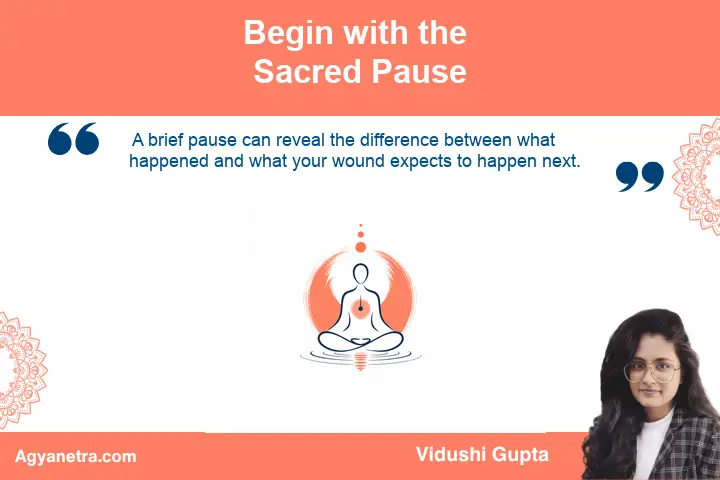
A brief pause can reveal the difference between what happened and what your wound expects to happen next.
Suppose someone important does not reply when expected. Your body tightens, your mind imagines rejection, and an urgent impulse appears to send another message, demand reassurance or withdraw first.
Before acting, pause. Notice whether your breathing has become shallow, your jaw is tense, your stomach is contracting or your chest feels heavy.
Then name the emotion as accurately as you can. It may be fear beneath anger, helplessness beneath control, or hurt beneath an accusation.
A simple sequence can help:
- Notice what happened externally.
- Feel the physical response without trying to remove it immediately.
- Name the emotion that seems present.
- Identify the story forming around the emotion.
- Delay action until you can see more clearly.
The pause does not require a dramatic spiritual state. Its purpose is to slow the inner chain of sensation, emotion, memory, interpretation and impulse so that they no longer feel like one unavoidable reaction.
Separate Feelings from Facts
Honor the feeling fully, then examine the story before treating it as truth.
A feeling can be completely genuine while the interpretation attached to it remains uncertain. Feeling rejected does not automatically prove that another person intended to reject you.
Likewise, feeling unsafe can come from a present danger or from an older wound activated by uncertainty. Both deserve attention, but they may require very different responses.
Ask what you know directly. Then ask what you have inferred, predicted or remembered. This is not an attempt to argue with the emotion; it is a way to stop the emotion from becoming evidence for every fearful conclusion.
For example, the fact may be that a conversation ended abruptly. The interpretation may be that the relationship is ending. The fear may be that you will be left without explanation.
Seeing these layers separately helps you address reality while caring for the vulnerable part within you. You can seek clarification when needed without making an accusation based solely on fear.
Witnessing Is Not Suppression or Escape
Real witnessing brings you closer to embodied experience rather than lifting you above it.
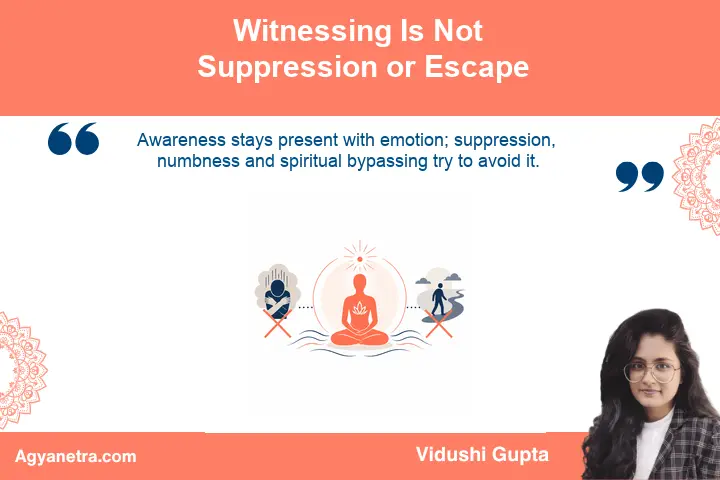
Awareness stays present with emotion; suppression, numbness and spiritual bypassing try to avoid it.
Suppression tells an unwanted emotion to disappear. Numbness acts as though nothing matters. Spiritual bypassing may cover pain with reassuring spiritual ideas before the pain has been honestly faced.
Witnessing takes another approach. You allow yourself to notice the tears, heat, trembling, contraction, desire or ache without demanding an immediate explanation.
Sometimes the body needs attention before the mind can make sense of the experience. Staying with a sensation for several breaths may reveal sadness beneath irritation or vulnerability beneath a defensive response.
This is also different from dissociation. The witness does not abandon the body or observe it from a cold distance. It remains connected, interested and willing to feel without being swallowed by what it feels.
The most helpful inner message may be very simple: I am here, and I am willing to stay with this moment.

Shadows
Meeting The Darkness Within
Shadows explores the parts of ourselves we often reject, hide or project onto others. Through shadow work, wounded inner parts, emotional triggers and conscious integration, the book follows the journey from fragmentation toward inner union and wholeness.
Combine Compassion with Responsibility
Your emotions deserve compassion, while your actions still require responsibility.
Self-compassion does not give every impulse permission to act. You can understand why anger has appeared without using it to justify cruelty, punishment or intimidation.
You can also recognize jealousy without turning it into an accusation. Fear may deserve tenderness, yet it does not entitle you to control another person or demand that they remove every uncertainty.
This distinction protects both honesty and dignity. The hurting part is heard, but it does not make every adult decision.
When emotions are intense, ask what action would honor the feeling without causing unnecessary harm. That might mean waiting before sending a message, expressing a need directly, setting a boundary or acknowledging that you do not yet have enough information.
Compassion makes you softer toward your inner experience. Responsibility keeps that softness from becoming indulgence.
Make Room for Contradictory Feelings
Inner maturity allows two honest feelings to exist without forcing either one to disappear.
Human experience rarely fits into a single clean emotion. You may love someone and still feel angry with them. You may want closeness while also needing time alone.
You can trust a relationship and notice fear. You can surrender an outcome while retaining discernment. You can feel hurt and remain responsible for how you speak.
Witnessing makes room for these apparent contradictions. Instead of deciding which feeling is acceptable, you listen for the concern carried by each one.
The part seeking closeness may need reassurance. The part seeking distance may need safety. Neither part has to control the whole situation, but both can provide valuable information.
This wider awareness reduces the pressure to become only strong, detached, trusting or peaceful. It allows you to be a complex human being while choosing conduct that reflects your values.
Questions for a Daily Witnessing Practice
Useful questions create space for awareness; they are not a test you must answer perfectly.
You do not need an elaborate ritual to practice inner observation. Use a few grounded questions when an emotion becomes intense or an interaction leaves you unsettled.
- What am I feeling right now?
- Where does this feeling appear in my body?
- What happened just before it arose?
- What story am I creating about the situation?
- Which parts of that story are facts, and which are interpretations?
- What am I afraid will happen?
- What is this reaction trying to protect?
- What do I need from myself before I respond?
- What belongs to me, and what belongs to the other person?
- What action would respect both truth and dignity?
Answers may not arrive immediately. A question may bring tears, silence or a clearer awareness of physical tension rather than a neat explanation.
That does not mean the practice has failed. Witnessing is not another standard of perfection. Becoming slightly more present than you were a moment ago is enough to interrupt an automatic pattern.
Becoming the One Who Stays
The most healing form of witnessing may be the decision to remain emotionally present with yourself.
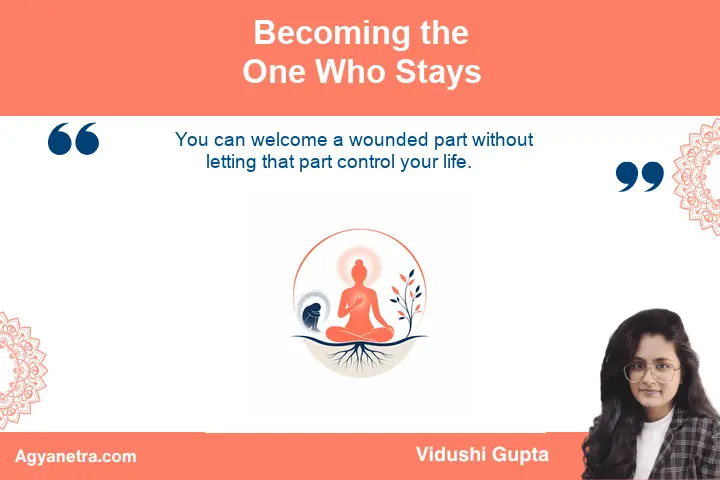
You can welcome a wounded part without letting that part control your life.
When fear, grief or longing appears, the usual urge may be to find quick reassurance, certainty or resolution. Staying means offering companionship before searching for an external solution.
You might silently acknowledge the frightened, angry or controlling part within you. Let it know that it is allowed to exist, that you are willing to listen and that it does not need to take charge.
Over time, you may recognize several inner voices: one seeking approval, another demanding independence, one fearing abandonment and another protecting you through emotional distance.
These voices are easier to understand when they are met with curiosity rather than treated as evidence that something is wrong with you. Awareness illuminates them without forcing them away.
Observation then becomes relationship. You are no longer merely watching your inner life; you are learning how to care for it without surrendering your capacity to choose.
Final Words
Witnessing does not remove every wound, prevent every reaction or make you emotionally detached. It gives you enough inner room to experience pain without adding shame and to notice an impulse without automatically obeying it.
Begin with one breath. Feel what is happening in the body, name the emotion, question the story and choose the next respectful action. Each pause strengthens your ability to stay close to yourself while remaining free to respond wisely.
FAQs
What is witnessing without judgment?
It is the practice of noticing thoughts, emotions, sensations and impulses without condemning yourself or treating them as your identity. You remain present with the experience while choosing how to respond.
How do I observe emotions without suppressing them?
Notice where the emotion appears in your body, name it and allow it to be present for a few breaths. Suppression demands that it disappear; witnessing lets it exist without giving it control.
Does non-judgmental awareness mean accepting harmful behavior?
No. You can understand your own emotions while taking responsibility for your actions, and you can acknowledge another person’s pain while maintaining clear boundaries.
How can I tell the difference between a feeling and a fact?
State what happened without interpretation, then identify the meaning your mind added. The feeling is real, but its explanation may need more evidence or clarification.
What should I do when I am too triggered to witness calmly?
Pause before acting, feel your feet or breathing, and name one physical sensation. If clarity does not return, delay the conversation or decision until your nervous system is less activated.
Is witnessing the same as emotional detachment?
No. Emotional detachment can involve distancing or numbness, while witnessing remains connected to the body and feeling. It creates enough space to choose without abandoning the experience.

Vidushi Gupta is a spiritual coach, energy healer, and emotional wellness counselor with over 10 years of experience guiding people through spiritual signs, emotional healing, and inner transformation. She is the founder of Agyanetra and a published author of nearly ten novels, reaching over 20 million readers worldwide. Her approach is grounded, fear-free, and focused on helping readers understand spiritual experiences with clarity and emotional balance.