
Becoming the Witness begins when you recognize that thoughts, emotions, and reactions are experiences within awareness—not the whole of who you are. This simple shift creates space between what happens inside you and how you choose to respond.
You do not need to silence the mind or rise above ordinary human feelings. You learn to notice inner activity clearly, without immediately believing, resisting, or obeying it.
Vidushi Gupta places this witnessing presence at the meeting point of psychology and spirituality. It supports self-understanding while pointing toward an awareness deeper than personality, conditioning, and temporary emotional states.
What Becoming the Witness Really Means
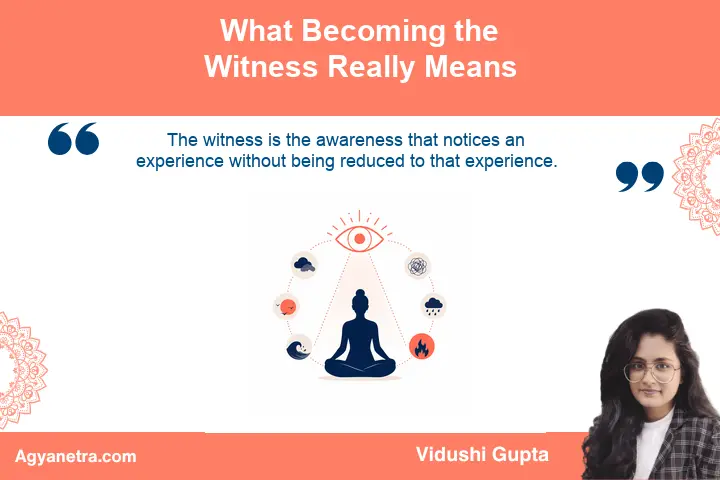
The witness is the awareness that notices an experience without being reduced to that experience.
You can recognize a thought because something in you is aware of it. You can feel sadness because awareness is present before, during, and after the feeling moves through you.
This does not require you to reject the mind, body, or personality. These remain valuable parts of human life, but they no longer need to carry the entire weight of your identity.
Psychology may describe this capacity through mindful awareness, metacognition, or the observing ego. Indian spiritual traditions use the word Sakshi, meaning the silent witness of changing experience.
The important point is practical rather than theoretical. When you notice what is happening within you, you are less likely to be unconsciously driven by it.
This capacity is closely related to developing self-awareness for growth and resilience. Clear observation helps you understand your patterns without turning every difficulty into a fixed judgment about yourself.
Why Identification Creates Suffering
A feeling can be fully present without becoming a permanent definition of you.
Identification occurs when the mind converts a passing experience into an identity. Instead of noticing anxiety, you conclude, “I am an anxious person.” Instead of facing disappointment, you decide, “I am a failure.”
The experience may be real, but the conclusion is larger than the evidence. A difficult state has been turned into a statement about your entire being.
Witnessing changes the language of the inner world. “I am angry” becomes “Anger is present.” “I am not good enough” becomes “I notice a thought questioning my worth.”
This wording is not a trick for avoiding reality. It accurately separates the person who is aware from the thought or emotion being observed.
Once that separation appears, the experience often becomes easier to hold. You can listen to its message, care for the need beneath it, and decide whether it deserves action.
Finding Space Between Trigger and Response
Most painful reactions happen quickly because old conditioning moves faster than conscious reflection.
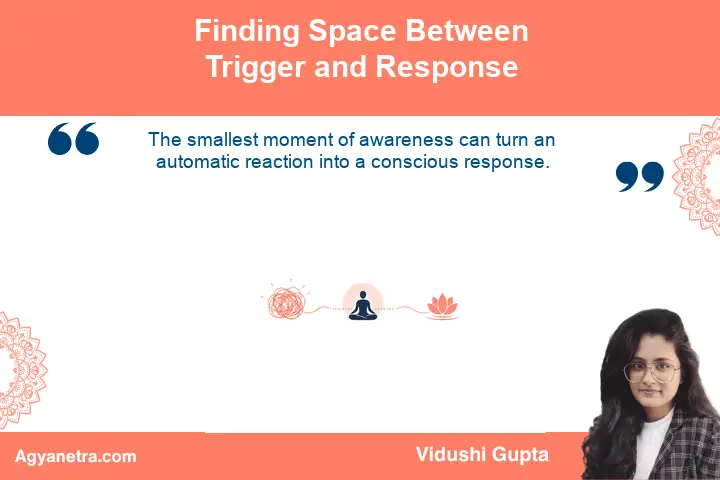
The smallest moment of awareness can turn an automatic reaction into a conscious response.
A sharp comment may activate anger. Uncertainty may awaken fear, while criticism can bring forward shame or defensiveness before you understand what has happened.
The witness introduces a pause into this chain. During that pause, you might notice a tightening chest, a heated face, a rehearsed defensive thought, or an impulse to withdraw.
You do not have to eliminate the reaction before responding wisely. Naming what is present can be enough: “Fear is here,” “My inner critic is active,” or “I want to defend myself.”
Then ask what response serves the situation. You may speak calmly, request time, set a boundary, apologize, or choose not to continue an unhelpful exchange.
This inner space is not passivity. It is where discernment becomes possible, allowing your actions to come from present understanding rather than an old emotional script.
Detachment Without Emotional Withdrawal
Healthy detachment means remaining present without allowing an outcome to possess your inner life.
Spiritual detachment is sometimes mistaken for coldness. A person may suppress grief, avoid intimacy, or refuse responsibility while calling the withdrawal spiritual freedom.
True detachment allows deeper participation. You can love another person, work toward a meaningful goal, and care about the result without making your entire identity depend on it.
Consider a parent supporting an adult child. Love remains active, yet the parent recognizes that care does not provide control over every decision or consequence.
The witness makes this balance possible. It notices attachment, fear, and the desire to control without condemning them, then helps you choose a response guided by love and clarity.
Detachment therefore does not weaken commitment. It reduces psychological possession, leaving more room for compassion, honesty, and respect for realities you cannot command.

Finding Wholeness in a Fractured World
Integration explores inner fragmentation, emotional healing, shadow work, self-awareness and the journey towards inner wholeness. It is written for readers who want to understand themselves more deeply and bring spiritual awareness into everyday life.
Daily Practices for Strengthening Witness Awareness
Awareness is already present, but regular practice helps you recognize it amid mental noise and emotional pressure.
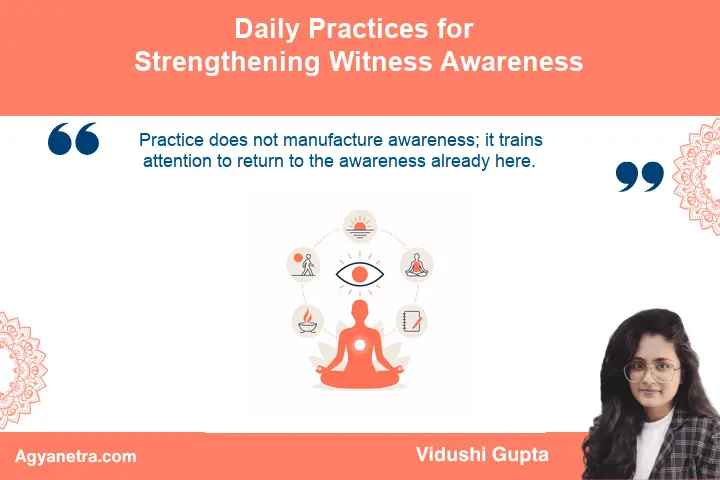
Practice does not manufacture awareness; it trains attention to return to the awareness already here.
Begin with short, repeatable exercises rather than waiting for perfect meditation conditions. The following practices can be included in ordinary routines:
- Observe the breath: Feel one complete inhalation and exhalation without trying to change their rhythm. When thoughts pull attention away, gently return.
- Name the experience: Use simple labels such as “planning,” “worrying,” “sadness,” or “tension.” Naming helps you notice a state without building a story around it.
- Scan the body: Notice the jaw, throat, chest, abdomen, and hands. Physical sensations often reveal an emotional response before the mind explains it.
- Write without editing: Journal for five minutes about a recurring reaction. Then underline beliefs, fears, or repeated phrases that appear.
- Pause before replying: Take one conscious breath before answering a difficult message or comment. Use the breath to check which part of you wants to respond.
Do not judge the practice by whether thoughts disappear. Success means recognizing a thought, sensation, or emotion with slightly more clarity than before.
Over time, these pauses support a more stable relationship with your inner life. They can also deepen the work of discovering the self beneath conditioning without denying the personal history that shaped you.
Using Self-Inquiry Without Overthinking
Self-inquiry loosens false identities when it is used for direct observation rather than intellectual debate.
The question “Who am I?” is not asking for a polished description. It invites you to examine whether your familiar labels can contain the full truth of your existence.
You may be a professional, partner, parent, student, or caregiver. These roles matter, but each can change while the basic capacity to be aware remains.
Try bringing one identity into attention. Ask, “Who am I when this role is unavailable?” Sit quietly instead of rushing to replace the old label with a more spiritual one.
You can also ask, “What is aware of this thought?” Do not search for a verbal answer. Turn attention toward the simple fact that knowing is already occurring.
If inquiry creates mental strain, return to breathing and bodily sensation. The purpose is not to solve yourself as a concept, but to experience identity with greater openness.
Used gently, inquiry reveals that achievements, relationships, beliefs, and moods are meaningful aspects of life without being the permanent center of awareness.
The Witness and Your Inner Parts
Human personality contains different voices, needs, and protective strategies that may pull in opposing directions.
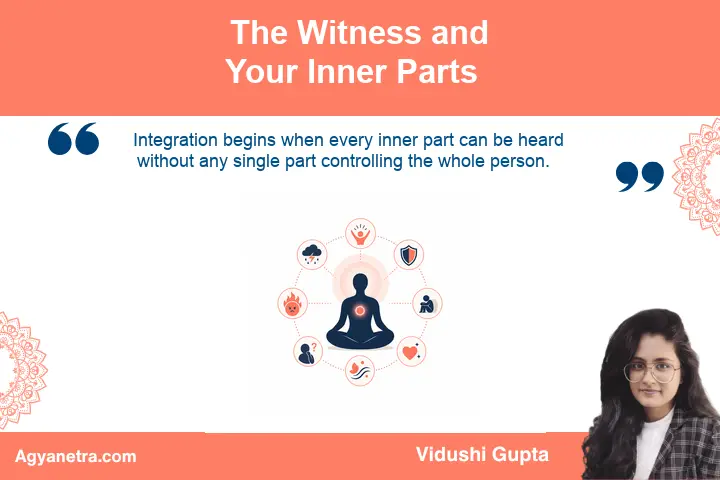
Integration begins when every inner part can be heard without any single part controlling the whole person.
An inner critic may use harshness to prevent failure. A protector may avoid vulnerability, while a wounded child may seek reassurance and an achiever may keep pushing for recognition.
Without witnessing awareness, whichever part is most activated can take charge. Its viewpoint then feels like the only truth, even when another part wants something completely different.
It helps to understand the many faces within the psyche before trying to remove them. These parts often formed as attempts to manage pain, gain safety, or preserve belonging.
The witness listens without handing over leadership. You might say, “I understand that the critic is trying to protect me from embarrassment, but I do not need to attack myself.”
This attitude brings compassion and responsibility together. The wounded part receives care, the protective part is acknowledged, and your present awareness chooses what happens next.
The Bhagavad Gita’s image of Krishna guiding Arjuna’s chariot offers a useful symbol. Awareness does not avoid the inner battlefield; it holds the reins so action can arise from wisdom rather than confusion.
Living as the Witness in Ordinary Life
Witnessing is not an escape from life; it is a way of meeting life without losing your center.
You do not need to maintain a special spiritual state throughout the day. Witnessing appears in ordinary moments whenever you notice yourself clearly and make room for a conscious choice.
At work, it may mean hearing feedback without converting it into a verdict on your worth. In relationships, it may mean noticing fear before making an accusation or withdrawing.
During grief, the witness does not ask you to feel less. It provides enough inner space for sorrow to be honored without persuading you that pain is the only reality remaining.
You will still forget, react, and become absorbed in thoughts. The moment you notice this, awareness has already returned; there is no need to add self-criticism.
As this way of living becomes familiar, personal awareness may also open questions about the relationship between individual self and universal consciousness. Such questions are best approached through humility and direct experience.
Final Words
Becoming the witness is not about creating a superior identity called “the observer.” It is the humble practice of recognizing thoughts, emotions, roles, and inner parts while remembering that none of them alone defines you.
Start with one honest pause today. Notice what is happening, feel it without immediate judgment, and ask what response reflects your clearest understanding.
Each such moment supports integration. You remain fully human, yet increasingly able to meet your inner world with steadiness, compassion, and freedom.
FAQs
What does becoming the witness mean?
It means noticing thoughts, emotions, and sensations without treating them as your complete identity. This awareness creates room for a more conscious response.
Is the witness the same as the mind?
The mind produces thoughts, memories, interpretations, and reactions. The witness is the awareness that recognizes this mental activity as it occurs.
How can I practice witnessing thoughts?
Sit quietly for a few minutes and notice each thought without following or suppressing it. Label it gently as planning, remembering, judging, or worrying, then return to the breath.
Does spiritual detachment mean avoiding emotions?
No. Healthy detachment allows emotions to be felt fully without letting them control your identity or every decision.
What should I do when a strong emotion takes over?
Pause, feel where the emotion appears in your body, and name it without judgment. Delay important reactions until you have enough space to choose a clear response.
Can witnessing awareness help with the inner critic?
Yes. You can hear the critic without automatically believing it, then explore what fear or protective intention lies beneath its harsh language.
How long does it take to become established as the witness?
There is no fixed timeline. Brief, consistent moments of observation gradually make witnessing more accessible during stress, conflict, and emotional change.

Vidushi Gupta is a spiritual coach, energy healer, and emotional wellness counselor with over 10 years of experience guiding people through spiritual signs, emotional healing, and inner transformation. She is the founder of Agyanetra and a published author of nearly ten novels, reaching over 20 million readers worldwide. Her approach is grounded, fear-free, and focused on helping readers understand spiritual experiences with clarity and emotional balance.
Pingback: Listening to the Wounded Parts: A Compassionate Path to Inner Healing