
The Many Faces Within Inner Parts describes the different inner parts that influence how you think, feel, choose, protect yourself, and relate to others. When one part wants change while another resists it, you are not necessarily confused or broken; you may simply be hearing different needs within your inner world.
Understanding these parts can reduce self-judgment. Instead of forcing every inner voice to agree, you can learn what each one is protecting and respond from a steadier center of awareness.
The Many Faces Within Inner Parts: What The Many Faces Within Really Means
Your personality may feel singular, but daily experience often reveals a more complex inner community.
Inner conflict softens when every voice is heard without being allowed to rule.
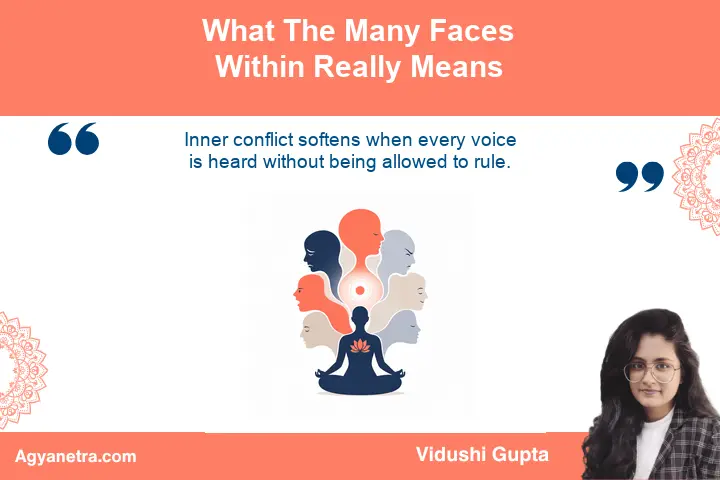
You may feel enthusiastic about a new opportunity in the morning and anxious about it by evening. You may long for closeness in a relationship but withdraw as soon as someone comes emotionally near. You may need rest while another voice insists that stopping would make you lazy.
These contradictions do not always mean that you lack clarity. Different parts of your psyche may be responding from different memories, beliefs, fears, and priorities.
Psychological traditions have used terms such as sub-personalities, ego states, complexes, and parts to describe this inner plurality. The names differ, but the practical insight is similar: human experience contains many patterns of thought and emotion rather than one fixed voice.
Recognizing this does not mean dividing yourself into rigid categories. It means becoming curious about the changing states that influence your behavior. A part can be real and important without representing the whole of who you are.
This perspective also supports the inner integration involved in individuation, where neglected or opposing aspects of personality are gradually brought into a more conscious relationship.
How The Many Faces Within Appear in Daily Life
Inner parts become easiest to recognize when your words, emotions, and actions seem to pull in opposite directions.
Imagine that you want to share an honest feeling with a loved one. One part values openness, another predicts rejection, and a third tries to avoid discomfort by changing the subject. The final silence may appear irrational until you understand the protective voices behind it.
The same pattern can appear at work. An ambitious part wants to apply for a better position, while a fearful part remembers earlier criticism. A perfectionistic voice then demands more preparation, creating delay that looks like procrastination but may actually be an attempt to prevent humiliation.
Common signs of competing inner parts include:
- Repeatedly changing your mind about an important choice
- Feeling guilty whenever you rest or set a boundary
- Craving intimacy but becoming distant when it is offered
- Judging yourself immediately after making a mistake
- Achieving external goals without feeling inwardly fulfilled
- Reacting with an intensity that seems larger than the present event
The purpose of noticing these patterns is not to analyze every passing thought. It is to recognize recurring inner positions with patience. When you can say, “A fearful part of me is present,” rather than “I am nothing but fear,” a little space opens between awareness and reaction.
Protectors and the Inner Critic
Many demanding or controlling patterns began as attempts to create safety during an earlier stage of life.
A protector may use old methods even when the present moment is safe.
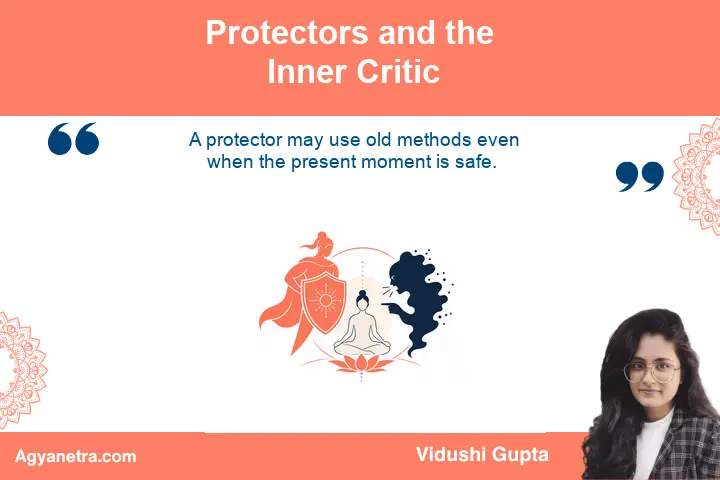
A child who receives approval mainly for achievement may develop a part that constantly pushes for success. Someone raised around unpredictability may become watchful, controlling, or highly prepared. A person who experienced rejection may learn to please others before expressing personal needs.
These strategies were not signs of weakness. They were intelligent adjustments made with the emotional understanding and resources available at the time. The difficulty arises when an old protective response continues automatically in adult situations that require a different approach.

Integration
Finding Wholeness in a Fractured World
Integration explores inner fragmentation, emotional healing, shadow work, self-awareness and the journey towards inner wholeness. It is written for readers who want to understand themselves more deeply and bring spiritual awareness into everyday life.
Why the inner critic sounds so harsh
The inner critic often believes that pressure will prevent failure. It may attack your appearance, work, relationships, or spiritual progress because it assumes that finding your faults first will protect you from being embarrassed or rejected by someone else.
Arguing aggressively with this voice can create another inner battle. A more useful response is to listen beneath its language. Ask what it fears would happen if it stopped criticizing you.
The answer may reveal fear of failure, exclusion, abandonment, or not being worthy of love. This does not make harmful self-talk acceptable, but it helps you address the fear rather than only fighting its surface expression.
Practices such as beginner-friendly shadow work can support this process when approached gently. The aim is not to obey every inner voice, but to understand the hidden emotions and unmet needs influencing it.
The Wounded Child and the False Self
Beneath protective behavior there may be a younger part carrying pain that was never fully acknowledged or supported.
The wounded part does not need a perfect past; it needs your presence now.
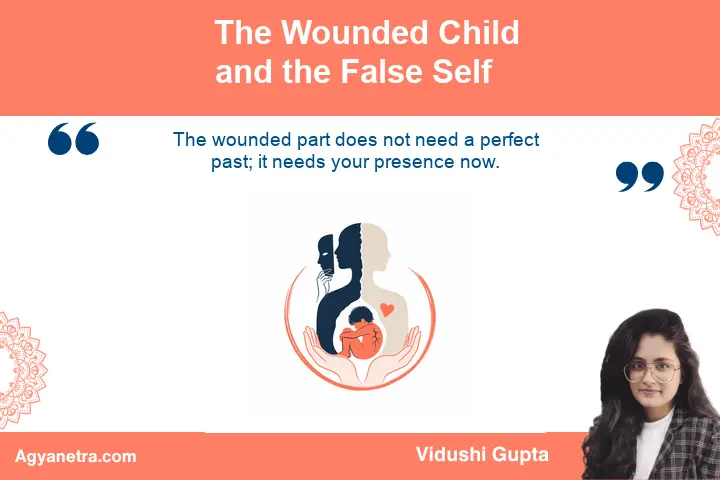
A painful childhood experience can remain emotionally active long after the event has ended. An adult may know that a delayed message does not equal abandonment, yet a younger inner part may respond as though connection is about to disappear.
This younger part is not simply being immature. It may be holding grief, fear, shame, loneliness, or helplessness that could not be processed when the original experience occurred. Learning about common signs of inner child wounds can make these reactions easier to recognize without turning them into a fixed identity.
How the false self develops
To maintain belonging, children often emphasize qualities that receive approval and conceal qualities that do not. One person learns to appear strong, another becomes endlessly helpful, and another builds an identity around being successful or spiritually composed.
This adapted identity is not entirely false. Its strengths may be genuine, but it becomes limiting when it leaves no room for vulnerability, personal needs, uncertainty, or honest emotion.
The strong person may secretly need support. The dependable caretaker may feel unseen. The achiever may fear that worth will disappear without success. The spiritual seeker may use calm language while avoiding unresolved pain.
Healing does not require destroying the identity that helped you function. It asks you to loosen your dependence on that role so a fuller and more authentic personality can emerge.
Divine Multiplicity as a Mirror of the Psyche
Indian spiritual imagery offers a meaningful way to understand how different qualities can belong to one greater reality.
Divine intelligence is represented through many forms: Saraswati expresses wisdom, Durga embodies courageous protection, Shiva represents the ending of what no longer serves, Hanuman reveals devotion, and Krishna joins love with discerning guidance.
From a psychological viewpoint, these sacred forms can also be approached as archetypal qualities available within human consciousness. Courage may need to act in one situation, wisdom in another, and surrender in another. No single quality is sufficient for every moment.
This comparison should not reduce deities to personality labels. Rather, it shows that unity does not require sameness. A whole life can contain tenderness and strength, stillness and action, devotion and discernment.
The inner problem begins when one energy tries to dominate everything. Strength without tenderness becomes rigid. Service without boundaries becomes exhaustion. Destruction without wisdom becomes impulsive, while preservation without change creates stagnation.
Healthy integration allows these different capacities to serve a deeper purpose. This complements the movement from individual identity toward wider consciousness, without denying the personal emotions that still require attention.
How to Integrate Your Inner Parts
Integration begins by developing an observing presence that can listen to an inner part without becoming completely identified with it.
Awareness becomes trustworthy when it listens first and chooses deliberately.
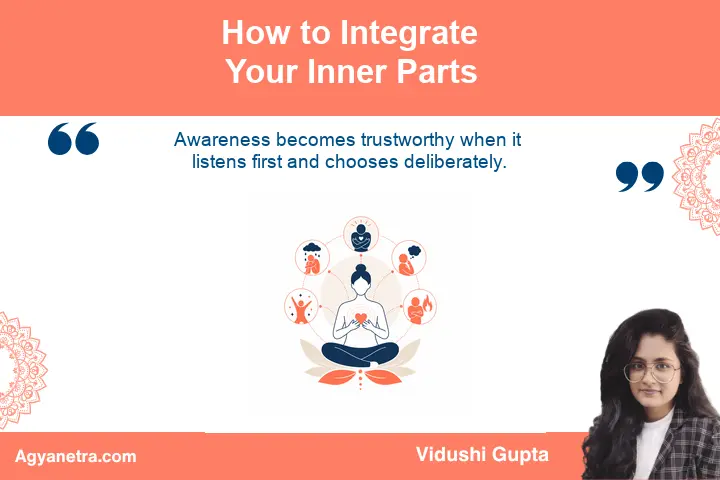
This observing presence is not another controlling voice. It is the calm capacity to notice fear, criticism, longing, anger, and hope while remembering that no single state defines your whole being.
Use the following reflection when a strong inner conflict appears:
- Pause before acting. Take a few unforced breaths and notice where the reaction appears in your body.
- Name the active part. Use simple language such as “a frightened part,” “the achiever,” or “the part that wants approval.”
- Ask what it wants. Its immediate goal may be safety, recognition, rest, control, connection, or dignity.
- Ask what it fears. Let the answer arise without correcting it or demanding that it sound reasonable.
- Acknowledge its intention. You can appreciate its effort to protect you without agreeing with its behavior.
- Respond from the present. Consider what the adult situation actually requires and choose one proportionate action.
For example, if a perfectionistic part insists that your work is not ready, acknowledge its wish to protect you from criticism. Then review the work once using clear standards and submit it, rather than remaining trapped in endless correction.
If a vulnerable part fears abandonment during a disagreement, offer inward reassurance before seeking a calm conversation. The goal is neither to suppress the fear nor to make another person responsible for removing it.
What integration is not
Integration is not giving every impulse permission to act. Anger may carry information about a violated boundary, but awareness still decides how to communicate it responsibly. Fear may request caution without being allowed to cancel every meaningful opportunity.
It is also not a substitute for professional mental health care. If inner experiences involve severe distress, persistent impairment, trauma symptoms, or concerns about safety, support from a qualified mental health professional may be appropriate.
Vidushi Gupta’s spiritually grounded view of inner multiplicity points toward relationship rather than rejection. Every part can be approached with curiosity, while the deeper center of awareness remains responsible for direction.
FAQs
These answers clarify common questions about inner parts, self-awareness, and spiritual integration.
What does The Many Faces Within mean?
The Many Faces Within refers to the different emotional and psychological parts operating inside one person. These may include a protector, critic, wounded child, achiever, caretaker, dreamer, or seeker. Each part has its own concerns, but none represents the complete self.
Is having different inner parts normal?
Yes, experiencing different inner tendencies is a normal part of human life. People commonly hold competing needs for safety, freedom, closeness, achievement, and rest. Recognizing these tendencies as parts can make internal conflict easier to understand, though it should not be used for self-diagnosis.
How can I identify which inner part is active?
Notice repeated thoughts, emotions, bodily tension, and impulses during a difficult moment. Then describe the pattern in neutral language, such as “the part that fears rejection.” Ask what it wants and what it believes it is preventing. The answers often reveal its role.
Is the inner critic always harmful?
The inner critic can cause harm when its language is relentless or degrading, but its underlying intention is often protective. It may believe criticism prevents failure or rejection. Understanding that intention allows you to set limits on harsh self-talk while addressing the fear beneath it.
What is the difference between the wounded child and the false self?
The wounded child carries unresolved emotions connected with earlier pain, while the false self is an adapted identity developed to gain safety, approval, or belonging. The false self may hide the wounded child by emphasizing strength, usefulness, success, or emotional control.
Who is the real self if many parts exist within me?
The deeper self can be understood as the awareness capable of observing and relating to all your inner parts. It is not limited to whichever emotion is strongest. Spiritually, this witnessing presence offers a stable center from which choices can be made with greater clarity.
Can meditation help integrate inner parts?
Yes, gentle meditation can strengthen your ability to observe thoughts and emotions without immediately reacting to them. It works best when it includes compassion and grounded awareness rather than emotional avoidance. Strong trauma reactions may require additional guidance from a qualified professional.
Final Words
The Many Faces Within are not defects that must be removed. They are patterns of protection, vulnerability, longing, strength, and adaptation that become healthier when they are recognized and guided consciously.
The next time an inner conflict appears, pause and ask, “Which part of me is speaking, and what is it trying to protect?” Listen without surrendering your judgment. That simple practice can turn an inner struggle into a relationship shaped by awareness.

Vidushi Gupta is a spiritual coach, energy healer, and emotional wellness counselor with over 10 years of experience guiding people through spiritual signs, emotional healing, and inner transformation. She is the founder of Agyanetra and a published author of nearly ten novels, reaching over 20 million readers worldwide. Her approach is grounded, fear-free, and focused on helping readers understand spiritual experiences with clarity and emotional balance.
Pingback: Listening to the Wounded Parts: A Compassionate Path to Inner Healing
Pingback: Trauma and the Splitting of Consciousness: A Path Back to Inner Wholeness - Agyanetra
Pingback: Becoming Whole: A Practical Path to Inner Integration