
Trauma and the Splitting of Consciousness describes what can happen when an experience is too overwhelming to process while remaining fully present. Instead of failing, the psyche protects itself by separating painful emotions, memories or self-states from ordinary awareness.
This inner division may help a person survive the original experience, but it can later appear as anxiety, emotional numbness, relationship difficulties, shame or a feeling of being disconnected from oneself. Healing begins by recognising these responses as protective adaptations rather than evidence of a damaged identity.
Understanding Trauma and the Splitting of Consciousness
Trauma is not defined only by the external event. It is also shaped by whether the person had enough safety, emotional support and inner capacity to process what occurred.
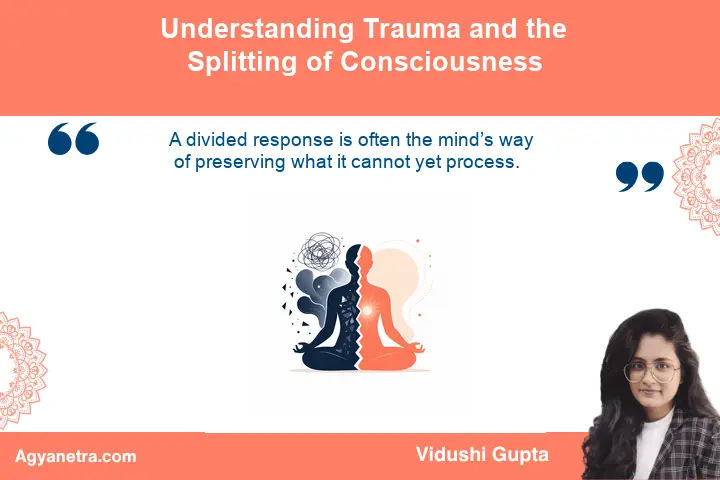
A divided response is often the mind’s way of preserving what it cannot yet process.
War, violence, abuse and serious accidents can be traumatic, but quieter experiences can also leave deep effects. Repeated criticism, emotional neglect, unpredictable caregiving, bullying or being punished for authentic feelings may overwhelm a developing child.
Sometimes the central wound concerns what was missing: comfort after fear, protection during vulnerability, affection without conditions or reassurance that emotions were welcome. The absence of these experiences can shape how a person later understands safety, love and belonging.
Two people may respond differently to similar circumstances because trauma depends on the nervous system’s experience, not only on the visible facts. Age, available support, previous stress and the possibility of escape all influence whether an experience can be integrated.
Trauma Is More Than a Painful Memory
A difficult memory can remain upsetting without dividing conscious experience. Trauma becomes more disruptive when the past continues to organise present reactions as though danger were still active.
A person may intellectually know that a disagreement is manageable while the body reacts with panic, collapse or an urgent need to leave. This difference between present knowledge and embodied alarm helps explain why reasoning alone does not always resolve trauma.
Trauma can influence attention, emotional regulation, self-perception and relationships. It may also make rest, intimacy or uncertainty feel unsafe, even when no immediate threat is present.
This does not mean every uncomfortable feeling is trauma. Disappointment, grief and ordinary stress are part of life. The important question is whether the experience continues to overwhelm the person’s ability to remain connected with the present.
How the Nervous System Holds the Past
The nervous system constantly evaluates safety before the thinking mind has completed its interpretation. When threat is detected, survival becomes more important than reflection, creativity or connection.
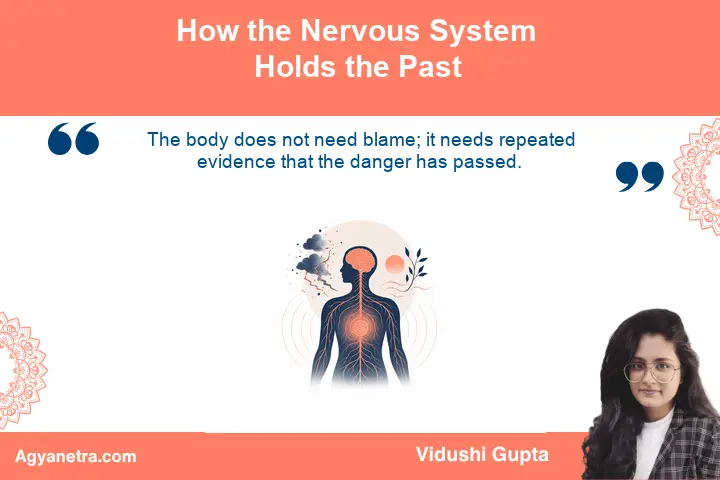
The body does not need blame; it needs repeated evidence that the danger has passed.
Fight, flight, freeze and submission are automatic survival responses. They are not moral weaknesses or deliberate choices. Each response attempts to reduce danger using the resources available in that moment.
Problems arise when these protective reactions remain active after the situation has ended. A neutral facial expression may be read as rejection, feedback may feel like humiliation, and emotional closeness may activate fear rather than comfort.
Because trauma can be carried through physical sensations and automatic reactions, recovery often involves more than analysing the past. Gentle attention to breathing, bodily tension, boundaries and present surroundings can help establish new signals of safety. A broader understanding of nervous system healing can support this process without treating the body as an obstacle.
How Trauma and the Splitting of Consciousness Appear in Daily Life
Splitting does not always feel dramatic. It may appear as a subtle gap between the part of a person that functions publicly and the part that privately carries fear, grief or shame.
One self-state may remain organised, successful and responsible, while another feels helpless or emotionally frozen. Someone may desire intimacy yet withdraw when affection becomes available. Another person may work tirelessly but feel unable to receive appreciation.
Dissociation in psychology includes experiences ranging from emotional detachment to more serious disconnection from memory, bodily experience or surroundings. Experiencing occasional detachment does not by itself establish a dissociative disorder; diagnosis belongs to a qualified mental health professional.
Possible everyday expressions of unresolved trauma include:
- Feeling emotionally numb during conflict or intimacy
- Reacting strongly to criticism, distance or uncertainty
- Losing contact with personal needs while caring for others
- Moving between perfectionism and complete exhaustion
- Feeling younger, smaller or powerless during certain interactions
- Remembering an event vaguely while experiencing strong bodily reactions
These signs have many possible causes and should not be used for self-diagnosis. They are invitations to observe patterns with curiosity and seek appropriate support when distress affects daily life.
Protective Parts Are Not Your Essential Identity
Trauma can make a protective adaptation feel like a fixed personality. A person may say, “I am broken” when the more accurate statement is, “A part of me learned to expect danger.”
The controlling part may be trying to prevent chaos. The perfectionist may believe mistakes lead to rejection. The withdrawn part may be protecting sensitivity, while anger may be guarding pain that once had no safe expression.
Understanding the different inner parts of the psyche does not require treating them as separate people. It is a compassionate way to notice that conflicting needs and emotional states can coexist within one person.
From a spiritual perspective, these adaptations can obscure the experience of inner wholeness without destroying it. Consciousness may be expressed through fear, defence or disconnection, yet the deeper capacity for awareness, love and presence remains available beneath those protective layers.
Why Trauma Patterns Repeat
Unresolved trauma can draw people toward familiar emotional situations. The nervous system may confuse what is familiar with what is safe, even when the familiar pattern is painful.
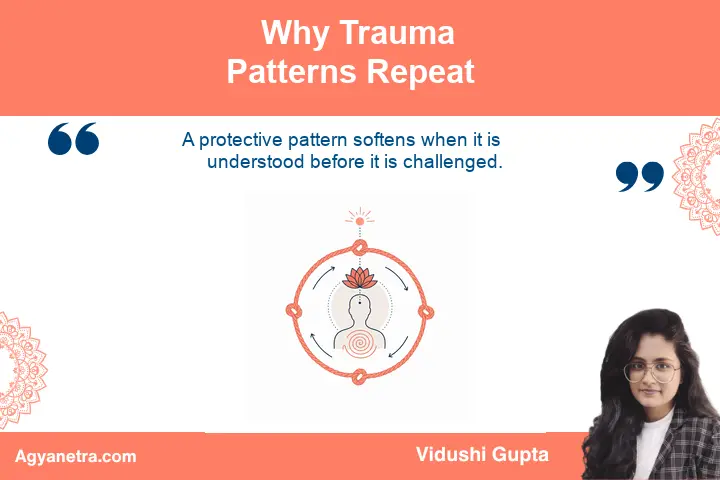
A protective pattern softens when it is understood before it is challenged.
A person raised around emotional unpredictability may feel restless in a calm relationship. Someone who experienced neglect may repeatedly pursue unavailable partners because distance feels recognisable, even while it causes suffering.
Psychology may describe this movement toward unfinished situations as repetition compulsion. Spiritual language sometimes interprets recurring patterns as karma, but this should not be used to blame a person or suggest that suffering was deserved.
Repetition is not fixed destiny. Once a pattern becomes conscious, a person can begin distinguishing attraction from safety, intensity from intimacy and self-abandonment from love. Understanding the difference between a soul connection and a trauma bond may be especially useful when powerful attachment is repeatedly mistaken for spiritual compatibility.
The Inner Battle Between Survival and Higher Awareness
Spiritual growth can feel like an inner conflict when survival responses are strong. Compassion, trust and creativity may still be present, but fear and control often speak with greater urgency.
The symbolic battles between devas and asuras in Hindu mythology offer a useful psychological image. Devas can represent harmony, courage and wisdom, while asuras can represent forces shaped by attachment, pride, fear and the drive to survive.
This symbolism should not turn wounded parts into inner enemies. Fear, anger and control may be disruptive, but they often developed in an attempt to preserve life or dignity. Healing is therefore not a campaign to destroy the “dark” parts of oneself.
The deeper task is to restore balance. Survival responses can be acknowledged without being allowed to govern every choice. Higher awareness becomes embodied when compassion includes the frightened, defensive and exiled aspects of the self.

Finding Wholeness in a Fractured World
Integration explores inner fragmentation, emotional healing, shadow work, self-awareness and the journey towards inner wholeness. It is written for readers who want to understand themselves more deeply and bring spiritual awareness into everyday life.
A Grounded Path Toward Integration
Integration means building enough safety for separated emotions, memories and needs to enter awareness without overwhelming the whole system. It is usually gradual rather than dramatic.
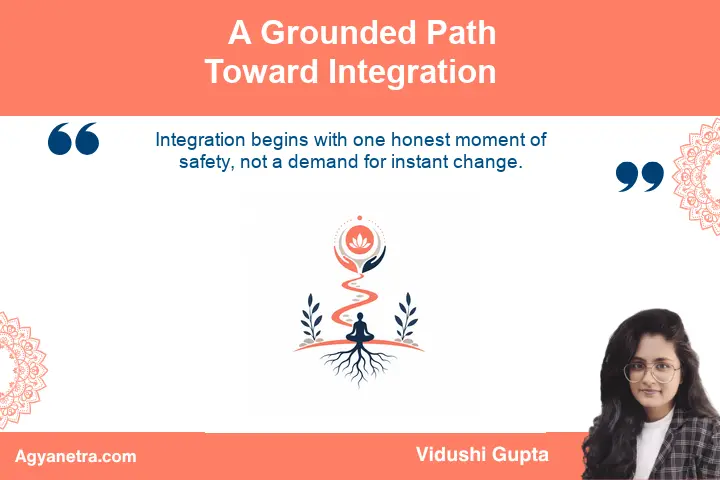
Integration begins with one honest moment of safety, not a demand for instant change.
Begin by replacing self-judgment with accurate observation. Instead of asking, “What is wrong with me?” try asking, “What might this reaction be protecting, and what does my body need right now?”
Useful practices may include:
- Orient to the present. Notice the date, your location and several neutral objects around you. This can help distinguish current surroundings from an earlier emotional state.
- Name the response. Quietly identify whether you feel activated, frozen, disconnected or eager to please. Naming a state creates a small space between awareness and reaction.
- Offer simple reassurance. Use believable words such as, “I am here, and I can pause before deciding.” Avoid forcing positive statements that the body cannot yet accept.
- Respect boundaries. Reduce exposure to relationships or situations that repeatedly violate emotional or physical safety. Compassion does not require continued access for harmful behaviour.
- Invite safe support. A trauma-informed therapist or qualified mental health professional can help when memories, dissociation or intense reactions are difficult to manage alone.
Inner-child reflection can also help a person recognise needs that were previously ignored. Guidance on identifying and healing inner-child wounds can provide language for these younger emotional states without turning every adult difficulty into a childhood explanation.
Spiritual practices can support integration when they increase presence, honesty and compassion. Meditation should not become a way to suppress grief, deny anger or rise above legitimate needs. If silent practice intensifies distress or disconnection, shorter grounding practices and professional support may be more appropriate.
What Healing Does and Does Not Mean
Healing does not require erasing the past or becoming unaffected by every trigger. It means developing more freedom to respond from the present rather than automatically repeating an old survival strategy.
Integration also does not mean that every part must feel the same. Healthy consciousness can hold sadness, strength, fear and hope without exiling any of them. The aim is communication and cooperation within the self, not emotional uniformity.
There may be periods of progress followed by renewed sensitivity. This does not necessarily mean healing has failed. New layers often become visible only after enough stability has developed to meet them.
The spiritual heart of recovery is the recognition that a wounded experience is not a wounded essence. Exploring the inner wholeness beneath conditioning can help separate the truth of one’s being from the strategies learned during danger.
FAQs
What does the splitting of consciousness mean in trauma?
It means aspects of an overwhelming experience may become separated from ordinary awareness so the person can continue functioning. Emotions, memories, bodily sensations or self-states may feel disconnected from one another. This is a protective response, although it can create difficulties when the separation continues after danger has passed.
Is the splitting of consciousness the same as dissociative identity disorder?
No. Splitting of conscious experience is a broad description and does not automatically mean dissociative identity disorder. Dissociation exists across a wide range of experiences, from temporary detachment to clinically significant conditions. Only a qualified mental health professional can assess symptoms and determine whether a diagnosis is appropriate.
Can emotional neglect cause trauma?
Yes, repeated emotional neglect can be traumatic, especially during childhood when safety and regulation depend heavily on caregivers. A lack of comfort, consistent attention or acceptance may teach the nervous system that needs are unsafe or unimportant. The effect depends on intensity, duration, developmental stage and available support.
Why does trauma make safe relationships feel uncomfortable?
Safe relationships may feel unfamiliar when the nervous system learned to associate love with criticism, unpredictability or distance. Calmness can then be misread as emptiness, while emotional intensity feels recognisable. With awareness, stable boundaries and repeated experiences of respectful connection, familiarity can gradually become aligned with genuine safety.
Can meditation heal trauma-related fragmentation?
Meditation may support awareness and emotional regulation, but it is not a guaranteed or complete treatment for trauma. Some forms of meditation can intensify distress or disconnection in vulnerable people. Grounding, shorter practices and guidance from a trauma-informed professional may be safer than prolonged silent observation when symptoms are strong.
How can I reconnect with an exiled part of myself?
Begin by noticing the emotion or need without forcing a memory to appear. Acknowledge the part with simple compassion, ask what it is protecting and respond with a realistic form of present-day care. If this process brings overwhelming sensations, memory gaps or severe distress, continue with qualified therapeutic support.
Does trauma permanently damage the soul?
No spiritual conclusion requires viewing the soul as permanently damaged. Trauma can strongly affect behaviour, self-perception, relationships and the felt experience of consciousness, but these adaptations are not the totality of a person. Recovery focuses on restoring safety and connection so deeper qualities can be expressed more freely.
Final Words
Trauma and the Splitting of Consciousness can be understood as a survival response rather than proof that the self is fundamentally broken. What became divided under pressure can gradually reconnect through safety, compassionate awareness and appropriate support.
As a next step, notice one recurring reaction without trying to eliminate it. Name what happens in your body, identify what the response may be protecting, and choose one small action that communicates safety in the present.
Wholeness is not created by rejecting wounded parts. It becomes visible as each part is met with enough patience to return from survival into relationship with the whole self.

Pingback: The Body as a Temple of Consciousness: A Practical Path to Embodiment