
Becoming Whole is the practice of ending the divisions within yourself, so your thoughts, emotions, body, and deeper values can work together. It does not require a flawless personality. It begins when you stop abandoning the parts of yourself that feel afraid, wounded, angry, ashamed, or difficult to accept.
Many people approach healing as a self-improvement project. They try to remove uncomfortable emotions, silence the ego, overcome vulnerability, or construct a more spiritual identity.
Inner integration follows another direction. Instead of asking which parts must disappear, it asks what each part needs in order to return to a healthy place within the whole.
This approach does not excuse destructive behavior. It helps you understand its inner roots, take responsibility, and respond from awareness rather than unconscious reaction.
What Becoming Whole Really Means
Wholeness is an inner relationship in which no essential part of your humanity is denied.
You become whole by bringing excluded parts into compassionate awareness, not by creating a perfect self.
Your fear, grief, anger, tenderness, strength, and uncertainty all carry information. Problems arise when one state controls your life or when you exile a feeling because it conflicts with the person you believe you should be.
Integration allows these experiences to be seen without making them your entire identity. You can notice fear without becoming only fearful, or feel anger without letting anger choose your actions.
This distinction creates space. Awareness becomes large enough to hold an experience, understand its message, and decide how to respond.
The process often feels less like acquiring something new and more like remembering what exists beneath conditioning. Exploring the self beneath learned identities can help clarify why wholeness is uncovered rather than manufactured.
Wholeness Is Different From Perfection
Perfection measures life against an imagined standard, while wholeness meets life as it is and responds consciously.
Perfection rejects what does not fit the ideal; wholeness gives every truthful experience an appropriate place.
The pursuit of perfection can look admirable, but it often depends on constant self-correction. There is always another weakness to hide, achievement to reach, or spiritual state to maintain.
Wholeness does not mean settling for harmful habits. It means that growth begins with honest contact rather than shame. You can change a pattern without treating the person who developed it as unworthy.
Consider a natural landscape. Its beauty does not depend on permanent sunshine or untouched surfaces. Growth, decay, open ground, dense vegetation, and changing weather all belong to one living system.
Human life also contains contrasts. Confidence may exist beside uncertainty, and gratitude may accompany grief. Inner maturity lets these realities coexist without demanding that one cancel the other.
Ask yourself, Am I trying to understand this part of me, or am I trying to prove that it should not exist? That question often reveals whether healing is being guided by compassion or perfectionism.

Finding Wholeness in a Fractured World
Integration explores inner fragmentation, emotional healing, shadow work, self-awareness and the journey towards inner wholeness. It is written for readers who want to understand themselves more deeply and bring spiritual awareness into everyday life.
Listening to the Inner Parts
A difficult inner voice often becomes less controlling when its fear, need, and protective purpose are understood.
The inner world is rarely one single voice. It may include a critic demanding better performance, a frightened child expecting rejection, a protector watching for danger, and a people-pleaser trying to preserve connection.
These parts can create suffering, but they are not necessarily enemies. A harsh critic may have learned that mistakes invite humiliation. Anger may be protecting a violated boundary, while constant agreement may once have helped maintain safety.
Understanding a protective purpose does not mean obeying every impulse. It allows you to address the vulnerable need beneath the behavior instead of fighting only its visible expression.
If you want to recognize these patterns more clearly, the exploration of the many inner parts offers a useful foundation for observing their different roles.
A simple way to meet an activated part
- Pause before reacting, especially when the emotional intensity feels larger than the present situation.
- Name what is present in neutral language, such as fear, defensiveness, anger, shame, or the urge to please.
- Ask what this response is trying to prevent or protect.
- Acknowledge its intention without automatically following its strategy.
- Choose an action that respects both the underlying need and present-day reality.
Over time, this practice changes the inner atmosphere. The critic can become discerning rather than cruel, the protector can become alert without remaining tense, and anger can support clear boundaries without causing harm.
How Integration Ends the Inner War
Inner conflict consumes energy because different parts pull toward competing forms of safety.
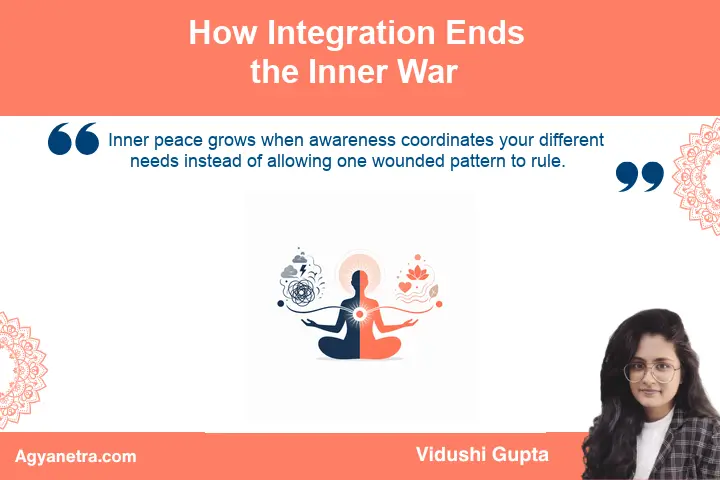
Inner peace grows when awareness coordinates your different needs instead of allowing one wounded pattern to rule.
One part may seek closeness while another fears being hurt. You may long to speak honestly yet feel compelled to preserve approval. Such contradictions do not make you false; they show that different needs have not yet learned to cooperate.
Awareness can serve as a steady center. It listens to each voice without handing complete control to any one of them.
This is similar to an orchestra. Distinct instruments do not need to sound identical, but they do need timing, proportion, and shared direction. Inner harmony also comes through coordination rather than sameness.
The capacity to observe experience without immediately identifying with it is important here. Practising the witnessing perspective can help you notice a reaction while retaining the freedom to choose your next step.
As cooperation grows, less energy is spent maintaining masks, suppressing feelings, or defending an idealized identity. That energy becomes available for honest relationships, creativity, meaningful work, rest, and service.
Bringing Spirit Into the Body and Daily Life
Integration becomes real when spiritual awareness shapes how you speak, work, rest, relate, and care for the body.
Spiritual insight remains incomplete when it exists only during meditation or reflection. Wholeness asks whether your inner understanding can enter ordinary choices.
This includes listening when the body signals exhaustion, speaking truth without unnecessary aggression, and remaining present during discomfort. It also includes repairing harm rather than using spiritual language to avoid accountability.
The body is not an obstacle to consciousness. Sensations often reveal what the thinking mind has minimized: a tight chest around fear, a clenched jaw around anger, or heaviness after repeatedly crossing a personal limit.
Embodiment means receiving those signals with curiosity. It may lead to slower breathing, a direct conversation, appropriate rest, grief support, or help from a qualified mental health professional when distress is persistent.
Integration also softens false divisions between sacred and ordinary life. Preparing food, earning a living, caring for someone, creating art, and keeping a promise can all express spiritual presence.
The balance of stillness and action echoes the deeper relationship explored through Shiva and Shakti in spiritual life: awareness is not separate from the living energy through which it acts.
The Ordinary Shape of Enlightenment
Enlightenment can be understood practically as a gradual freedom from unconscious division and resistance.
Spiritual awakening does not remove human experience; it changes your relationship with what arises.
A whole person can still experience sadness, uncertainty, physical pain, disappointment, and loss. Integration does not promise constant bliss or immunity from changing circumstances.
The difference is that an emotion no longer has to become a fixed identity. Sadness can move without proving that life is meaningless. Fear can be heard without being treated as a prophecy.
This freedom is often quiet. It appears as presence during a difficult conversation, the ability to apologize, or the willingness to feel grief without immediately escaping into distraction.
Vidushi Gupta’s framing of integration is especially useful here: spiritual realization becomes humanly meaningful when awareness reaches the places we previously rejected. Inner division diminishes as more of life is met consciously.
Such awakening is less about appearing extraordinary and more about becoming congruent. Thoughts, values, words, and actions increasingly point in the same direction.
A Practical Path Toward Wholeness
The path becomes manageable when you practise small acts of honest inclusion instead of waiting for one final breakthrough.
Becoming whole is rarely a single event. It is a repeated choice to remain present with yourself while responding responsibly to life.
1. Notice your language of rejection
Pay attention to phrases such as I should not feel this or This part of me is unacceptable. Replace them with a more accurate question: What is this experience asking me to notice?
2. Separate feeling from action
Every emotion can be acknowledged, but not every impulse should be acted upon. You can validate anger while choosing not to attack, or honor fear while taking a necessary step carefully.
3. Include the body
Before analyzing a reaction, locate it physically. Describe the sensation without judgment, breathe steadily, and allow enough time for the nervous system to settle before making an important decision.
4. Offer the younger self what was missing
If a reaction carries helplessness, abandonment, or intense shame, imagine addressing the younger part with protection and steadiness. Offer a simple message such as, You are not facing this alone now.
5. Give each part a healthier role
Do not merely tell the critic or protector to disappear. Invite the critic to support wise evaluation, the protector to identify real boundaries, and the people-pleaser to value connection without self-erasure.
6. Practise alignment
At the end of the day, ask whether your words, actions, body, and deeper values moved together. Choose one small correction for tomorrow rather than turning reflection into another form of punishment.
7. Let healing become relational
Wholeness is tested and strengthened through relationships. Practise receiving care, stating needs, tolerating respectful disagreement, and making repairs when your protective patterns affect another person.
These steps are not a demand to fix yourself quickly. They create a patient structure through which excluded experiences can return to awareness without overwhelming the whole system.
Wholeness Naturally Becomes Service
The inner journey matures when the compassion discovered within becomes available to other people.
Personal healing is important, but it does not end with private relief. A person who is less divided can listen without immediately defending, offer care without controlling, and act without needing constant recognition.
This is the return that completes the inner journey. The wisdom gained through fear, grief, shadow, and self-understanding becomes useful in family life, community, creative work, and service.
You do not need to become a teacher or spiritual authority. Your contribution may be the steadiness you bring to a tense room, the dignity with which you treat another person, or the honesty that makes a relationship safer.
The healed heart does not become invulnerable. It becomes available—able to remain open while using boundaries, discernment, and grounded action.
Final Words
Becoming Whole does not mean that every problem has been solved. It means you no longer divide yourself into acceptable and unacceptable pieces in order to deserve peace.
The fearful part can be reassured, the wounded part can receive care, and the protective part can rest when danger has passed. The ego can support daily life without becoming the center of identity.
Wholeness was never a distant prize reserved for a perfected future self. It becomes visible whenever you meet your humanity with awareness, take responsibility for your choices, and refuse to abandon what needs compassionate attention.
The deepest homecoming is not an escape from life. It is the willingness to inhabit your life completely, with every part gathered around a wiser and more loving center.
FAQs
What does Becoming Whole mean spiritually?
It means bringing your emotions, body, thoughts, values, and inner parts into a more conscious relationship. Nothing essential is rejected, but every part is guided toward a healthy role.
Is becoming whole the same as becoming perfect?
No. Perfection depends on meeting an ideal, while wholeness depends on honest self-acceptance, responsibility, and integration. You can be whole while still learning and healing.
How do I begin integrating rejected parts of myself?
Start by noticing a strong reaction without judging it. Name the emotion, ask what it is trying to protect, and choose a response that respects the need without automatically following the impulse.
Does wholeness mean accepting harmful behavior?
No. You can understand the fear or wound beneath a behavior while still setting boundaries, taking responsibility, repairing harm, and choosing a healthier action.
Can a whole person still experience fear, grief, or anger?
Yes. Wholeness does not remove normal human emotions. It allows emotions to be felt and understood without letting them become permanent identities or unconscious commands.
How is becoming whole connected to enlightenment?
Integration reduces unconscious inner division. As rejected experiences enter awareness, a person gains greater freedom, presence, integrity, and the ability to respond consciously.
How long does the process of becoming whole take?
There is no fixed timeline. Integration usually unfolds through repeated moments of awareness, self-compassion, responsible action, relational repair, and support when deeper wounds need professional care.

Vidushi Gupta is a spiritual coach, energy healer, and emotional wellness counselor with over 10 years of experience guiding people through spiritual signs, emotional healing, and inner transformation. She is the founder of Agyanetra and a published author of nearly ten novels, reaching over 20 million readers worldwide. Her approach is grounded, fear-free, and focused on helping readers understand spiritual experiences with clarity and emotional balance.