
Karma as Unintegrated Experience offers a compassionate way to understand why certain emotions, conflicts, and relationship patterns keep returning. Instead of treating hardship as cosmic punishment, this perspective invites us to notice what remains unresolved within us and meet it with awareness.
Karma literally refers to action, but an action does not always end when the visible event is over. It can leave an emotional impression that continues to influence perception, identity, and behavior.
When that impression is understood and integrated, repetition can give way to choice. The aim is not to erase the past, but to stop letting the past unconsciously direct the present.
What Is Karma as Unintegrated Experience?
In this understanding, karma includes the inner residue of experiences that were never fully felt, understood, or accepted.
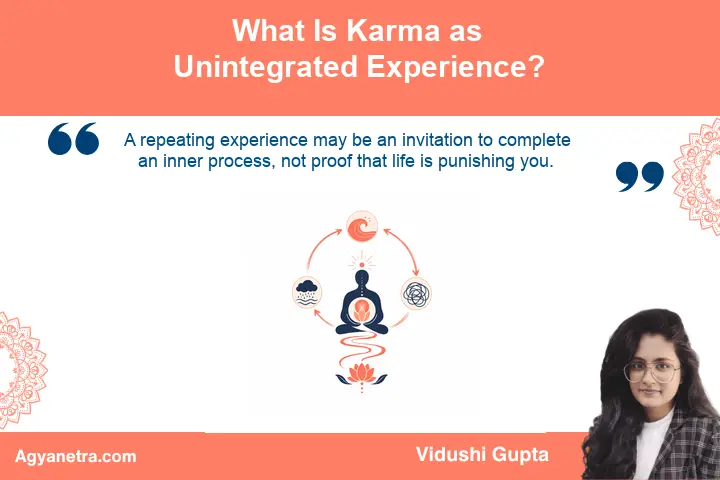
A repeating experience may be an invitation to complete an inner process, not proof that life is punishing you.
An experience can be externally finished while remaining psychologically active. A relationship may have ended years ago, yet the fear, shame, anger, or longing connected with it may still shape new relationships.
The unfinished element is not necessarily the event itself. It may be an emotion that could not be safely expressed, a truth that was denied, or a need that was never acknowledged.
This is why changing circumstances does not always change the pattern. A person may find a new partner, workplace, or community while carrying the same expectations and protective reactions into the new setting.
Seeing karma in this way removes the language of condemnation. The pattern is not evidence that someone deserves pain. It is a sign that part of the inner experience still needs conscious attention.
How Experience Becomes a Karmic Pattern
What is repeatedly thought, felt, and enacted gradually becomes the lens through which life is interpreted.
Yogic philosophy uses the word samskara for an impression left in consciousness. Some impressions fade naturally, while others become stronger through repetition and emotional intensity.
Psychological conditioning describes a similar process. Repeated beliefs become familiar mental pathways, repeated emotions become habitual states, and repeated reactions begin to feel like fixed personality traits.
For example, a child who regularly feels ignored may form the belief that their needs do not matter. As an adult, that person may remain silent, over-accommodate others, or feel hurt when people fail to notice needs that were never expressed.
Each new disappointment then appears to confirm the original belief. The reaction creates consequences that strengthen the pattern, even though the present situation may not be identical to the past.
Karma therefore operates through momentum. An old impression influences perception, perception shapes response, and the response produces another experience that reinforces the impression.
How to Recognize an Unfinished Emotional Loop
Emotional repetition becomes easier to understand when you examine the sequence between an event and your response.
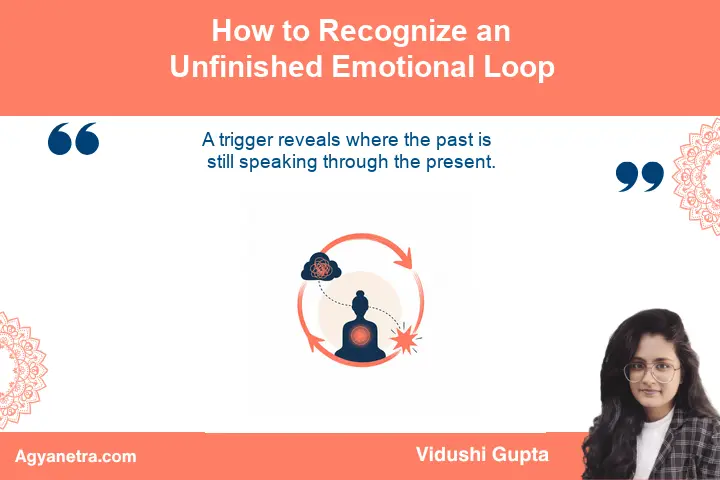
A trigger reveals where the past is still speaking through the present.
A common loop begins with an ordinary event. That event activates an old belief, the belief produces a strong emotion, and the emotion drives a familiar protective behavior.
Suppose a colleague receives praise. If this awakens the belief “I am not good enough,” shame or comparison may arise. The person may withdraw, resent the colleague, dismiss the praise, or work compulsively to prove their worth.
The colleague did not create the original wound. The event simply exposed an impression that was already present.
Signs of an unfinished loop can include reactions that feel larger than the situation, recurring conflicts with different people, repeated fear of rejection, and a sense that the same story follows you everywhere.
When these reactions are rooted in early neglect, criticism, or abandonment, learning about the signs of inner child wounds and how to heal them can provide a practical starting point.
Recognition does not mean blaming yourself for the pattern. It means becoming curious about what the reaction protects and what the activated part of you actually needs.

Finding Wholeness in a Fractured World
Integration explores inner fragmentation, emotional healing, shadow work, self-awareness and the journey towards inner wholeness. It is written for readers who want to understand themselves more deeply and bring spiritual awareness into everyday life.
Inherited Karma and Family Conditioning
Healing an inherited pattern means becoming conscious enough that it no longer passes through you automatically.
Not every pattern begins with a personal decision. Families transmit emotional habits, beliefs, coping strategies, and relationship dynamics alongside their cultural and material inheritance.
A child raised around constant anxiety may learn to scan for danger. A family shaped by scarcity may pass down fear around money, while a home that avoids affection may teach children to hide tenderness.
These lessons are often communicated through atmosphere and behavior rather than direct instruction. The child adapts to belong and remain safe, then carries the adaptation into adulthood.
Spiritual traditions may interpret inherited karma across generations or lifetimes. Psychologically, the essential point remains practical: we can receive unfinished stories that did not originate with us.
The purpose of awareness is not to accuse parents or ancestors. It is to understand the conditions that formed the pattern and take responsibility for what happens next.
Practices such as shadow work for beginners can help bring disowned fears, needs, and protective responses into compassionate awareness.
Why Karma Is Momentum, Not Fate
A karmic pattern may be powerful, but it is not necessarily a permanent destiny.
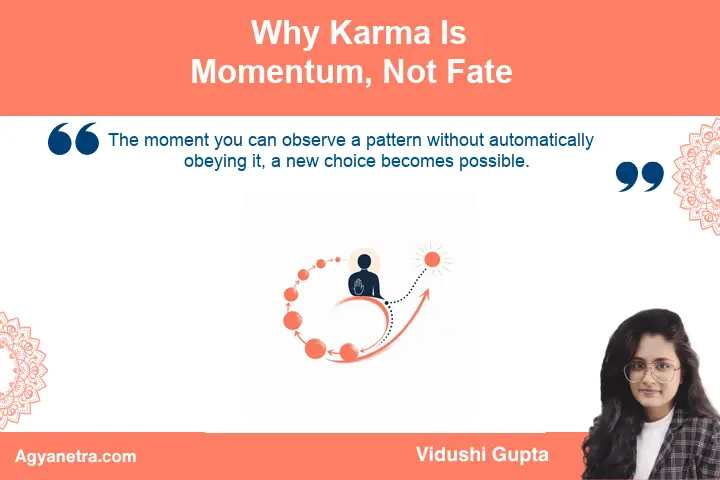
The moment you can observe a pattern without automatically obeying it, a new choice becomes possible.
Momentum explains why a habit continues even after we understand that it causes suffering. Familiar thoughts and reactions move along established paths unless something interrupts them.
Without awareness, this momentum can feel like fate. The same conflict, fear, or disappointment appears so often that it seems predetermined.
Awareness creates a pause between activation and action. Within that pause, you can notice bodily sensations, name the emotion, question the old belief, and decide whether the usual response is appropriate now.
This does not mean every external difficulty is created by an inner pattern. People face real loss, injustice, illness, and circumstances beyond personal control.
The inner-work perspective focuses on the part where choice is available: how the experience is processed, what meaning is assigned to it, and whether it becomes another unconscious cycle.
Karma becomes less like a sentence and more like an invitation. The recurring situation shows where greater freedom, understanding, or responsibility can be developed.
Why the Ego Holds On to Familiar Pain
A painful identity can feel safer than an unfamiliar freedom because the ego knows how to survive inside what is predictable.
People do not usually repeat suffering because they consciously want it. They repeat what is familiar because familiarity can feel safer than uncertainty.
A person identified as the overlooked one may distrust genuine attention. Someone who believes worth must be earned may feel restless when not achieving, fixing, or proving something.
Every persistent pattern is often supported by an identity: the victim, the rescuer, the achiever, the rejected one, or the person who must always remain in control.
As the pattern loosens, the familiar identity also begins to change. This can produce grief, confusion, or fear, even when the transformation is healthy.
Integration asks a deeper question: “Who am I when I no longer organize my life around this wound?” Exploring the self beneath conditioning can support this transition without replacing one rigid identity with another.
The goal is not to attack the ego. Its strategies were often formed for protection. Healing begins when those strategies are appreciated for their past purpose without allowing them to govern the future.
How to Integrate an Unfinished Experience
Integration means allowing an experience to be consciously felt, understood, and placed within a larger life story.
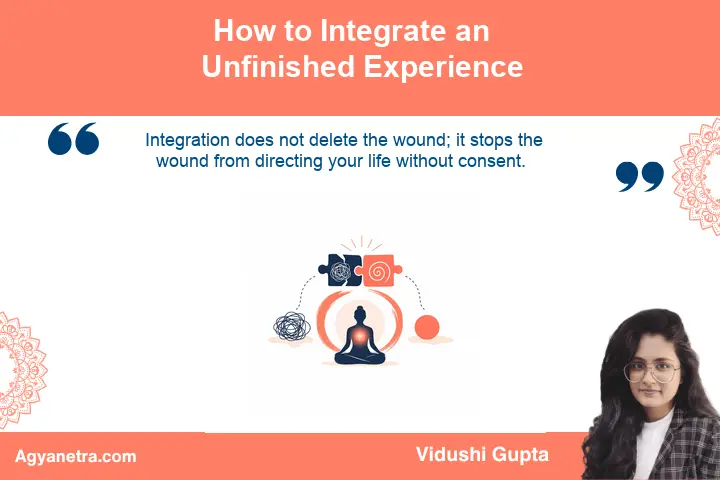
Integration does not delete the wound; it stops the wound from directing your life without consent.
This work should be gentle. Forcing yourself to relive overwhelming experiences can increase distress, so move slowly and seek qualified professional support when trauma feels unmanageable.
- Notice the repetition. Identify the situation, emotion, or relationship dynamic that keeps returning.
- Pause before reacting. Feel your feet, soften your breathing, and give the nervous system time to settle.
- Name what is present. Use specific words such as shame, grief, envy, fear, anger, or loneliness.
- Find the underlying belief. Ask what the reaction seems to say about your safety, worth, belonging, or ability to be loved.
- Separate past from present. Consider how the current event resembles an earlier experience and how it is genuinely different.
- Offer the missing response. This may involve self-compassion, a boundary, honest expression, rest, grief, or asking for support.
- Choose one new action. Respond in a way that reflects present awareness rather than the old protective script.
Integration is rarely a single breakthrough. It is usually a series of small moments in which the emotion is welcomed without being allowed to control behavior.
Over time, the memory may remain while losing its power to define identity. Energy once consumed by vigilance, resentment, or compulsive repetition becomes available for relationship, creativity, and service.
From Karmic Reaction to Dharmic Action
Karma reacts from accumulated conditioning; dharma responds from awareness of what this moment truly requires.
Dharma is often translated as duty, but here it can be understood as conscious expression. It appears when action is less distorted by unresolved fear, shame, or compulsion.
If an insult immediately activates an old wound and produces automatic retaliation, the past is directing the present. If you notice the wound, steady yourself, and choose a wise response, awareness has interrupted the cycle.
This does not require passivity. A dharmic response may be compassionate, firm, silent, honest, or boundaried. What matters is that it arises from clarity rather than unconscious repetition.
The relationship between action and spiritual development is also explored through Karma Yoga and Gyana Yoga, which approach growth through selfless action and knowledge.
Psychologically, every repeating pattern is a small wheel of birth and return: the belief appears, the emotion rises, the reaction follows, and the result strengthens the belief.
Liberation begins when awareness witnesses the cycle without becoming completely identified with it. Life continues, but the same experience no longer has to produce the same response.
FAQs
What does Karma as Unintegrated Experience mean?
It means unresolved emotions, beliefs, and wounds can continue influencing present choices until they are consciously felt, understood, and integrated.
Is every difficult experience caused by karma?
No. Hardship can arise from many personal, social, physical, and external causes, and it should not automatically be interpreted as punishment or personal fault.
How do I know whether a pattern is karmic?
Look for recurring emotional reactions, relationship dynamics, beliefs, or consequences that continue despite changes in people, places, and circumstances.
Can awareness alone dissolve karma?
Awareness begins the process, but lasting change usually also requires emotional processing, compassionate understanding, new choices, and consistent practice.
What is the difference between karma and fate?
Fate suggests a fixed outcome, while karma can be understood as accumulated momentum that awareness and conscious action may redirect.
Can family patterns be a form of karma?
Yes. Inherited beliefs, fears, coping habits, and relationship styles can function as karmic patterns when they continue unconsciously across generations.
Does integrating karma erase the past?
No. Integration preserves the truth of what happened while reducing its unconscious authority over your identity, relationships, and decisions.
Final Words
Karma as unintegrated experience is not a doctrine of blame. It is a practical invitation to recognize what remains unfinished, meet it with compassion, and choose from present awareness.\
As old patterns lose their authority, dharma can emerge naturally as the expression of a life no longer ruled by unconscious repetition.

Vidushi Gupta is a spiritual coach, energy healer, and emotional wellness counselor with over 10 years of experience guiding people through spiritual signs, emotional healing, and inner transformation. She is the founder of Agyanetra and a published author of nearly ten novels, reaching over 20 million readers worldwide. Her approach is grounded, fear-free, and focused on helping readers understand spiritual experiences with clarity and emotional balance.
Pingback: Soul Dharma versus Karma: Moving From Repetition to Conscious Living