
Soul Dharma versus Karma describes the inner shift from living through inherited patterns to acting from the truth of the soul. Karma carries yesterday’s reactions into today, while dharma allows awareness, integrity, and purpose to guide the next step.
This distinction is not simply about good deeds earning rewards or wrong actions bringing punishment. It is also a practical way to understand why certain fears, relationships, and conflicts keep repeating.
As these patterns become conscious, you gain space to respond differently. The past may still influence you, but it no longer has to make every decision for you.
What Soul Dharma versus Karma Really Means
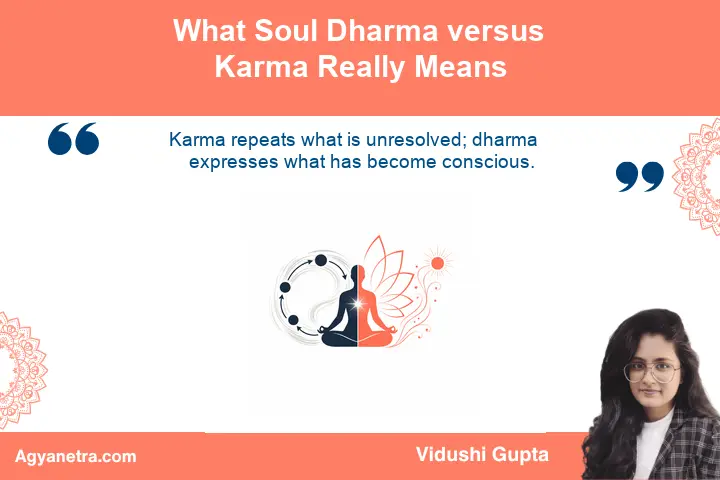
Karma repeats what is unresolved; dharma expresses what has become conscious.
Karma traditionally refers to action and its consequences. Psychologically, it can also be understood as momentum created by repeated thoughts, emotional reactions, beliefs, and choices.
Dharma is a broad spiritual concept connected with truth, responsibility, right conduct, and the sustaining order of life. At a personal level, it points toward living in alignment with your deepest nature.
Karma tends to operate automatically. Dharma requires participation: you notice what is arising, discern what is true, and choose an action that reflects your values rather than your conditioning.
The difference is therefore not between a “bad” past and a “good” future. It is between unconscious repetition and conscious expression.
How Karma Becomes Psychological Momentum
A pattern feels like fate when its hidden origin has not yet been seen.
Every repeated experience leaves a trace. If a child receives affection only after achieving something, that child may grow into an adult who connects worth with performance.
Someone who experienced rejection may anticipate rejection in neutral situations. Someone raised around instability may feel strangely familiar with chaotic relationships, even while consciously longing for peace.
Such patterns may appear as beliefs, bodily tension, attachment habits, defensive strategies, or automatic emotional reactions. They can begin as intelligent attempts to stay safe, yet later restrict the person they once protected.
This is why recurring experiences should not automatically be viewed as cosmic punishment. They may reveal an unresolved inner structure seeking recognition and integration.
The deeper relationship between memory, fragmentation, and repetition is explored further in Karma as Unintegrated Experience.
Awareness interrupts momentum. Once you can observe a pattern without immediately obeying it, what seemed inevitable becomes workable.
Dharma as the Natural Expression of the Soul
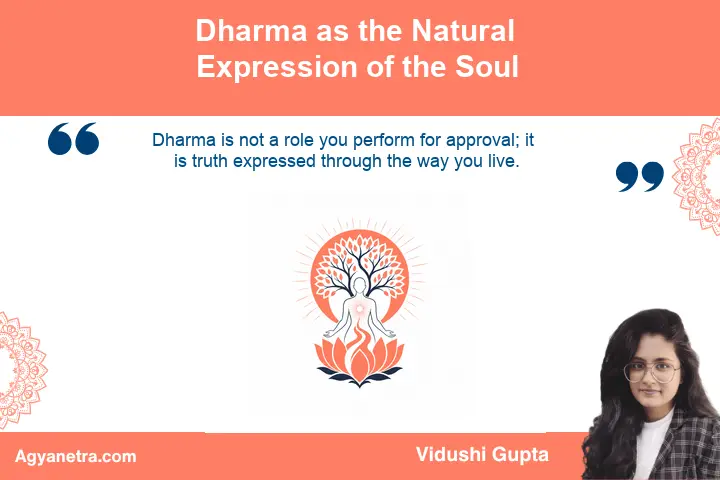
Dharma is not a role you perform for approval; it is truth expressed through the way you live.
Many people search for dharma as though it were one perfect career, mission, or spiritual identity. This can create anxiety because every decision begins to feel permanent and spiritually loaded.
Your work may become a vehicle for dharma, but dharma is deeper than an occupation. It is the quality of consciousness you bring to teaching, parenting, creating, healing, farming, leading, serving, or learning.
You live closer to dharma when honesty becomes more important than image, service matters more than recognition, and love is no longer exchanged merely for approval.
This does not require becoming extraordinary. It means allowing ordinary actions to reflect what is most sincere, responsible, and life-giving within you.
As described in The Soul Behind the Story, identity becomes clearer when you stop confusing your conditioned narrative with the whole of who you are.
Reaction and Response Reveal the Difference
Reaction carries the past into the moment; response meets the moment with awareness.
Imagine that someone criticizes you. An old pattern may immediately defend, attack, withdraw, please the other person, or collapse into shame.
Dharma begins with a pause. That pause does not guarantee a gentle answer, nor does it require tolerating disrespect. It creates enough space to discern what is actually happening.
You may realize that the criticism is useful, partly true, manipulative, or entirely misplaced. Instead of letting an old wound decide, you choose the clearest and most responsible response available.
This capacity depends on the inner witness—the awareness that can notice thoughts, sensations, and impulses without becoming identical to them.
Freedom Does Not Mean Erasing Conditioning
Inner freedom begins when an emotion can be felt without being given complete authority.
Spiritual maturity does not remove every trace of fear, anger, grief, or insecurity. Human emotions may continue to arise even after significant healing.
The essential change is that these states no longer rule automatically. Fear can offer information without making the decision. Anger can identify a violated boundary without becoming cruelty.
Integration, as developed in Vidushi Gupta’s work, supports this grounded form of freedom. The aim is not to reject personal history but to hold it consciously, learn from it, and stop living inside it.
Your past then becomes a source of understanding rather than a fixed identity. You carry your history, but it does not carry you into the same choice every time.
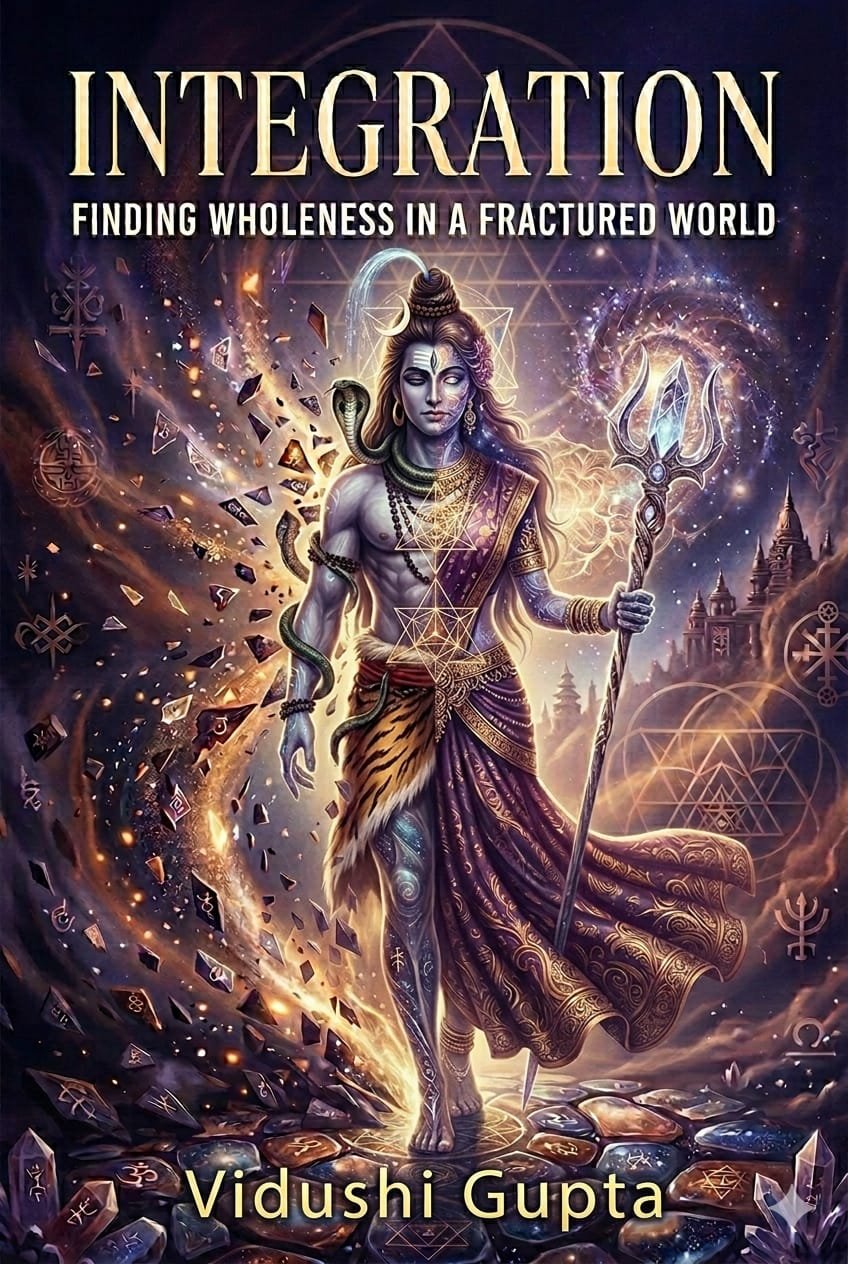
Finding Wholeness in a Fractured World
Integration explores inner fragmentation, emotional healing, shadow work, self-awareness and the journey towards inner wholeness. It is written for readers who want to understand themselves more deeply and bring spiritual awareness into everyday life.
Destiny, Tendencies, and the Power of Choice
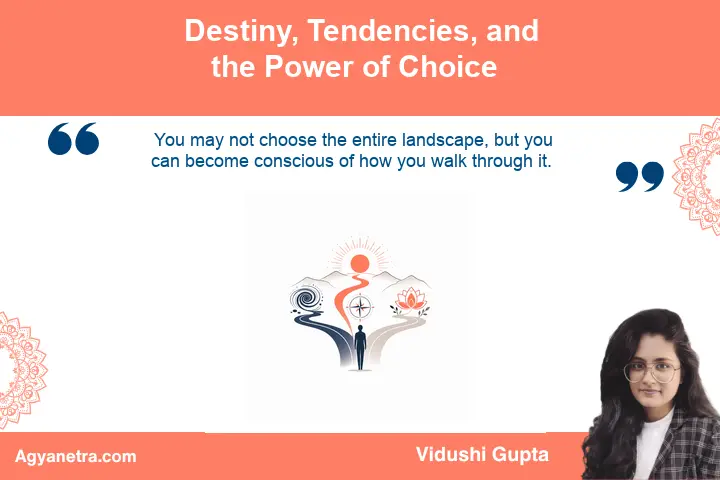
You may not choose the entire landscape, but you can become conscious of how you walk through it.
Some parts of life arrive without permission: family conditions, cultural influences, physical limitations, losses, opportunities, and unexpected challenges. These form part of the field in which your life unfolds.
Choice still exists within that field. You can examine an inherited belief, repair a harmful response, ask for support, establish a boundary, or refuse to pass an old pattern to the next generation.
Karma creates tendencies rather than removing all possibility. A tendency may be strong, but awareness introduces another direction.
Dharma does not promise control over every outcome. It gives you a conscious relationship with the action that is yours to take.
Learning to recognize quiet inner guidance can help with this discernment. Intuition and Soul Alignment Meaning offers additional context for separating grounded guidance from fear-driven impulses.
Living Your Dharma in Ordinary Life
The next truthful action is often more useful than a perfect vision of your entire purpose.
Dharma is expressed through repeated, grounded choices. It may appear as a difficult conversation, a sincere apology, ethical work, patient care, responsible rest, or the courage to stop participating in harm.
Before making a choice, ask what is driving it. Are you acting to avoid rejection, prove your worth, control another person, or protect an image?
Then ask a second question: “What is the most truthful and loving action available now?” Love here does not mean passivity. At times, love requires firmness, distance, accountability, or a clear no.
Notice the body as well. Conditioning often arrives with urgency, contraction, or a demand for immediate relief. Dharma may still feel difficult, but it usually carries greater steadiness and inner coherence.
Do not expect perfect certainty. A sincere choice can still produce an uncomfortable outcome, and a dharmic life can include mistakes. What matters is the willingness to listen, correct, and return to alignment.
Krishna, Arjuna, and Action Without Attachment
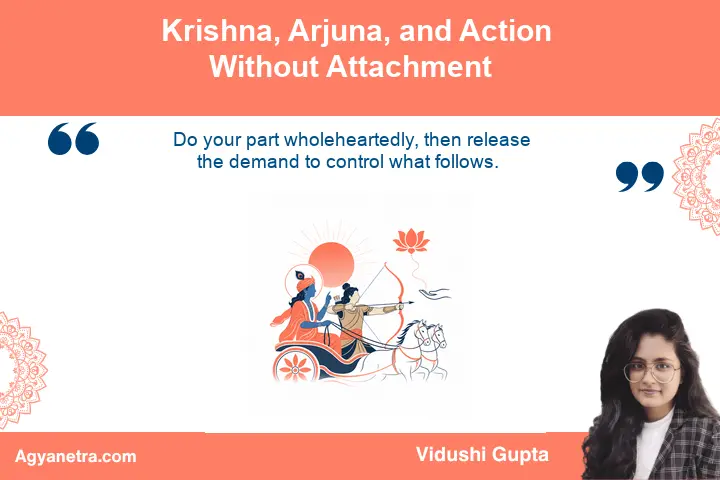
Do your part wholeheartedly, then release the demand to control what follows.
In the Bhagavad Gita, Arjuna’s battlefield reflects an inner human conflict: fear and grief pull him toward retreat, while responsibility calls him to act from a deeper center.
Krishna’s guidance does not present freedom as escape from life. It points toward clear action without making identity, peace, or worth dependent on the result.
This is the heart of Karma Yoga. You remain responsible for intention, preparation, effort, and conduct, but you cannot command every response or consequence.
Detachment is therefore not indifference. It means caring deeply without allowing success to inflate the ego or failure to destroy your inner foundation.
For a broader comparison of spiritual approaches to action and understanding, read Karma Yoga and Gyana Yoga Meaning.
How to Move From Karma to Dharma
Each conscious response weakens repetition and strengthens alignment.
The movement from karma to dharma usually occurs through small choices rather than one dramatic awakening. Use the following process whenever you notice a recurring emotional or relational pattern.
- Name what is repeating. Describe the pattern without judging yourself. Be specific about the situations, emotions, beliefs, and behaviors involved.
- Notice the trigger. Identify what happens immediately before the reaction. It may be criticism, uncertainty, intimacy, silence, failure, or loss of control.
- Feel the body. Observe tension, heat, numbness, shallow breathing, or restlessness. Bodily awareness can reveal conditioning before the familiar story takes over.
- Find the protective intention. Ask what the reaction is trying to prevent. Many harmful patterns began as attempts to avoid rejection, shame, helplessness, or abandonment.
- Create a pause. Take a breath, delay a message, walk briefly, pray, journal, or seek wise support. A pause gives awareness time to enter the decision.
- Choose by values. Ask which response reflects truth, compassion, courage, responsibility, and appropriate boundaries.
- Release the outcome. Carry out the action carefully, then let other people and life respond as they will.
Repeated practice matters. Every time you interrupt an automatic response, you teach the mind and body that another way is possible.
Final Words
Soul Dharma versus Karma is ultimately a lived distinction. Karma is the force of unexamined repetition, while dharma is the soul’s truth translated into conscious action.
You do not have to erase the past before living meaningfully. You need enough awareness to recognize when the past is speaking and enough courage to choose what is honest now.
With each such choice, the old momentum loses strength. Your history becomes wisdom, the personality learns to serve a deeper center, and life becomes less about repeating who you were and more about embodying who you are.
FAQs
What is the main difference between karma and dharma?
Karma is the momentum created by actions, conditioning, and repeated responses. Dharma is conscious action aligned with truth, responsibility, and your deeper nature.
Does karma mean punishment for past actions?
Not necessarily. Karma includes cause and effect, but recurring difficulties may also reflect unconscious patterns rather than punishment.
How can I know whether I am acting from karma or dharma?
Karmic reactions often feel automatic, defensive, or driven by old fear. Dharmic responses involve a pause, honest discernment, and action consistent with your values.
Is dharma the same as a career or life purpose?
No. A career can express your dharma, but dharma is primarily the consciousness, integrity, and service you bring to any role.
Can I change my karma through conscious choices?
You may not be able to change every circumstance, but you can interrupt habitual responses. Each conscious choice reduces the power of an old pattern and creates a new possibility.
What does action without attachment mean?
It means giving full attention and effort to what is yours to do without making your peace or worth dependent on the result. It is responsible action, not indifference.
Does living from dharma eliminate fear and anger?
No. Fear and anger may still arise, but they no longer have to control your behavior. Dharma helps you listen to emotions without automatically obeying them.

Vidushi Gupta is a spiritual coach, energy healer, and emotional wellness counselor with over 10 years of experience guiding people through spiritual signs, emotional healing, and inner transformation. She is the founder of Agyanetra and a published author of nearly ten novels, reaching over 20 million readers worldwide. Her approach is grounded, fear-free, and focused on helping readers understand spiritual experiences with clarity and emotional balance.