
The Soul Behind the Story is the deeper meaning that emerges when you view your life as more than a collection of achievements, mistakes, relationships, and losses. It invites you to ask not only what has happened, but how each experience has shaped your consciousness and called you toward greater truth, love, and wholeness.
Many people begin asking spiritual questions when outward success stops feeling complete. A career, relationship, possession, or personal milestone may still matter, yet it can no longer answer the quiet inner question: Why am I here?
This question does not always lead to one dramatic revelation. More often, its answer becomes visible through recurring themes, meaningful relationships, difficult turning points, and the qualities you are gradually learning to embody.
What Does The Soul Behind the Story Mean?
Your outer story describes the visible events of your life. Your soul’s story concerns the inner transformation taking place through those events.
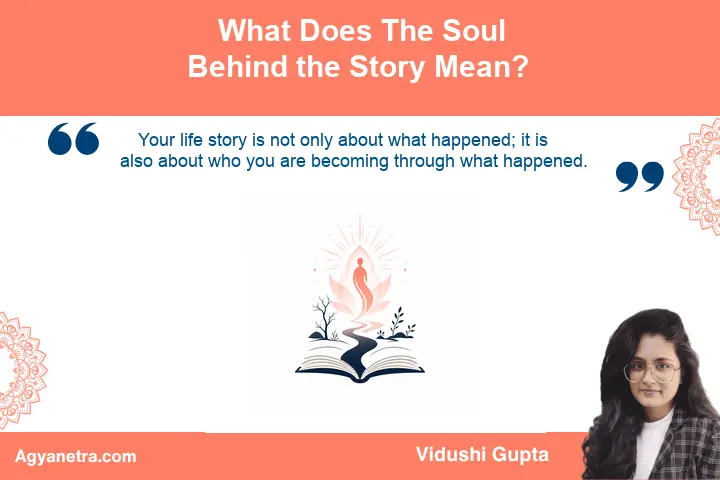
Your life story is not only about what happened; it is also about who you are becoming through what happened.
Two people can pass through similar circumstances and develop in very different ways. One may become closed and resentful, while the other becomes more discerning, compassionate, and honest.
This does not mean painful events are automatically good or spiritually necessary. It means your response can prevent pain from having the final word.
The personality often measures life through comfort, approval, certainty, and control. The soul is more concerned with authenticity, awareness, courage, and the capacity to love.
Understanding the distinction between soul and ego can help you notice which inner voice is guiding your choices. The ego usually seeks protection, while the soul calls you toward what feels deeply true.
Seeing the Pattern Beneath Your Life
Some experiences appear unrelated when viewed separately. With time, however, repeated lessons can reveal an underlying pattern.
A life pattern becomes meaningful when it helps you recognize what is asking to be healed, learned, or expressed.
You may repeatedly face situations involving boundaries, self-worth, forgiveness, courage, trust, or surrender. The people and settings change, but the emotional invitation remains familiar.
Recognizing a pattern is not the same as blaming yourself for everything that happens. It is a way of identifying where you still have agency and where a more conscious response may be possible.
Intuition can also help you sense which experiences deserve deeper attention. Learning about intuition and soul alignment may clarify the difference between quiet inner knowing, fear-driven urgency, and wishful thinking.
Look for patterns gently. The purpose is not to force every event into a perfect spiritual explanation, but to become more awake to what your life consistently brings forward.
Are Repeating Themes a Soul Contract?
A soul contract is a spiritual idea suggesting that a person enters life with particular intentions, relationships, or lessons. It can be approached as a literal belief or as a symbolic framework for reflection.
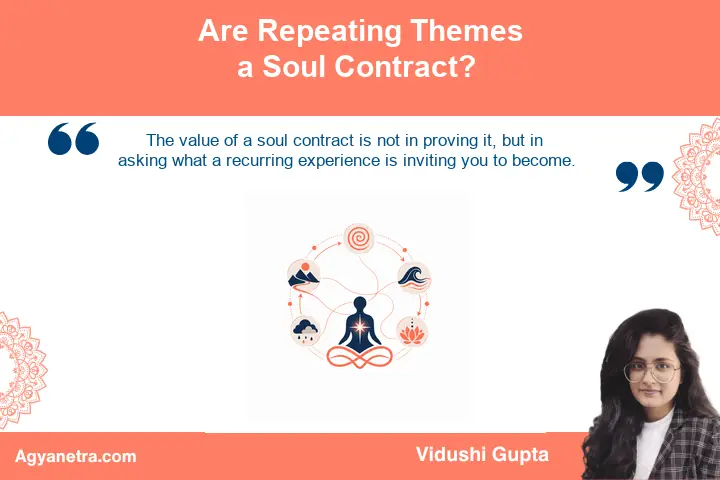
The value of a soul contract is not in proving it, but in asking what a recurring experience is inviting you to become.
This perspective does not imply that a soul chooses abuse, injustice, or tragedy because suffering is desirable. Such an interpretation can become harmful, especially when it dismisses real pain or removes responsibility from those who cause harm.
A grounded use of the idea is simpler. When a theme keeps returning, ask whether it is inviting a new quality of consciousness rather than another repetition of the same reaction.
Perhaps the lesson concerns speaking honestly, receiving love, releasing control, showing compassion, or leaving a destructive situation. Growth may involve acceptance in one circumstance and decisive action in another.
Hindu teachings about karma, dharma, and reincarnation also place an individual life within a longer movement of consciousness. Whether understood spiritually or symbolically, this view encourages patience: deep transformation may unfold through many seasons rather than one sudden breakthrough.
Purpose and Mission Are Not the Same
Purpose is often confused with profession. People may believe they must discover one perfect career before their lives can become meaningful.
Purpose describes the consciousness you embody; mission describes the particular way you express it in the world.
Your purpose may involve awakening, loving, living truthfully, and becoming more present. These qualities are not limited to a job title and can be practiced wherever you are.
Your mission is more individual. It may be expressed through raising children, creating art, teaching, healing, protecting nature, building a community, conducting research, writing, or quietly caring for someone in need.
The same outward activity can carry different inner qualities. A person can teach from insecurity and control, or teach from service, patience, and love.
Instead of asking only, What should I do with my life?, also ask:
- What quality is life asking me to embody?
- Which forms of service feel honest and natural?
- Where do my abilities meet a genuine need?
- What would I continue valuing without applause?
These questions shift purpose from a future achievement to a present way of living.
Spiritual Evolution Happens in Ordinary Life
Spiritual evolution is the gradual development of consciousness. It can be seen in greater honesty, compassion, presence, humility, forgiveness, and alignment with your deepest values.
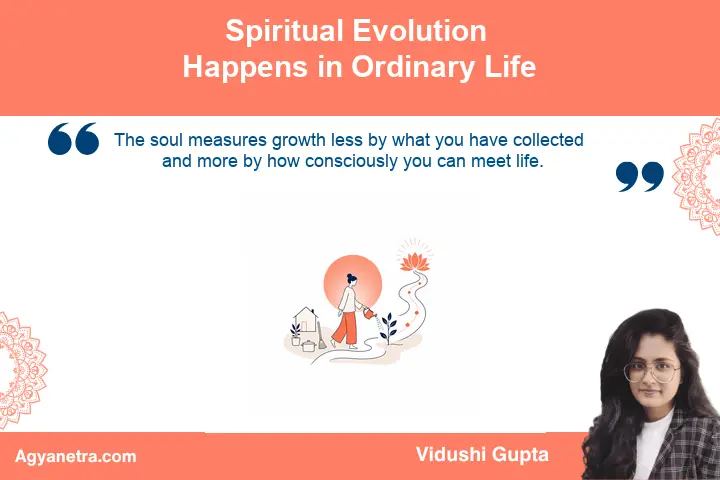
The soul measures growth less by what you have collected and more by how consciously you can meet life.
External milestones are visible and easy to compare. Inner growth is quieter, and it may occur during experiences the world does not celebrate.
Success can teach confidence and responsibility. Failure may reveal humility, resilience, or the need to change direction. Love opens the heart, while loss confronts you with impermanence and the limits of control.
A period of spiritual darkness can also unsettle old identities and assumptions. If you are moving through such a season, understanding the meaning of the dark night of the soul may help you approach it without treating every difficult emotion as a mystical sign.
Growth is not proven by appearing peaceful all the time. It is reflected in your willingness to face reality, seek appropriate support, take responsibility, and return to awareness when fear or old conditioning takes over.
Nothing needs to be romanticized for it to become part of your development. Even an unwanted experience can become material for wiser choices.

Finding Wholeness in a Fractured World
Integration explores inner fragmentation, emotional healing, shadow work, self-awareness and the journey towards inner wholeness. It is written for readers who want to understand themselves more deeply and bring spiritual awareness into everyday life.
Relationships Can Reveal What Needs Growth
Relationships are among the clearest places to observe the soul’s story. They expose our capacity for love as well as our attachments, expectations, fears, and unhealed wounds.
A meaningful relationship is not measured only by how long it lasts, but also by what it reveals and awakens within you.
Some people teach tenderness and trust. Others show you where a boundary is necessary. A brief encounter may redirect your life, while a long relationship may repeatedly invite patience, honesty, or self-respect.
Seeing relationships as teachers does not require you to remain in harmful situations. Sometimes the lesson is to leave, ask for help, stop abandoning yourself, or recognize that intensity is not the same as spiritual compatibility.
This discernment is especially important when interpreting powerful bonds. Exploring soul connection versus trauma bond can help separate mutual growth and respect from cycles driven by fear, dependency, and emotional instability.
After an important relationship, ask more than what you gained or lost. Consider what it showed you about your needs, choices, values, and capacity to love without betraying yourself.
How to Find Meaning Without Glorifying Pain
Meaning does not erase grief, excuse injustice, or make every tragedy understandable. It changes how you participate in life after something painful has occurred.
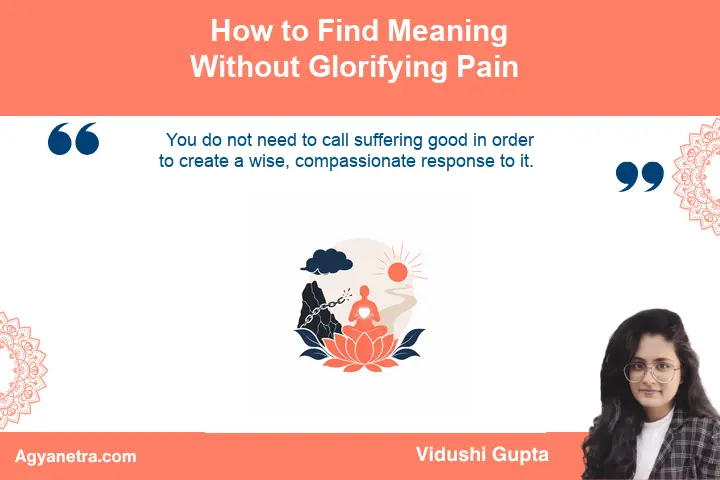
You do not need to call suffering good in order to create a wise, compassionate response to it.
Searching too quickly for a spiritual reason can interrupt genuine grieving. It may also pressure someone to forgive, feel grateful, or appear healed before they are ready.
A healthier approach allows pain to be acknowledged first. Practical care, emotional support, boundaries, medical help, therapy, or rest may be more important than finding an immediate metaphysical explanation.
Meaning can emerge later through the way you respond. You might become more compassionate, protect others from similar harm, live with clearer priorities, or stop postponing what matters.
Viktor Frankl’s work is often associated with the human capacity to endure through meaning. The useful principle is not that suffering must occur, but that a person can still choose a meaningful orientation when circumstances cannot be immediately changed.
Some events may always remain mysterious. A soul-centered life does not demand a complete explanation; it asks for conscious participation in the reality that is here.
A Practical Soul-Story Reflection
You can explore the deeper movement of your life without trying to decode every event. Begin with patterns you can honestly observe.
Reflection becomes spiritually useful when it leads to clearer awareness, kinder action, and greater responsibility.
Set aside twenty quiet minutes and draw a simple timeline of major turning points. Include successes, losses, relationships, decisions, endings, and unexpected changes.
Then reflect on the following questions:
- Which emotional themes have appeared more than once?
- What qualities did difficult periods require me to develop?
- Where am I still repeating a familiar reaction?
- Which relationships changed how I understand myself?
- What values have become clearer with time?
- What wants to be expressed through my life now?
Write concrete answers rather than grand spiritual conclusions. For example, replace I am here to transform humanity with I am learning to speak truthfully and support people without controlling them.
Notice whether your interpretation produces humility or superiority. A genuine insight usually makes you more present and responsible; it does not make you feel spiritually more important than others.
Choose one small action from the reflection. Set a boundary, offer an apology, complete neglected work, ask for support, create something meaningful, or give your full attention to a person you love.
The soul’s story is lived through such choices. Insight becomes transformative when it enters your behavior.
Final Words
The deeper story of a life is not defined by fame, wealth, status, or a flawless spiritual identity. It is revealed through the consciousness you bring to love, work, uncertainty, success, heartbreak, and change.
You may never understand why every event occurred. Yet you can meet each chapter with honesty, curiosity, gratitude, discernment, and presence.
Over time, experiences that once seemed disconnected may reveal a quiet coherence. The destination is not escape from ordinary life, but a return to your essential wholeness while living fully within it.
FAQs
What is the meaning of The Soul Behind the Story?
It refers to the inner growth taking place beneath the visible events of your life. The focus shifts from what happened to how your experiences are shaping your awareness, values, and capacity to love.
How can I recognize the deeper pattern in my life?
Review recurring relationship dynamics, emotional triggers, turning points, and lessons. Look for themes such as boundaries, forgiveness, courage, self-worth, surrender, or trust without forcing every event into a spiritual explanation.
Is a soul contract a proven spiritual fact?
No. A soul contract is a spiritual belief that can also be used symbolically as a tool for reflection. Its practical value lies in helping you consider what a recurring experience may be asking you to learn or change.
Is life purpose the same as a career?
No. Purpose is the quality of consciousness you embody, such as love, truth, awareness, or compassion. A career can become one expression of that purpose, but it is not the only one.
Does finding meaning in suffering mean the suffering was necessary?
No. Finding meaning does not make suffering good, justified, or necessary. It means choosing a conscious response that supports healing, wisdom, service, or clearer priorities.
Can a difficult relationship be part of spiritual growth?
Yes, if it helps you recognize wounds, needs, patterns, or necessary boundaries. Spiritual growth never requires remaining in an abusive or unsafe relationship.
What is one practical way to live the soul’s story?
Identify one recurring life lesson and take a small action aligned with what you have learned. This could mean setting a boundary, apologizing, asking for help, serving someone, or expressing an important truth.

Vidushi Gupta is a spiritual coach, energy healer, and emotional wellness counselor with over 10 years of experience guiding people through spiritual signs, emotional healing, and inner transformation. She is the founder of Agyanetra and a published author of nearly ten novels, reaching over 20 million readers worldwide. Her approach is grounded, fear-free, and focused on helping readers understand spiritual experiences with clarity and emotional balance.
Pingback: Soul Dharma versus Karma: Moving From Repetition to Conscious Living