
Returning to Source is the spiritual recognition that the life we seek is not elsewhere, but present beneath the identities, fears, and habits that make us feel separate.
This return is not a rejection of the body, personality, relationships, or ordinary responsibilities. It is a shift from living as an isolated self to recognizing our participation in a larger field of consciousness.
The path includes healing and self-understanding, yet it eventually points beyond self-improvement. Its deeper invitation is to remember the awareness that remains present while every role, belief, and life stage changes.
What Returning to Source Really Means
Returning does not mean travelling back to a distant spiritual home. It means seeing through the conditions that made us forget our deeper nature.
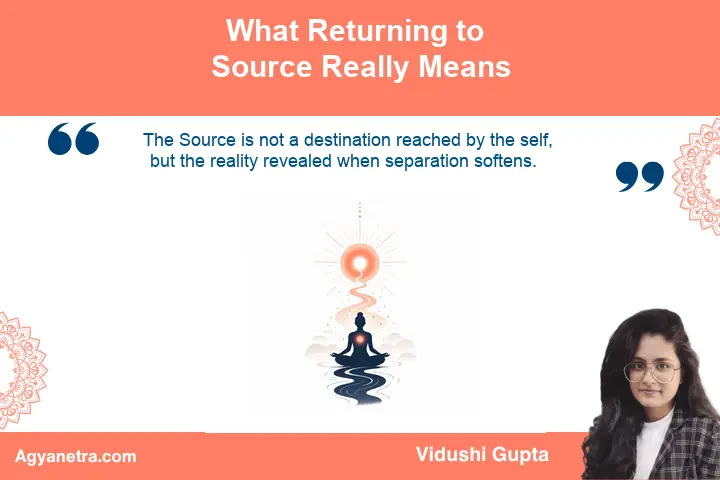
The Source is not a destination reached by the self, but the reality revealed when separation softens.
We usually build identity from temporary features: our name, history, work, relationships, successes, wounds, and beliefs. These features matter, but none of them remains unchanged throughout life.
Behind these changes is the simple capacity to be aware. Thoughts appear within it, emotions move through it, and the body ages while awareness quietly witnesses the movement.
Returning to Source begins when we stop treating every passing experience as the whole of who we are. We learn to participate fully without allowing one role or condition to define our entire existence.
This understanding is closely related to spiritual evolution and Source consciousness, where growth becomes less about constructing a perfect identity and more about remembering an underlying unity.
Moksha as Freedom From Mistaken Identity
Moksha is freedom from confusing the changing contents of life with the deepest Self.
Moksha is commonly understood as liberation from suffering, karma, and repeated cycles of birth and death. At a practical level, it also describes freedom from an identity built entirely around what can be gained or lost.
This does not require neglecting material needs or emotional healing. It asks us to notice whether we expect possessions, recognition, knowledge, relationships, or spiritual status to resolve a deeper sense of incompleteness.
Temporary experiences can bring genuine pleasure and meaning. They cannot provide permanent security, because their nature is to change.
The search begins to relax when we recognize that awareness is already present before the next achievement. Nothing needs to be added for awareness to exist, and no failure can remove it.
For a deeper exploration of this traditional goal, read about moksha and spiritual liberation. Liberation is not passivity; it is action without captivity to a rigid self-image.
How the Separate Self Creates Struggle
The functional ego helps us plan, communicate, and protect healthy boundaries. Suffering grows when this useful identity is mistaken for an independent and permanent self.
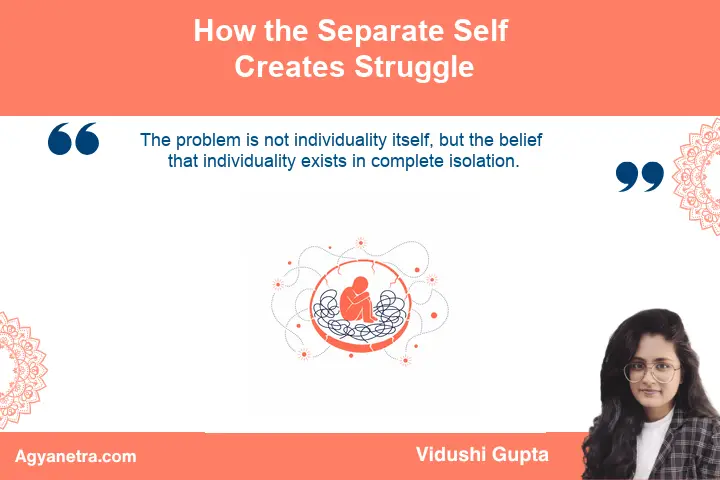
The problem is not individuality itself, but the belief that individuality exists in complete isolation.
When separation becomes our basic assumption, life turns into an endless project of defending and completing ourselves. Comparison intensifies, criticism feels threatening, and uncertainty appears to endanger our very existence.
Even spiritual practice can strengthen this pattern. A person may chase exceptional experiences, seek a superior identity, or judge ordinary emotions as evidence of spiritual failure.
Returning to Source interrupts this struggle through honest observation. Instead of asking how to perfect the separate self, we ask what is aware of its fear, ambition, and need for control.
This inquiry should not become emotional avoidance. Trauma, grief, and unmet needs still deserve compassionate attention; spiritual insight does not erase the human nervous system or replace appropriate support.
Vidushi Gupta’s emphasis on integration is helpful here. Healing the personality and seeing beyond exclusive identification with it can support each other, allowing spirituality to become embodied rather than disconnected from human life.
Freedom From Karma Without Avoiding Action
Freedom from karma means releasing unconscious identification with action, not withdrawing from life.
Karma can be understood practically as the momentum of actions shaped by conditioning. A fear triggers a reaction, the reaction reinforces a habit, and the habit influences the next choice.
Awareness creates space inside this chain. We may still feel anger, longing, or anxiety, but we become more capable of responding deliberately instead of repeating the first impulse.
As awareness matures, responsible action continues while the burden of personal ownership becomes lighter. We prepare carefully, make decisions, and accept consequences without imagining that one isolated self controls every condition.
This is not an excuse to deny responsibility. It is a more balanced recognition that each action arises through personal intention, past experience, relationships, circumstances, and forces larger than individual control.
The movement from automatic reaction to purposeful living is explored further through soul dharma versus karma. Dharma gives action direction, while non-attachment prevents action from becoming another prison.
Does Returning to Source Erase Individuality?
Many seekers fear that spiritual unity will remove everything personal and distinctive. This fear confuses the end of isolation with the destruction of individuality.
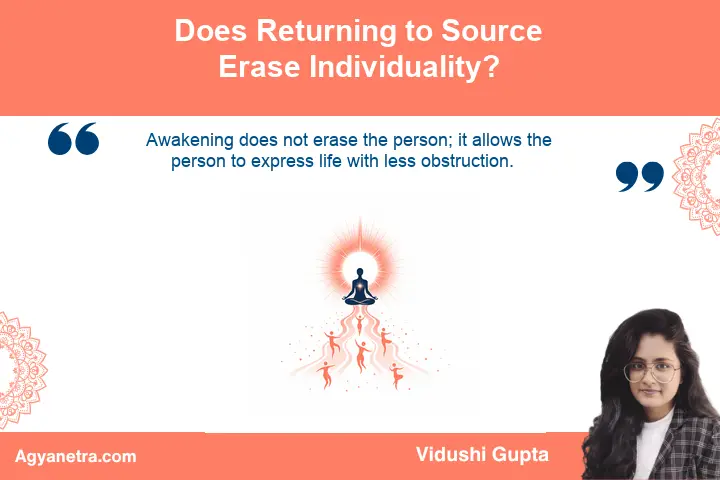
Awakening does not erase the person; it allows the person to express life with less obstruction.
A wave does not need to stop having a particular shape to recognize that it is ocean. In the same way, personality, creativity, relationships, and unique abilities can remain after the belief in absolute separation weakens.
What changes is the claim of independent ownership. A gift is no longer used only to prove worth; it becomes a way for life to serve, create, communicate, or heal through a particular person.
The Upanishadic teaching that Atman is Brahman points toward this recognition. The innermost Self and ultimate reality are not two unrelated substances, although thought naturally experiences them as separate concepts.
This is experiential rather than merely intellectual. Reading about unity can guide inquiry, but direct awareness becomes clearer through observation, silence, ethical living, and open engagement with others.
The shift from individual self to universal consciousness therefore includes the individual rather than treating human life as a mistake.
Death, Impermanence and the Awareness That Remains
Contemplating impermanence helps us release what cannot stay and value what is present now.
Fear of death is closely connected to identification with changing form. The body, social role, memories, and relationships all become precious partly because we know they will not remain in their present form forever.
Spiritual reflection does not require pretending to know exactly what happens after physical death. Different traditions offer different answers, and sincere seekers may interpret continuity of consciousness literally, symbolically, or with uncertainty.
The immediate lesson is available regardless of belief: everything visible changes. Remembering this can soften resentment, reduce unnecessary delay, and help us express love while the opportunity is still here.
Notice how much has changed since childhood. Your body, preferences, knowledge, and circumstances have developed, yet the basic sense of being present has accompanied every stage.
Meditating on that continuity can reduce rigid attachment, but it should not suppress grief. Mature spirituality allows loss to hurt while recognizing that love and awareness are larger than any single form.
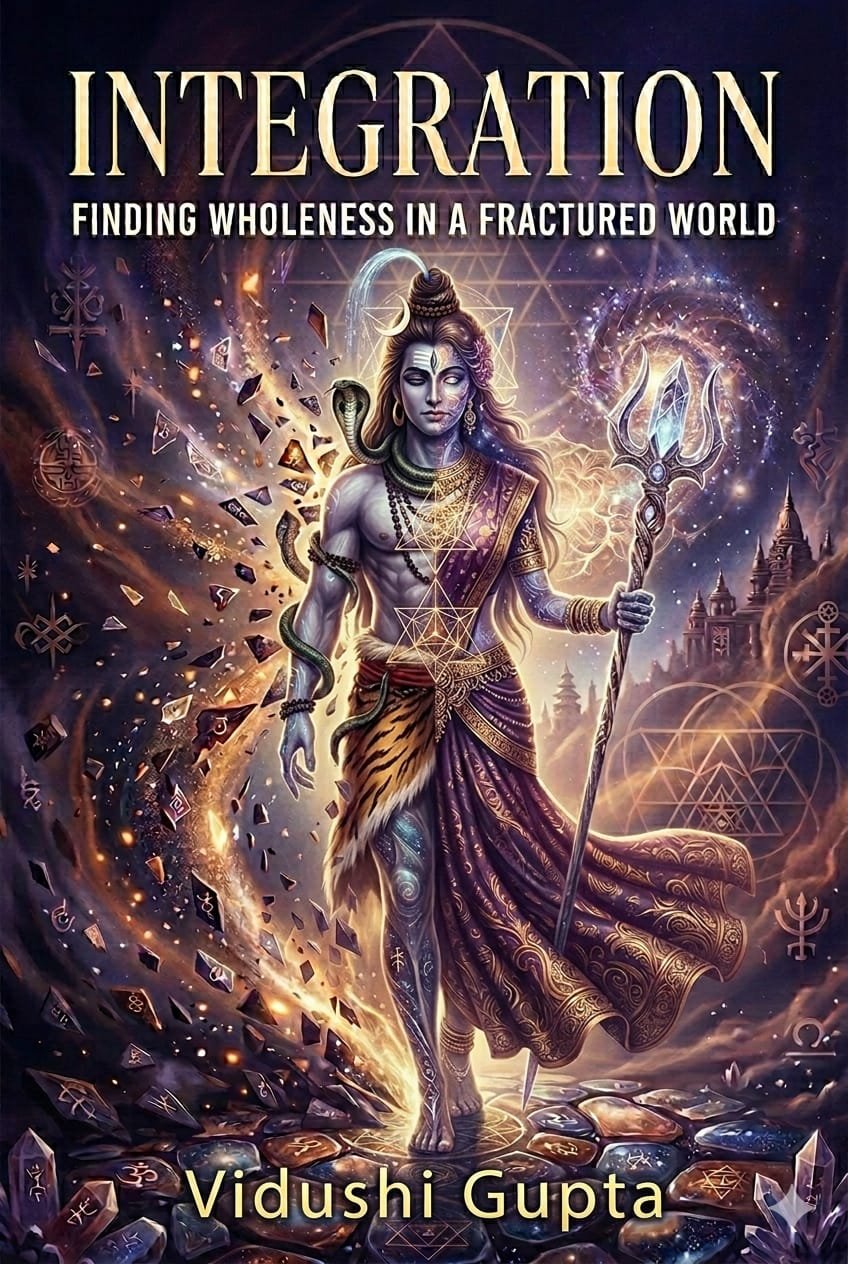
Finding Wholeness in a Fractured World
Integration explores inner fragmentation, emotional healing, shadow work, self-awareness and the journey towards inner wholeness. It is written for readers who want to understand themselves more deeply and bring spiritual awareness into everyday life.
A Practical Way to Return to Source
Returning to Source is not reserved for a dramatic mystical event. It can be practised through small moments in which identification relaxes and awareness becomes more available.
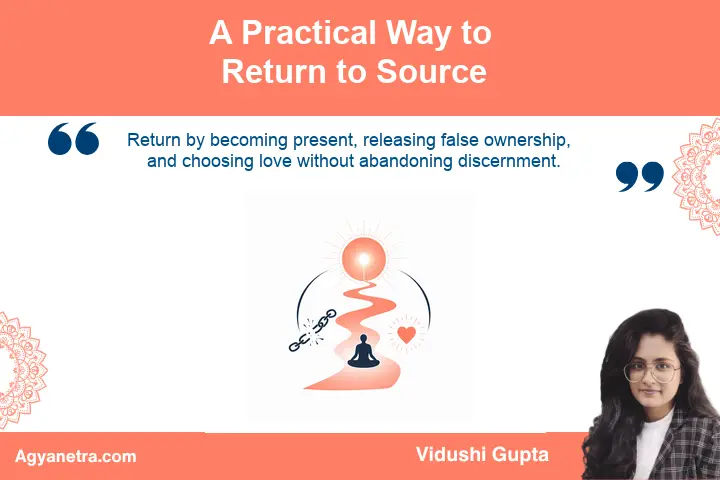
Return by becoming present, releasing false ownership, and choosing love without abandoning discernment.
- Pause before reacting. Take one conscious breath and notice the impulse in the body before speaking or acting.
- Name the temporary identity. Silently acknowledge the role currently dominating you, such as the achiever, victim, controller, rescuer, or rejected child.
- Ask what is aware. Without searching for a verbal answer, notice the awareness in which the identity, emotion, and bodily sensation are appearing.
- Allow the feeling. Give the emotion space without turning it into a permanent definition of yourself or using spirituality to dismiss it.
- Choose the next honest action. Respond according to compassion, responsibility, and present reality rather than the demand to defend an image.
- Release the result. Complete what belongs to you, then acknowledge that the outcome depends on more conditions than personal effort alone.
This practice may last less than a minute during an ordinary day. Repeated consistently, it loosens automatic patterns and brings spiritual understanding into speech, relationships, work, and decision-making.
Formal meditation can support the process. Sit quietly, feel the breath, let thoughts come and go, and notice that awareness does not need to chase or resist every mental event.
The aim is not to maintain a blank mind. It is to discover that thoughts can move without controlling the whole field of consciousness.
Living Liberation in Everyday Life
The clearest sign of spiritual remembrance is not escape, but a freer and more loving way of living.
Returning to Source becomes meaningful when it changes how we meet life. Forgiveness may become possible without denying harm, service may lose its need for praise, and boundaries may become clearer without hatred.
Liberation can begin before death through many small endings. An outdated identity falls away, resentment is released, control loosens, or an honest apology ends the need to appear flawless.
This is sometimes described as dying before physical death. What dies is not healthy personality but the unquestioned belief that an image, possession, role, or wound contains the whole Self.
Life still includes conflict, pain, effort, and uncertainty. The difference is that these experiences arise within a wider awareness rather than becoming proof that we are spiritually abandoned or fundamentally incomplete.
In this sense, living from the soul means allowing inner unity to take visible form through integrity, compassion, courage, and useful participation in the world.
Final Words
Returning to Source completes a circle without ending human life. We continue to learn, relate, work, grieve, create, and serve, but we no longer need every experience to confirm a separate identity.
The deepest home is not reached by becoming someone spiritually impressive. It becomes visible as false identification softens and awareness recognizes itself within the changing movement of life.
Wholeness, service, unity, and liberation are therefore not disconnected goals. They are expressions of one movement: remembering what we are, then allowing that remembrance to shape how we live.
FAQs
What does Returning to Source mean spiritually?
It means recognizing the deeper awareness beneath temporary roles, thoughts, fears, and identities. It is a movement from perceived isolation toward conscious unity with life.
Is Returning to Source the same as moksha?
They are closely related. Moksha describes liberation from mistaken identity and karmic bondage, while Returning to Source emphasizes recognizing the reality from which we were never truly separate.
Does spiritual liberation destroy the personality?
No. Personality and individual abilities can continue, but they are no longer treated as a completely separate or permanent self.
How can I practise Returning to Source every day?
Pause before reacting, observe the identity or emotion currently active, rest briefly as awareness, and choose a compassionate, responsible response. Release excessive control over the result.
Can healing trauma support spiritual awakening?
Yes. Compassionate healing can reduce defensive patterns that obscure awareness and make spiritual insight easier to embody. Spiritual practice should not be used to dismiss trauma or avoid appropriate support.
Do I need to believe in reincarnation to understand moksha?
No. Moksha can also be approached psychologically as freedom from compulsive patterns, rigid identity, and the belief that fulfilment depends entirely on temporary conditions.

Vidushi Gupta is a spiritual coach, energy healer, and emotional wellness counselor with over 10 years of experience guiding people through spiritual signs, emotional healing, and inner transformation. She is the founder of Agyanetra and a published author of nearly ten novels, reaching over 20 million readers worldwide. Her approach is grounded, fear-free, and focused on helping readers understand spiritual experiences with clarity and emotional balance.