
Meeting the Inner Cast of Characters means recognising the different fears, needs, beliefs and protective voices influencing your choices. Instead of treating every thought or emotion as your complete identity, you learn to notice which part of you is active and what it is trying to communicate.
This approach can make repeated patterns less confusing. It helps you understand why you may desire change yet resist it, seek closeness yet withdraw, or work hard while secretly feeling unworthy.
What Meeting the Inner Cast of Characters Means
Your inner cast is the collection of psychological roles that appear in response to different situations.
Self-awareness begins when an inner voice becomes something you can hear, not something you must obey.
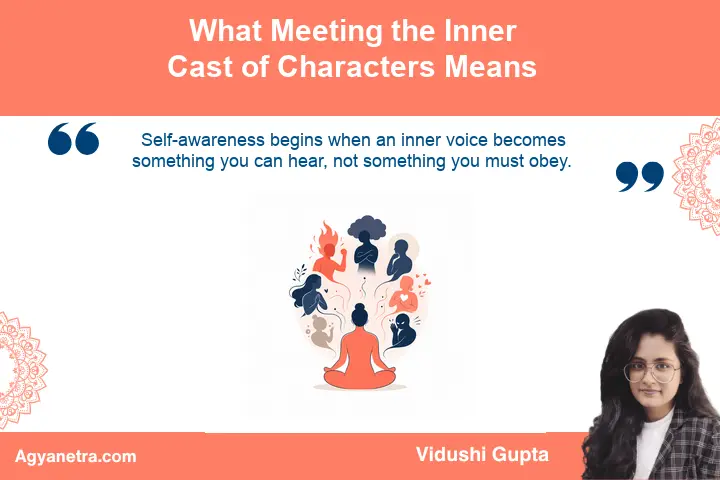
You may have an achiever that pushes you towards ambitious goals, a critic that searches for mistakes, a caretaker that prioritises other people and a protector that avoids uncertainty.
These are not separate people living inside you. They are useful ways of naming recurring patterns within one complex human mind.
Having different inner perspectives is not automatically a sign that something is wrong. A new opportunity, for example, can awaken excitement, fear, self-doubt and hope at the same time.
The difficulty begins when you unconsciously identify with the loudest reaction. Fear says, “Do not try,” and you assume that fear represents your final decision. Awareness creates another possibility: “A fearful part of me wants safety, but I can listen before choosing.”
Common Characters in the Inner World
Every person has a different inner cast, but several roles appear frequently because they develop around common human needs.
The inner critic
The critic monitors faults and predicts judgement. Beneath its harsh language may be an attempt to prevent rejection, embarrassment or failure by finding every possible weakness first.
The perfectionist
The perfectionist believes safety or acceptance depends on flawless performance. It can support discipline, but it becomes exhausting when mistakes are treated as evidence of personal inadequacy.
The achiever
The achiever values progress, recognition and competence. Its energy is constructive until accomplishment becomes the only available source of self-worth.
The caretaker
The caretaker notices what everyone else needs. It may express genuine compassion, yet it can neglect personal boundaries when being useful becomes a strategy for receiving love.
The rebel
The rebel resists control and protects independence. It may preserve authenticity, but automatic resistance can also reject healthy guidance, commitment or cooperation.
The wounded child
This sensitive part carries earlier experiences of fear, loneliness, shame or unmet affection. Exploring the signs of inner child wounds can help you recognise when an adult situation has activated an older emotional need.
These descriptions are invitations to observe, not labels to place on yourself. One reaction may contain several roles, and each role can change as awareness grows.
Why Inner Conflict Feels So Exhausting
Internal conflict arises when different parts pursue needs that seem incompatible.
Indecision is often not a lack of strength, but a meeting of needs that have not yet been heard.
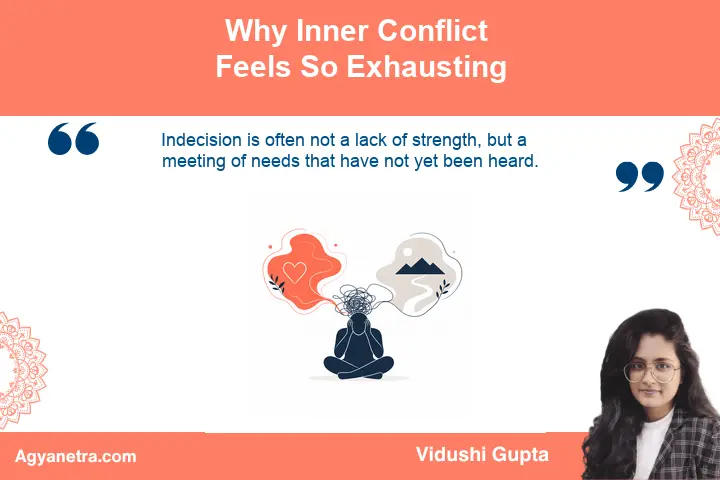
Imagine considering a new career. The dreamer sees meaning and possibility, while the protector worries about income. The achiever wants advancement, the caretaker fears disappointing the family and an exhausted part simply wants rest.
This tension divides attention and energy. You may delay the decision, repeatedly change your mind or criticise yourself for lacking courage.
Yet force rarely creates lasting peace. If ambition defeats fear without hearing it, anxiety may return through procrastination, sleeplessness or retreat.
A more balanced question is not “Which part must disappear?” but “What does each part need me to understand?” The protector may need a financial plan rather than total control. The dreamer may need a small experiment rather than an immediate leap.
Emotional Patterns Are Messages, Not Enemies
Recurring emotions often point towards an unmet need, an old wound or a strategy designed to protect you.
Anxiety may reveal perceived danger or uncertainty. Anger can indicate that a boundary has been crossed. Sadness may ask you to acknowledge loss, while shame can reflect a fear of exclusion or unworthiness. Jealousy sometimes reveals a desire that has not been honestly admitted.
This does not mean every emotion provides a complete or objective account of a situation. Anger may identify a real boundary problem, but it does not automatically justify hurtful behaviour. Fear may deserve attention without being allowed to make every choice.
Try separating the messenger from the message. Instead of saying, “I am an anxious person,” say, “An anxious part is expecting danger.” Then ask what triggered it, what outcome it predicts and what support it needs now.
Related practices such as beginner-friendly shadow work can reveal emotions and traits that have been denied because they felt unacceptable. The purpose is honest recognition, not self-punishment.
Look Beneath the Surface of Your Behaviour
The same outward action can arise from very different inner motivations, so behaviour alone does not tell the whole story.
You may help someone because you sincerely care, because you fear disapproval, or because both motives are present. You may pursue spiritual practice from a love of truth while also hoping meditation will help you avoid an unresolved relationship.
Discovering a mixed motive does not make your kindness or spiritual interest false. It reveals that the psyche is layered. Ask, “What am I hoping to receive, prevent or prove through this action?” The answer can help you act more freely and honestly.
Your Inner Kurukshetra: Choosing What Leads
The battlefield of Kurukshetra offers a grounded spiritual image for the competing forces within human consciousness.
Inner peace does not require every voice to agree; it requires awareness to choose the guide.
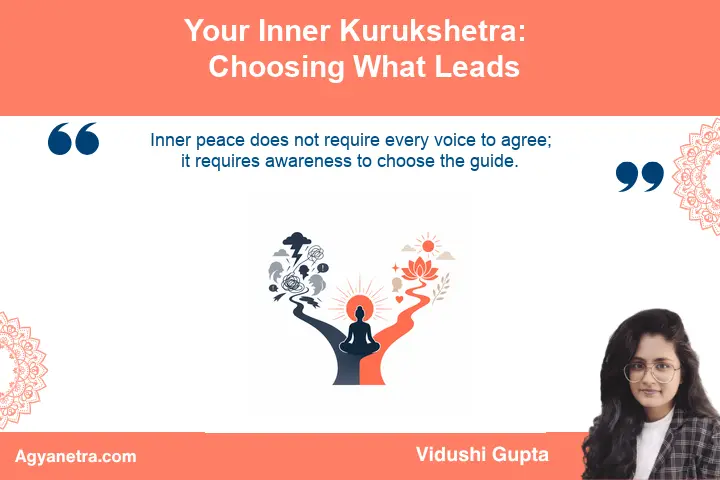
Within us are courage and avoidance, generosity and self-interest, truthfulness and the desire for approval.
The inner battle is therefore not a simple division between a perfect spiritual self and unacceptable emotions. It is the challenge of deciding which qualities will guide conduct.
A fearful part may remain present while you act courageously. Jealousy may arise while you choose not to behave possessively.
The presence of a difficult impulse does not determine your character; your conscious relationship with it matters.
Spiritual guide Vidushi Gupta presents this inner battlefield as a call to awareness rather than conquest. The deeper centre of consciousness listens to each voice but does not place fear, shame, pride or perfectionism on the throne.
This movement towards a coherent centre is closely related to individuation and the inner marriage of self, where opposing qualities are brought into a more conscious relationship.
A Practical Method for Meeting the Inner Cast of Characters
You can begin this practice during an emotionally charged moment or while reflecting quietly at the end of the day.
Meet each part with curiosity, then let your deeper awareness decide the next step.
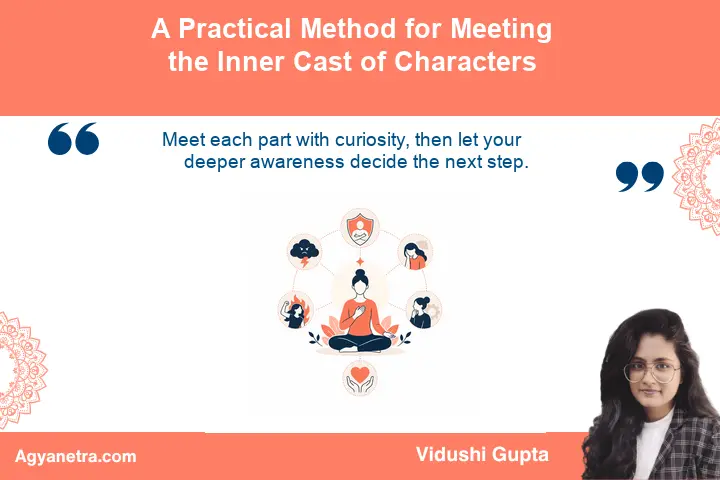
- Pause before reacting. Take several unforced breaths and notice what is happening in your body. The aim is to create a small space between the trigger and your response.
- Name the active part. Choose a simple description such as critic, protector, pleaser, achiever, rebel or frightened child. Use the name lightly rather than turning it into another fixed identity.
- Record its message. Complete the sentence, “This part believes that…” You may discover a belief such as “If I disappoint someone, I will lose their love.”
- Ask what it is protecting. Look for the feared outcome beneath the reaction. A controlling part may fear helplessness, while perfectionism may fear humiliation or rejection.
- Identify the present need. The part may need reassurance, a boundary, rest, preparation, grief or permission to speak. Meeting a need does not mean obeying every demand.
- Choose from awareness. Consider the facts, your values and the needs of everyone affected. Then select a proportionate action rather than allowing the most intense voice to rule.
For example, before agreeing to another request, you may notice a caretaker saying, “Refusal will make me selfish.” Thank it for protecting connection, recognise your exhaustion and respond with a respectful boundary.
A brief journal can make patterns easier to see. Write down the situation, active character, emotion, underlying belief, need and conscious response. Over time, you may notice that the same part appears around authority, intimacy, visibility or uncertainty.
Integration Is Different From Suppression
Integration gives every part a place without allowing any single part to govern your entire life.
The goal is not to destroy the critic, rebel or protector. The critic can become discernment, the rebel can defend authenticity, and the protector can support sensible caution when each is guided by awareness.
This requires both receptivity and direction: the capacity to listen inwardly and the capacity to act. Understanding divine masculine and divine feminine qualities in healing can offer another spiritual language for balancing these complementary movements without reducing them to rigid gender roles.
Inner-parts reflection is a self-awareness practice, not a diagnosis or substitute for professional care. If inner experiences feel overwhelming, seriously disrupt daily life or involve commands that may endanger you or someone else, seek support from a qualified mental health professional.
Frequently Asked Questions
These concise answers clarify how to recognise and work with your inner characters in everyday life.
What does meeting the inner cast of characters mean?
It means becoming aware of the different emotional roles, beliefs and protective tendencies influencing your behaviour. Rather than assuming every reaction represents your whole identity, you notice which part is active, listen to its concern and choose a response from a more balanced centre of awareness.
Is having different inner parts normal?
Yes, experiencing different needs or perspectives is a normal part of being psychologically complex. You may want intimacy and independence, or change and security, at the same time.
Inner-parts language simply helps you observe these competing tendencies without turning each one into a fixed identity.
How can I identify which inner character is speaking?
Pause during a strong reaction and notice its words, emotion and predicted danger. Ask what this voice wants you to do and what it fears would happen otherwise. A voice demanding flawless work may be a perfectionist, while one urging withdrawal may be a protector seeking safety.
What is the difference between observing a part and obeying it?
Observing means acknowledging the part’s emotion, belief and need without automatically acting on its instructions.
Obeying means allowing that reaction to make the decision. Awareness lets you respect fear or anger as information while still considering present facts, personal values, consequences and other people’s needs.
Can emotions help reveal the inner cast of characters?
Yes, recurring emotions can reveal which part has been activated and what it is protecting. Anger may point towards a boundary, anxiety towards expected danger and sadness towards loss. Emotions provide meaningful information, but they still need reflection because they do not always describe present reality completely.
How do I work with an inner critic?
Listen for the rejection, failure or humiliation the critic is trying to prevent. Then separate any useful guidance from its harsh judgement. You can correct a mistake, prepare carefully or improve a skill without accepting the belief that imperfection makes you unworthy of respect or belonging.
Does integration mean getting rid of difficult inner parts?
No, integration means placing difficult parts in a healthier relationship with conscious awareness. A protector can offer caution without controlling every decision, and a critic can support discernment without attacking your worth.
The aim is cooperation and appropriate leadership rather than suppression, exile or inner domination.
Final Words
Meeting the Inner Cast of Characters is an invitation to replace automatic identification with conscious listening.
Your critic, protector, achiever, caretaker and wounded child may carry limited beliefs, but each also contains information about what you have needed, feared or learned.
Begin with one recurring situation this week. Pause, name the part that appears, write down its message and ask what a balanced response would look like. Wholeness develops gradually each time awareness listens without surrendering its ability to choose.

Vidushi Gupta is a spiritual coach, energy healer, and emotional wellness counselor with over 10 years of experience guiding people through spiritual signs, emotional healing, and inner transformation. She is the founder of Agyanetra and a published author of nearly ten novels, reaching over 20 million readers worldwide. Her approach is grounded, fear-free, and focused on helping readers understand spiritual experiences with clarity and emotional balance.