
The Alchemy of Acceptance begins when we stop treating difficult emotions as enemies and learn to meet them with steady awareness. Acceptance does not make pain desirable or excuse harmful circumstances. It creates enough inner space to see what is present, understand what it needs, and choose a wiser response.
Many attempts at healing begin with the wish to eliminate fear, grief, anger, or shame. Yet transformation often starts with a different movement: allowing an experience to be known without letting it define who we are.
What Acceptance Really Means
Acceptance is an honest recognition of present reality. It acknowledges what is happening within us before we rush to fix it, explain it away, or cover it with forced positivity.
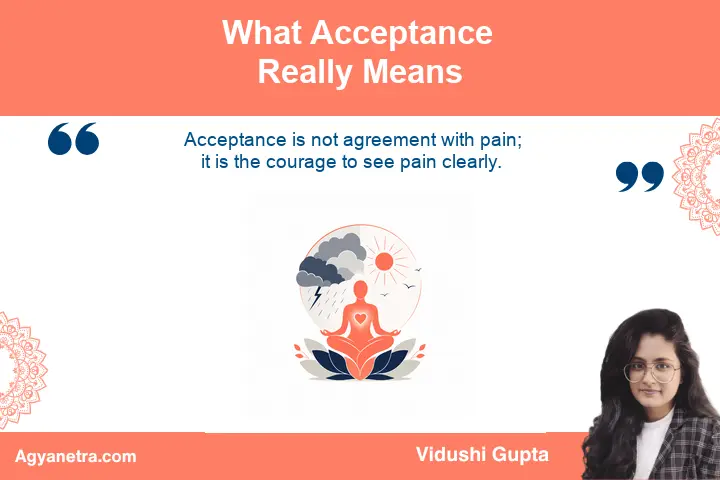
Acceptance is not agreement with pain; it is the courage to see pain clearly.
This recognition is not passive. When you admit that you are frightened, grieving, resentful, or exhausted, you gain accurate information from which meaningful action can arise.
Resignation assumes that nothing can improve. Acceptance simply recognizes that this is the current situation. One closes the future, while the other gives you a stable place from which to begin.
You can accept that a relationship is unhealthy and still leave it. You can acknowledge anxiety and seek support. You can recognize an old wound without believing that it must control the rest of your life.
Why Resistance Creates More Suffering
An uncomfortable emotion is often followed by an immediate judgment. Sadness appears, and the mind demands that it disappear. Fear emerges, and another voice calls it weakness.
Pain may be unavoidable, but fighting your own humanity adds a second layer of suffering.
The first feeling and the judgment of that feeling are different experiences. Anger may contain useful information, while shame about being angry can keep the whole pattern hidden for years.
Resistance also consumes energy. Part of you carries the original pain, while another part works continuously to deny, control, or criticize it. This internal division can become more exhausting than the emotion itself.
Acceptance ends that struggle without demanding instant relief. It allows you to say, “This feeling is here, and I do not have to attack myself for having it.”
This distinction is central to emotional and spiritual healing, where honest awareness supports change more effectively than self-rejection.
Emotions Are Messengers, Not Masters
Every emotion carries a function or signal. Fear looks for danger, anger notices violation, grief responds to loss, and shame often points toward a threatened need for dignity or belonging.
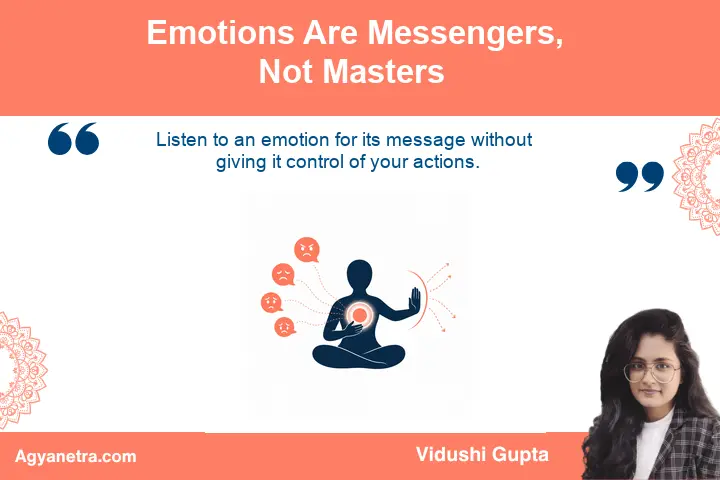
Listen to an emotion for its message without giving it control of your actions.
Accepting an emotion does not mean obeying every impulse it creates. Anger may reveal that a boundary has been crossed, but it does not justify cruelty. Fear may ask for caution without requiring lifelong avoidance.
The balanced response lies between suppression and overwhelm. Instead of pushing the feeling away or becoming completely absorbed in it, remain close enough to understand what it is protecting.
Try asking: What happened just before this feeling arose? What does it seem to fear? Is there a need, loss, or boundary beneath it? These questions turn emotional intensity into usable self-knowledge.
When recurring situations produce disproportionate reactions, learning about emotional triggers and healing can help distinguish a present challenge from an older wound.
Presence Is the Inner Alchemical Fire
Traditional alchemy involved the purification and transformation of materials. Spiritually and psychologically, it offers a fitting image for how conscious awareness changes our relationship with painful experience.
Presence transforms pain by changing the way it is held, not by pretending it never happened.
The past event remains part of your history, but it no longer has to become your complete identity. Loss may deepen compassion, failure may cultivate humility, and fear may uncover courage that was previously unused.
This does not mean trauma is automatically beneficial or that suffering should be romanticized. The transformation comes from how the experience is met, processed, and integrated—not from the harm itself.
Vidushi Gupta’s framing of acceptance as an alchemical movement is valuable here. Awareness supplies the heat, compassion creates safety, and patience allows experience to take on a different meaning.

Finding Wholeness in a Fractured World
Integration explores inner fragmentation, emotional healing, shadow work, self-awareness and the journey towards inner wholeness. It is written for readers who want to understand themselves more deeply and bring spiritual awareness into everyday life.
Shiva and the Wisdom of Holding Poison
The Samudra Manthana story offers a powerful spiritual image for conscious containment. During the churning of the cosmic ocean, a deadly poison emerges before the long-awaited nectar.
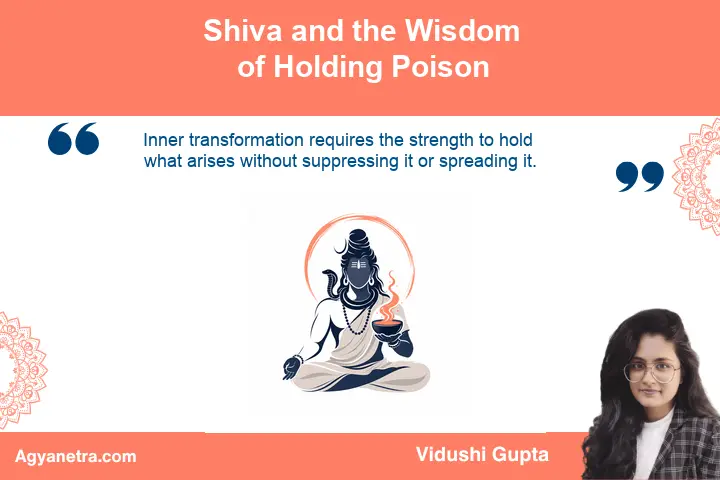
Inner transformation requires the strength to hold what arises without suppressing it or spreading it.
Shiva receives the poison but does not allow it to enter and destroy his whole being. He also does not cast it back into the world. Held at his throat, it turns the region blue and gives him the name Neelkantha.
As an inner metaphor, the ocean resembles the unconscious, while the churning resembles sustained self-inquiry. The poison represents buried grief, fear, guilt, rage, envy, or shame that can surface when deeper healing begins.
Shiva’s response shows a path between repression and uncontrolled expression. We do not have to bury pain, and we do not have to discharge it onto other people. We can hold it consciously until a responsible response becomes possible.
This symbolism becomes clearer when we explore what Shiva and Shakti represent in spiritual life. Shiva reflects spacious awareness, while Shakti expresses the living energy moving within that awareness.
Conscious containment is not silent endurance of abuse or danger. External protection, firm boundaries, professional help, or physical distance may still be necessary. Acceptance concerns clear seeing; it never requires tolerating preventable harm.
How to Hold Pain Without Becoming It
Holding an emotion begins by remembering that you are the one noticing the experience. The feeling is real and deserves attention, but it is not the totality of your identity.
You can make room for a difficult feeling without making it the definition of who you are.
A simple practice can help when emotional intensity is manageable:
- Pause before reacting. Give your body a few slow breaths so that awareness can return before action begins.
- Name what is present. Use plain language such as “fear is here” or “grief is moving through me.” This creates gentle distance without denial.
- Notice the body. Observe tightness, heat, heaviness, trembling, or numbness without immediately trying to alter the sensation.
- Offer compassion. Speak inwardly as you would to someone you genuinely love: firmly, patiently, and without humiliation.
- Choose the next safe action. This may involve rest, journaling, a boundary, an honest conversation, prayer, or qualified therapeutic support.
The aim is not to force an emotional breakthrough. The nervous system and psyche often move toward integration when they receive sufficient awareness, time, and safety.
Acceptance Makes Room for Opposites
Human experience rarely fits into neat categories. You may be courageous and frightened, grateful and grieving, spiritually devoted and deeply uncertain at the same time.
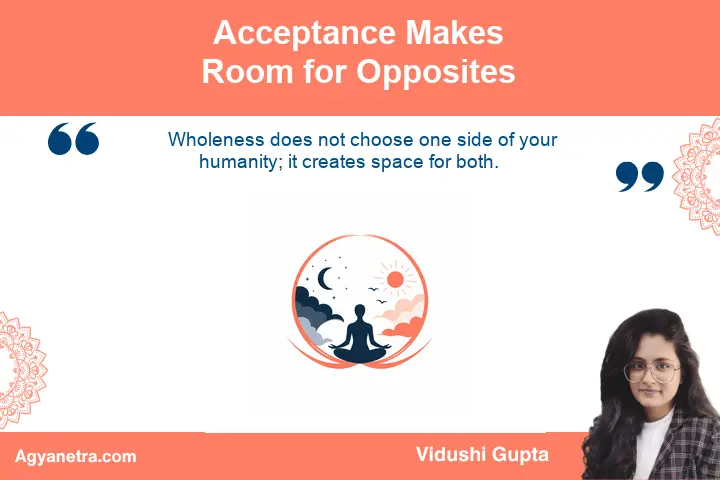
Wholeness does not choose one side of your humanity; it creates space for both.
Rejecting one side creates inner division. When strength is valued but vulnerability is condemned, tenderness becomes hidden. When only positivity is considered spiritual, authentic grief and anger are pushed into shadow.
Maturity involves staying present with apparent contradictions without demanding a premature answer. Jung’s work linked psychological transformation with alchemical symbolism, a connection explored in Psychology and Alchemy.
The Hindu image of Ardhanarishvara expresses a related truth through the unified form of Shiva and Shakti. Distinct energies are not erased; they are held within a larger wholeness.
Acceptance therefore replaces rigid either-or thinking with a more spacious both-and understanding. You can honor grief while welcoming joy, recognize uncertainty while acting wisely, and remain tender without surrendering your boundaries.
From Acceptance to Surrender
As acceptance deepens, it becomes surrender. This is not surrender to mistreatment, helplessness, or avoidable suffering. It is the release of the demand that the present must change before inner peace is possible.
Surrender begins when you stop postponing your presence until life meets all your conditions.
The mind often bargains with life: peace will come after success, self-love after improvement, and rest after every task is complete. Such conditions keep wholeness permanently out of reach.
Surrender returns attention to the reality that can actually be lived: this breath, this body, this choice, and this moment. From there, change becomes participation rather than escape.
Paradoxically, releasing inner resistance often makes practical action clearer. Energy once spent arguing with reality becomes available for boundaries, repair, learning, creativity, and service.
This movement can be part of spiritual transformation and transcendence, provided transcendence does not become another way to avoid ordinary human feelings.
A Daily Practice of Acceptance
Acceptance becomes reliable through small, repeated choices. It is usually developed in ordinary moments rather than through one dramatic spiritual experience.
Practice acceptance in small moments so it is available when larger waves of emotion arrive.
Once a day, sit quietly for five minutes and notice what is present. Avoid searching for a special state. Include physical sensations, emotions, thoughts, and the impulse to change them.
Then complete three honest statements: “Right now, I notice…,” “The hardest part to allow is…,” and “A compassionate next step would be….” Keep the answers concrete rather than philosophical.
If the experience becomes overwhelming, open your eyes, feel your feet on the floor, and name objects around you. Acceptance works best within a tolerable range; flooding yourself is not a spiritual achievement.
Some experiences require the support of a trauma-informed therapist, counselor, trusted spiritual mentor, or medical professional. Seeking appropriate help is an expression of acceptance because it acknowledges what the situation genuinely needs.
With practice, emotions may still arise, but the secondary war begins to soften. You become more capable of feeling deeply, choosing responsibly, and returning to the present without abandoning yourself.
Final Words
The Alchemy of Acceptance is the movement from self-opposition to compassionate awareness. What once seemed like inner poison can be held, understood, and integrated without being denied or allowed to rule your life.
The deepest change begins when pain is met with presence rather than judgment. In that spacious meeting, scattered parts begin to reconnect, emotional energy becomes wisdom, and the quiet nectar of wholeness can rise.
FAQs
What is the alchemy of acceptance?
It is the inner transformation that occurs when painful emotions are met with awareness, compassion, and honesty instead of resistance. The experience may remain part of your history, but it no longer has to define your identity.
Is acceptance the same as giving up?
No. Giving up assumes that change is impossible, while acceptance recognizes what is true now so that wise action can begin.
Does accepting an emotion mean acting on it?
No. You can acknowledge anger, fear, or grief without obeying every impulse it produces. Acceptance creates space to understand the emotion and choose a responsible response.
How can I practice acceptance during a difficult moment?
Pause, breathe slowly, name the emotion, and notice where it appears in your body. Then identify one compassionate and safe next step instead of demanding immediate relief.
What does Shiva drinking poison symbolize?
It symbolizes conscious containment: holding painful inner material without suppressing it, becoming consumed by it, or projecting it onto others. It is a spiritual image of awareness joined with responsibility.
Can acceptance help with trauma?
Acceptance can support trauma healing, but it should not be used to force exposure to overwhelming memories. Trauma may require gradual work with a qualified, trauma-informed mental health professional.

Vidushi Gupta is a spiritual coach, energy healer, and emotional wellness counselor with over 10 years of experience guiding people through spiritual signs, emotional healing, and inner transformation. She is the founder of Agyanetra and a published author of nearly ten novels, reaching over 20 million readers worldwide. Her approach is grounded, fear-free, and focused on helping readers understand spiritual experiences with clarity and emotional balance.