
The Awakening of Shakti is the gradual release of the living intelligence already present within you. Rather than chasing dramatic spiritual experiences, it involves removing the inner barriers that restrict vitality, creativity, truth, love, and meaningful action.
You may recognize Shakti as the impulse to create, heal, connect, grow, or begin again. It is felt whenever life moves through you with clarity instead of compulsion.
Awakening this force does not require rejecting ordinary life. It asks you to become more present within your body, choices, relationships, and responsibilities.
What the Awakening of Shakti Really Means
Shakti is commonly understood as the dynamic power of consciousness. In Hindu thought, Shakti is the universal energy that sustains existence and is often personified as the Divine Feminine.
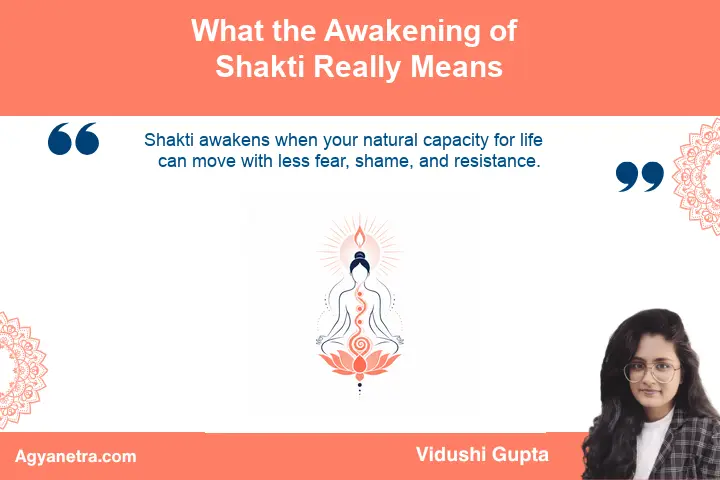
Shakti awakens when your natural capacity for life can move with less fear, shame, and resistance.
This energy is more than physical stamina. It appears as curiosity, emotional warmth, resilience, imagination, compassion, and the willingness to participate fully in life.
When Shakti is flowing, you do not necessarily feel excited all the time. You feel available to the moment, able to respond honestly without abandoning yourself.
The awakening is therefore not the acquisition of a supernatural power. It is a restoration of inner movement where stagnation, repression, or disconnection once dominated.
Vidushi Gupta’s Integration offers a helpful lens for understanding this process: spiritual growth becomes real when awareness, embodiment, emotional healing, and purposeful action begin supporting one another.
Shiva and Shakti Within Human Experience
Shiva represents silent awareness, while Shakti represents its expressive power. One is the capacity to witness experience; the other is the movement of thought, emotion, creativity, healing, and action.
Inner balance arises when action is guided by awareness rather than driven by fear.
These principles are not competing forces. Awareness without expression remains inactive, while energy without awareness can become scattered, reactive, or destructive.
Their union can be understood practically. You pause before speaking, but you do not suppress your truth. You observe an emotion, then choose a constructive way to express its underlying need.
Integration does not mean remaining detached from life. It means allowing stillness to inform movement, so that your actions become clearer and less compulsive.
For a deeper exploration of this relationship, read what Shiva and Shakti represent in spiritual life.
How Life-Force Energy Becomes Blocked
Shakti naturally moves toward expression. When grief, fear, creativity, or truth cannot be acknowledged safely, the energy connected with them may become restricted.
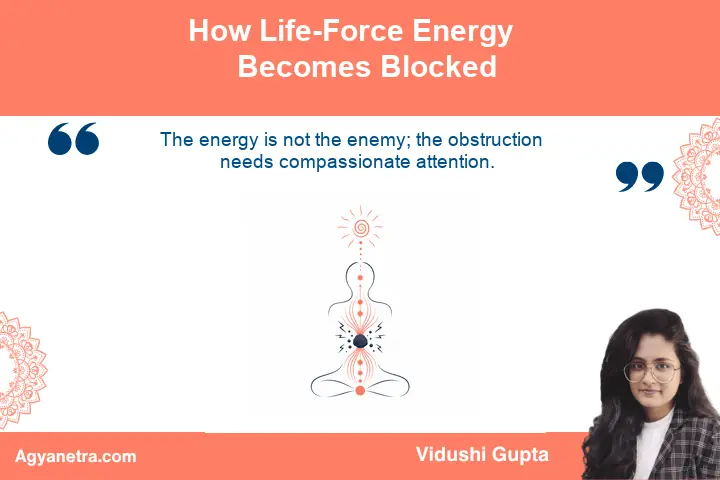
The energy is not the enemy; the obstruction needs compassionate attention.
Suppressed grief may feel like heaviness. Unspoken truth can appear as inner pressure, while neglected creativity may become restlessness, frustration, or a persistent sense that something important is missing.
People sometimes try to escape these feelings through overwork, constant stimulation, compulsive achievement, or emotional withdrawal. Such patterns may reduce discomfort temporarily without addressing what is waiting to move.
The purpose of inner work is not to force energy upward or manufacture intensity. It is to notice where life has become constricted and create enough safety for honest feeling and expression.
Signs that your vitality may be restricted
- You feel emotionally numb even when life appears stable.
- You repeatedly silence your needs to avoid conflict or rejection.
- You have creative impulses but continually postpone expressing them.
- Your body remains tense when no immediate danger is present.
- You pursue goals compulsively yet feel little meaning or satisfaction.
These experiences do not automatically prove an energetic blockage. Physical or psychological symptoms can have many causes, so persistent distress deserves appropriate medical or mental health support.
Kundalini as a Map of Human Development
Kundalini is traditionally pictured as coiled energy at the base of the spine. Its ascent through subtle centers symbolizes a movement from limited identification toward wider consciousness.
Kundalini can be approached as a map of maturing consciousness, not merely a search for unusual sensations.
The symbolic journey begins with basic survival and gradually includes belonging, agency, love, communication, insight, and unity. Each stage expands the range of life you can meet consciously.
Traditional Kundalini yoga connects this energy with yogic and tantric practices. Interpretations differ, however, and no single physical sensation can confirm that a spiritual awakening is occurring.
A grounded understanding focuses less on spectacular experiences and more on development. Are you becoming more truthful, compassionate, responsible, embodied, and able to remain present with difficulty?
The chakra framework can also provide a symbolic way to examine different areas of growth. This guide to Kundalini awakening through the chakras explores that progression in greater detail.
When Transformation Feels Intense
An awakening may unfold quietly, but transformation can also disrupt familiar identities. Relationships, ambitions, values, or roles may stop feeling aligned with the person you are becoming.
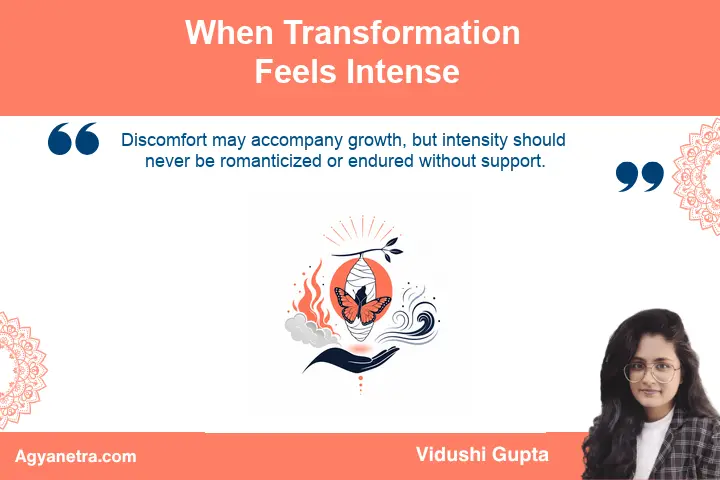
Discomfort may accompany growth, but intensity should never be romanticized or endured without support.
When an old identity begins loosening, uncertainty can arise. You may know that a former way of living no longer fits without yet seeing what should replace it.
This middle space requires patience. Immediate decisions made from panic can create more instability, whereas careful listening allows a new direction to emerge without unnecessary force.
Fear does not always mean you are moving in the wrong direction. It can appear when familiar defenses are challenged, although severe or prolonged fear should be treated as a genuine need for care.
If anxiety is becoming central to the experience, understanding fear during spiritual awakening can help you respond without treating every difficult feeling as a mystical sign.
How to meet an intense period responsibly
- Maintain regular meals, rest, movement, and simple daily routines.
- Delay major choices until you can consider them with reasonable calm.
- Speak with a trusted person instead of processing everything alone.
- Reduce practices that leave you overstimulated, sleepless, or detached.
- Seek professional help for severe anxiety, confusion, insomnia, or impaired functioning.
Spiritual language should not replace practical care. Supporting the body and mind gives transformation a stable foundation rather than suppressing it.

Finding Wholeness in a Fractured World
Integration explores inner fragmentation, emotional healing, shadow work, self-awareness and the journey towards inner wholeness. It is written for readers who want to understand themselves more deeply and bring spiritual awareness into everyday life.
Awakening Shakti Through Everyday Life
The most dependable expressions of awakening are often ordinary. Shakti moves when you tell the truth kindly, listen without preparing a defense, rest when exhausted, or create without demanding approval.
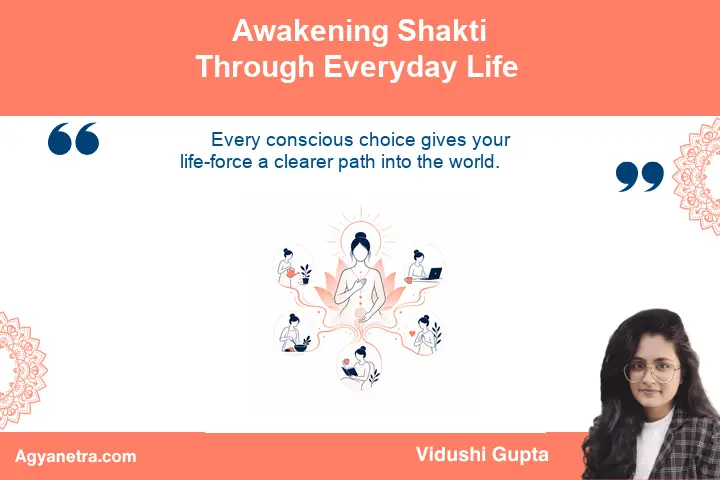
Every conscious choice gives your life-force a clearer path into the world.
Begin by noticing where your actions repeatedly contradict what you know inwardly. The gap may appear in a relationship, work pattern, neglected talent, boundary, or physical need.
Do not try to transform your entire life at once. Choose one small response that brings awareness and action into closer alignment.
A simple daily Shakti practice
- Pause and feel your body before reaching for distraction.
- Name the emotion or need that is most present.
- Ask what honest movement wants to happen next.
- Choose one safe, proportionate action.
- Observe whether the action produces clarity or greater compulsion.
The action might be writing one page, declining an unwanted commitment, asking for help, allowing tears, taking restorative rest, or having a respectful conversation.
Grounding is especially important if spiritual practices produce agitation or disconnection. These Kundalini awakening grounding techniques offer practical ways to return attention to the body and present environment.
Awakening is not measured by how unusual your experiences become. Its value appears in your growing capacity to live truthfully while remaining kind, stable, and accountable.
From Personal Control to Sacred Participation
As inner resistance softens, life may feel less like a problem to dominate. You begin listening for what can be expressed through your abilities, circumstances, and relationships.
Sacred service begins when personal gifts are offered without making the ego the center of the offering.
This does not erase individuality or personal choice. It allows the personality to become a clearer instrument for creativity, care, wisdom, and meaningful contribution.
A useful question is not only, “What can life give me?” You can also ask, “What quality of life is asking to be expressed through me now?”
The answer may be courage, patience, art, protection, teaching, service, or honest presence. Its authenticity is tested by how it affects both you and the people around you.
Healthy expression usually increases coherence. You become more embodied and responsible, not more grandiose, isolated, or convinced that ordinary limits no longer apply.
This is conscious evolution at the personal level. Fear gradually becomes discernment, separation gives way to connection, and the ego learns to support life rather than control every movement.
How to Recognize Grounded Shakti Awakening
No checklist can prove that Shakti has awakened. Still, certain changes suggest that inner awareness and life-force are becoming more integrated.
The clearest evidence of awakening is a more conscious life, not a more impressive spiritual identity.
- You recover more steadily after emotional difficulty.
- You can feel emotions without immediately acting them out.
- Your creativity becomes more consistent and less dependent on praise.
- You respect bodily limits instead of treating them as obstacles.
- You express boundaries with greater honesty and less aggression.
- You feel increasingly drawn toward meaningful contribution.
- Your spiritual understanding improves your ordinary relationships.
Progress will not be perfectly linear. Periods of openness can alternate with fatigue, contraction, grief, or uncertainty as deeper patterns become visible.
Nervous system support can make these changes easier to integrate. Learning about spiritual awakening and nervous system regulation may help you distinguish grounded growth from escalating overwhelm.
The goal is not uninterrupted bliss. It is the capacity to remain in relationship with life while awareness, body, heart, and action gradually become more coherent.
Final Words
The Awakening of Shakti is ultimately an invitation to become fully available to life. It brings awareness out of abstraction and into the way you feel, speak, create, relate, work, and serve.
You do not need to chase energy or force a mystical process. Attend gently to what has been silenced, protect your stability, and allow truthful expression to unfold at a pace your whole being can hold.
As stillness and movement learn to cooperate, spiritual growth becomes embodied. Awareness remains awake, the heart becomes more open, and your unique life becomes a practical expression of the sacred.
FAQs
What is the awakening of Shakti?
It is the release and integration of the life-force associated with vitality, creativity, healing, truth, and transformation. Practically, it means allowing awareness and authentic action to work together.
Is Shakti awakening the same as Kundalini awakening?
The ideas are closely related, but they are not always used identically. Shakti is the broader divine creative power, while Kundalini commonly refers to that power symbolized as coiled energy awakening through the subtle body.
What are signs of a grounded Shakti awakening?
Possible signs include greater vitality, emotional honesty, creativity, compassion, resilience, and meaningful action. Grounded awakening generally improves responsibility and relationships rather than creating superiority or instability.
Can Shakti awaken through ordinary daily life?
Yes. Honest communication, creative expression, restorative rest, compassionate boundaries, conscious listening, and service can all become practical expressions of awakening.
Should I try to force Shakti or Kundalini energy to rise?
No. Forcing intense practices can create unnecessary physical or emotional strain. A safer approach emphasizes patience, grounding, bodily care, and qualified guidance when needed.
What should I do if an awakening experience becomes overwhelming?
Reduce stimulating practices, maintain basic routines, ground through the body, and speak with someone trustworthy. Seek medical or mental health support if you experience severe anxiety, confusion, persistent sleeplessness, detachment, or impaired functioning.

Vidushi Gupta is a spiritual coach, energy healer, and emotional wellness counselor with over 10 years of experience guiding people through spiritual signs, emotional healing, and inner transformation. She is the founder of Agyanetra and a published author of nearly ten novels, reaching over 20 million readers worldwide. Her approach is grounded, fear-free, and focused on helping readers understand spiritual experiences with clarity and emotional balance.