
The Emergence of the Authentic Self begins when we stop treating our learned identity as the whole of who we are. Beneath the roles shaped by approval, fear, duty, and survival is a quieter center that does not need to perform in order to belong.
Authenticity is not about rejecting your personality or inventing a more spiritual identity. It is the gradual movement from unconscious protection toward honest, present, and values-aligned living.
This movement can feel unfamiliar because many protective identities have been useful. The aim is not to destroy them, but to see them clearly enough that they no longer direct every choice.
What Is the Authentic Self?
The authentic Self is revealed when fear no longer has to manage your identity.
The authentic Self is not a perfect version of your personality. It is the deeper awareness from which your thoughts, feelings, gifts, and individual character can be expressed without constant distortion by fear.
It appears through qualities rather than labels. Honesty, compassion, humility, courage, creativity, joy, and integrity become more available when you are not preoccupied with earning acceptance or protecting an image.
This does not make your roles meaningless. You may still be a parent, professional, partner, artist, caregiver, or spiritual practitioner, but these roles become expressions of life rather than definitions that imprison it.
Psychology also recognizes the distinction between spontaneous experience and a defensive social façade. Donald Winnicott’s concept of the true self and false self offers useful context, although spiritual authenticity extends beyond any single psychological model.
The central test is simple: are you living from what feels deeply true, or mainly from what keeps you approved, admired, needed, or safe?
Why Personality and Protective Masks Develop
Your personality is not an enemy to overcome. It is an intelligent collection of strategies formed through family expectations, social experience, emotional needs, and the situations you had to navigate.
A mask becomes limiting only when you forget that it is a mask.
A child may become unusually helpful to preserve connection. Another may become successful to receive praise, agreeable to prevent conflict, rebellious to protect independence, or emotionally strong because vulnerability once felt unsafe.
These patterns often continue long after their original conditions have changed. The adult then performs competence, kindness, confidence, or independence automatically, even when the performance creates exhaustion and distance.
Understanding the birth of the fragmented self can help you approach these patterns with compassion. They were attempts to protect something tender, not evidence that you are false or broken.
The work begins by noticing the difference between a flexible role and a compulsory identity. A flexible role can be set down; a compulsory identity makes you anxious whenever you stop performing it.
How the Authentic Self Emerges
Authenticity grows through awareness, acceptance, and increasingly honest choices rather than through dramatic self-reinvention.
You do not manufacture your deepest nature; you create space for it to become visible.
The first step is observation. Notice when your words, facial expression, or behaviour contradict what you actually feel, especially around authority, conflict, affection, success, and the possibility of disappointing someone.
The second step is compassionate inquiry. Instead of asking, “What is wrong with me?” ask, “What is this reaction trying to protect, and is that protection still needed now?”
The third step is a small truthful response. You might admit uncertainty, decline a request, ask for help, name a boundary, acknowledge hurt, or apologize without defending your image.
Useful questions for this process include:
- What am I feeling before I edit it for others?
- What response am I afraid this truth will create?
- Which value do I want my next action to express?
- Can I be honest without becoming harsh or impulsive?
Authenticity does not require disclosing everything to everyone. Mature truthfulness includes timing, discernment, privacy, and care for consequences.
As these choices become consistent, the gap between your inner experience and outer life begins to narrow. That coherence is a practical expression of inner wholeness beneath conditioning.
Presence Makes Inner Truth Easier to Hear
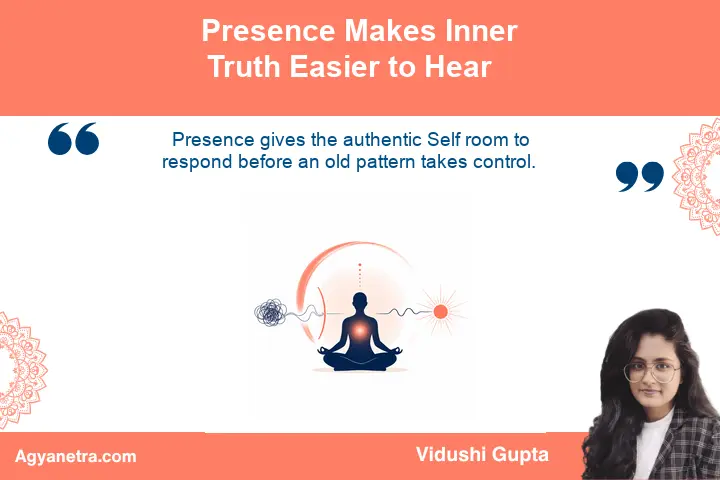
Presence gives the authentic Self room to respond before an old pattern takes control.
Protective identities are usually powered by memory and anticipation. The mind recalls rejection, predicts criticism, compares outcomes, and prepares a familiar performance before the present situation has been fully experienced.
Presence interrupts this sequence. When attention returns to breathing, bodily sensation, and the reality of the current moment, you gain a small but important space between a trigger and your response.
Try this brief practice when you notice yourself performing:
- Pause and take three unforced breaths.
- Feel your feet, hands, jaw, and abdomen.
- Name the emotion without turning it into an identity.
- Ask what is true and kind in this moment.
- Choose one response that respects both truth and context.
This practice is not meant to eliminate fear. It helps you recognize fear as an experience moving through awareness rather than as the unquestioned ruler of your behaviour.
Ordinary activities can support the same return. Drinking tea without scrolling, listening without preparing a reply, or walking beneath trees with full attention can restore contact with life as it is.
If awareness feels intense or destabilizing, learning how to ground yourself during spiritual awakening can make inner work steadier and more embodied.

Finding Wholeness in a Fractured World
Integration explores inner fragmentation, emotional healing, shadow work, self-awareness and the journey towards inner wholeness. It is written for readers who want to understand themselves more deeply and bring spiritual awareness into everyday life.
Living Without Constant Performance
Modern life makes identity easy to display and difficult to rest. Achievement, productivity, appearance, spiritual knowledge, and social approval can all become ways of proving that we deserve attention or belonging.
Authentic living replaces the question “How do I appear?” with “What is mine to live truthfully?”
At work, this may mean allowing purpose and integrity to guide ambition. You can pursue excellence without using every result as a verdict on your worth.
In relationships, it means replacing impression management with respectful honesty. Love becomes less dependent on pleasing, rescuing, controlling, or making yourself indispensable.
In spiritual life, it means valuing practice over identity. The appearance of being wise, peaceful, or awakened matters less than how you respond when frustrated, overlooked, uncertain, or wrong.
Living without performance does not mean ignoring social responsibilities. It means fulfilling them without abandoning your inner reality merely to maintain an acceptable image.
This shift often simplifies life. There may still be difficult conversations and demanding duties, but less energy is consumed by hiding, proving, rehearsing, and managing incompatible versions of yourself.
Rama as a Symbol of Inner Congruence
Within the Hindu tradition, Rama offers a powerful image of a person whose conduct remains rooted in dharma amid changing circumstances.
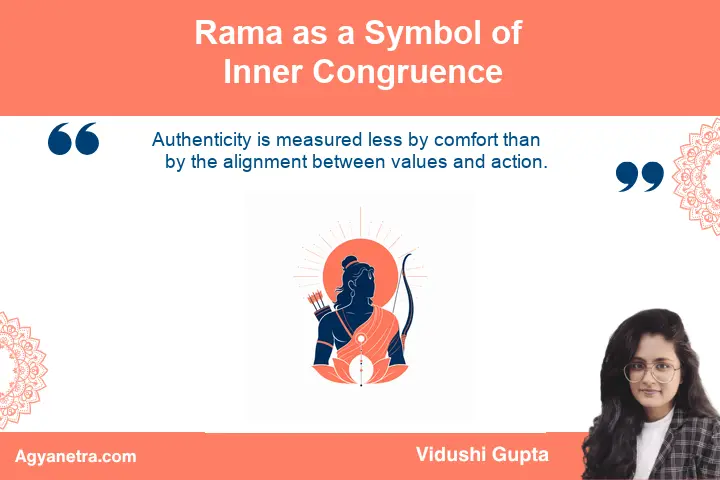
Authenticity is measured less by comfort than by the alignment between values and action.
Rama’s life includes exile, separation, grief, responsibility, and moral difficulty. His significance for inner integration is therefore not based on an easy life, but on steadiness in the presence of hardship.
Psychologically, Rama can represent the center within us that seeks congruence. Strength does not need to exclude compassion, courage does not require aggression, and authority can remain connected to service.
This symbolism makes authenticity practical. Your values are not only ideas for peaceful moments; they become the ground from which you speak and act when circumstances are uncomfortable.
Congruence does not guarantee that every decision will be flawless. It asks that you listen carefully, accept responsibility, correct yourself when necessary, and avoid sacrificing truth merely to protect pride.
Signs That Integration Is Becoming Real
The emergence of an authentic life is usually quiet. It is revealed less through grand declarations than through changes in motivation, relationships, and the way you meet ordinary moments.
Real integration produces greater honesty and freedom, not a more impressive spiritual image.
You may notice that you can admit fear without becoming defined by it. You can say “I do not know,” receive correction, or ask for support without experiencing these actions as personal failure.
Other signs may include:
- Your words and actions increasingly reflect the same values.
- You need less praise before trusting a meaningful choice.
- You can set boundaries without unnecessary hostility.
- You feel compassion for your protective patterns without obeying them.
- You listen to understand rather than merely to win.
- You recover more quickly after acting out of alignment.
- Simple moments carry more depth and satisfaction.
These signs are not achievements to display. Turning them into a new checklist for superiority would simply create another mask.
Authenticity remains human. Sadness, insecurity, confusion, and mistakes continue, but they are met more directly and held within a wider awareness.
This is closely related to individuation and the inner marriage of self, where previously divided aspects of life are brought into a more conscious relationship.
Final Words
The Emergence of the Authentic Self is not a final state in which every wound disappears. It is an ongoing return to presence, truth, and inner alignment whenever fear invites you back into performance.
Vidushi Gupta’s understanding of integration points toward a simple spiritual paradox: growth can feel like becoming someone new, while its deeper movement is a return to what was never absent.
You do not need to attack the personality that helped you survive. Meet it with gratitude, loosen what is no longer necessary, and let your daily choices reveal the steadiness beneath it.
The authentic Self does not need to announce that it has arrived. It becomes visible through honesty, compassionate courage, quiet service, and a life that increasingly expresses what is true.
FAQs
What does the emergence of the authentic Self mean?
It means becoming less controlled by protective identities and more able to live from truth, presence, and deeply held values. The authentic Self is revealed rather than manufactured.
How can I tell whether I am wearing a mask?
Notice where you regularly hide feelings, seek approval, avoid necessary conflict, or perform strength and competence despite inner exhaustion. A mask often feels compulsory rather than freely chosen.
Is the authentic Self the same as the personality?
No. Personality includes learned traits, roles, and survival strategies, while the authentic Self is the deeper awareness expressing itself through those human qualities. Personality remains useful when it is not mistaken for your entire identity.
Does being authentic mean saying everything I feel?
No. Authenticity includes discernment, timing, privacy, and compassion. The aim is honest alignment, not impulsive disclosure or using truth to harm others.
Can an authentic person still feel afraid or insecure?
Yes. Authenticity does not remove difficult emotions; it changes your relationship with them. You can acknowledge fear or insecurity without building your identity around either one.
What daily practice supports authentic living?
Pause before automatic reactions, notice your body and emotions, and ask what response is both true and kind. Then choose one small action that aligns with your values.

Vidushi Gupta is a spiritual coach, energy healer, and emotional wellness counselor with over 10 years of experience guiding people through spiritual signs, emotional healing, and inner transformation. She is the founder of Agyanetra and a published author of nearly ten novels, reaching over 20 million readers worldwide. Her approach is grounded, fear-free, and focused on helping readers understand spiritual experiences with clarity and emotional balance.