
The Hunger for Heaven is the deep human longing to reach beyond familiar identity and touch something timeless, meaningful, and whole. Yet spiritual growth becomes complete only when what we discover beyond the ordinary is brought back into everyday life.
This longing can appear as a desire for truth, inner freedom, unity, or direct knowledge of who we are beneath our roles. It may quietly remain beneath ambition and relationships until an awakening brings it into view.
Looking upward is not the problem. The difficulty begins when we assume that rising above human experience is the same as healing, integrating, or completing it.
Understanding the Hunger for Heaven
The hunger for Heaven is not necessarily a wish for a distant afterlife. It can be an immediate longing to experience reality without the limits of fear, separation, social identity, and habitual thought.
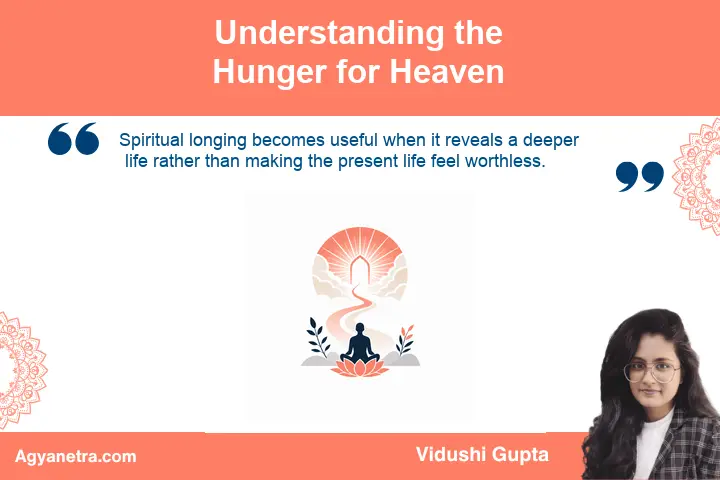
Spiritual longing becomes useful when it reveals a deeper life rather than making the present life feel worthless.
A person may feel that ordinary routines cannot satisfy an inner question. Success, approval, possessions, and even loving relationships may matter, yet none of them fully answers the need to know what existence means.
During spiritual awakening, this longing may become more intense. Moments of silence, synchronicity, expanded awareness, or interconnectedness can suggest that consciousness is larger than the personality through which it usually operates.
Such experiences can genuinely transform our perspective. They loosen the belief that our history, emotions, achievements, and struggles represent the whole of who we are.
Vidushi Gupta uses this upward longing as an entry into a larger question: what are we meant to do after touching a reality that feels greater than the individual self?
Why Spiritual Ascension Feels So Appealing
Many spiritual images describe awakening as an upward movement. The seeker climbs a mountain, moves from darkness into light, raises awareness, or travels symbolically from the Root toward the Crown.
This language expresses something valuable. Greater awareness can help us see beyond conditioned reactions, inherited beliefs, and the narrow stories through which we have defined ourselves.
From a wider perspective, an old conflict may no longer feel absolute. An identity that once seemed fixed may be recognized as a temporary structure rather than the entirety of the self.
The experience of spaciousness can also bring relief. When thought becomes quieter and personal concerns lose their usual intensity, freedom may feel like distance from everything heavy, emotional, or unresolved.
Ascension opens the view, but a wider view still has to be lived through the body, choices, and relationships.
When Transcendence Becomes Spiritual Escape
Transcendence becomes escape when spiritual ideas are used to avoid emotions, responsibilities, conflict, vulnerability, or the practical conditions of life.
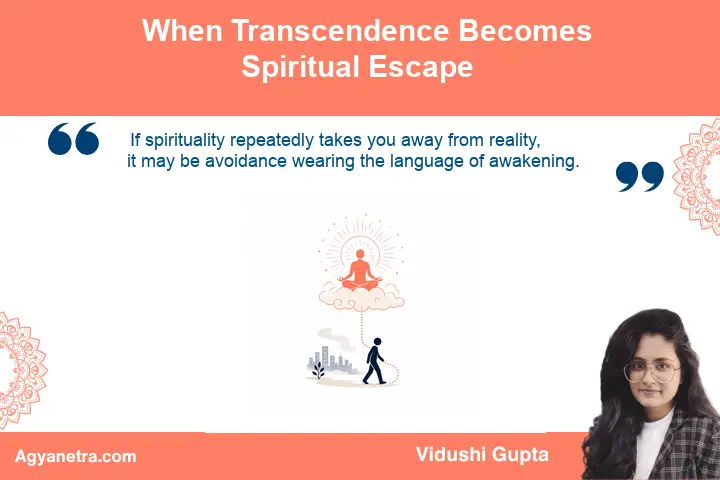
If spirituality repeatedly takes you away from reality, it may be avoidance wearing the language of awakening.
A person may dismiss grief as low vibration, treat attachment as personal failure, or consider material concerns unworthy of attention. Instead of becoming more conscious within human life, the seeker tries to become untouched by it.
The distinction can be subtle because both genuine spaciousness and emotional avoidance may initially feel like detachment. The difference becomes clearer through consequences: healthy perspective supports honest engagement, while escape reduces our willingness to feel and respond.
If awakening leaves you persistently numb, disoriented, or unable to manage basic routines, the experience needs grounding rather than romanticizing. A closer look at feeling disconnected from reality during spiritual awakening can help distinguish expansion from destabilization.
Spiritual insight should not be used to deny practical needs. Food, sleep, money, boundaries, health, and dependable relationships remain part of conscious living.
The Hidden Formation of a Spiritual Ego
The ordinary ego wants to feel important through status, achievement, control, or recognition. A spiritual ego can seek the same importance through purity, special experiences, superior awareness, or the belief that it has moved beyond ordinary people.
This identity may compare levels of consciousness, resist criticism, or use spiritual language to stay emotionally unavailable. It can speak about surrender while remaining deeply invested in appearing awakened.
The answer is not to condemn the ego or distrust every spiritual experience. It is to notice whether an experience is producing greater honesty, humility, compassion, and capacity for relationship.
Isolation may sometimes provide necessary space, but prolonged withdrawal can also protect an identity that does not want to be challenged. Understanding spiritual isolation during awakening can clarify when solitude is restorative and when it becomes avoidance.
A spiritual experience does not make anyone superior; its value appears in how consciously that person lives.
Why the Return to Ordinary Life Matters
The summit offers perspective, but it is not a permanent home. The deeper work begins when expanded awareness returns to conversations, commitments, uncertainty, work, family, and the limits of the body.
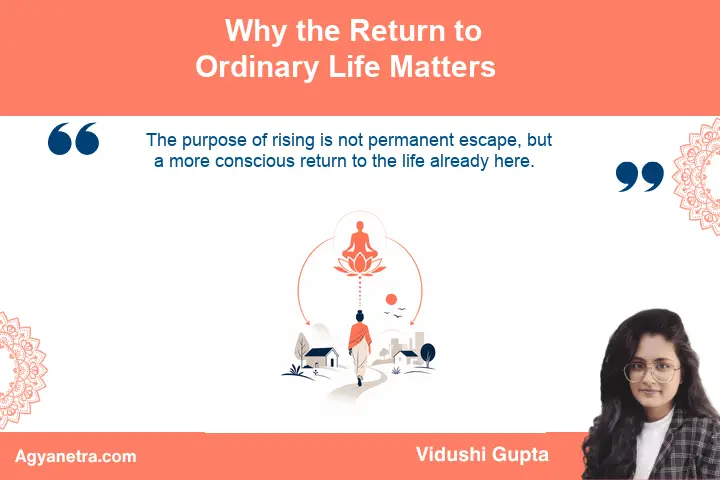
The purpose of rising is not permanent escape, but a more conscious return to the life already here.
This return does not erase transcendence. It gives transcendence a human expression through patience, truthful speech, responsible action, creativity, boundaries, and the willingness to remain present during discomfort.
Spiritual life therefore contains two complementary movements. One loosens rigid identification with the personal self; the other allows expanded awareness to inhabit personality, relationship, and material reality more fully.
The first movement can reveal inner freedom. The second tests whether that freedom remains available when someone disagrees with us, plans fail, grief arrives, or an old emotional pattern is activated.
This is why a spiritual awakening integration process matters. Insight becomes stable when it is gradually translated into embodied choices rather than protected as a special state.
How to Bring Heaven Home
Bringing Heaven home means allowing spiritual insight to change how you inhabit ordinary moments. The following practices make the movement from transcendence to embodiment more practical.
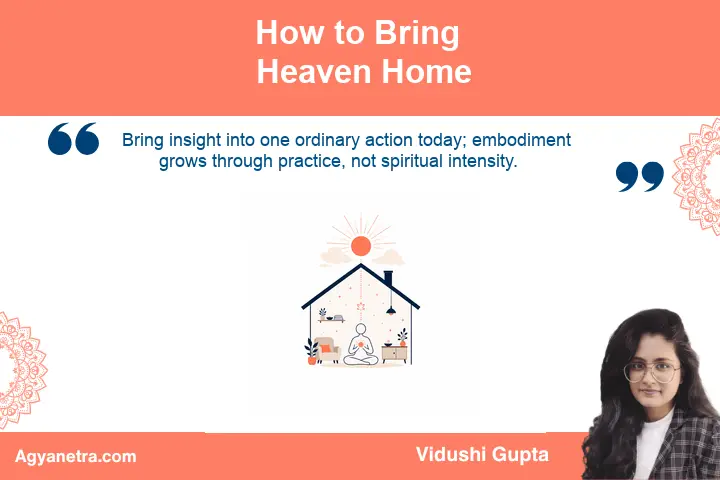
Bring insight into one ordinary action today; embodiment grows through practice, not spiritual intensity.
Return attention to the body
Notice your feet, breathing, posture, temperature, and physical surroundings. Simple sensory awareness can interrupt the tendency to live entirely in abstract spiritual ideas.
Eat regularly, protect your sleep, walk, and spend time in nature when possible. These actions are not less spiritual than meditation; they support the conditions needed to process experience.
Name what you are actually feeling
Instead of labeling an emotion as spiritually undesirable, identify it plainly: sadness, envy, fear, anger, shame, or loneliness. Naming an emotion helps you relate to it without becoming completely defined by it.
Ask what the feeling needs you to understand. The aim is neither indulgence nor suppression, but conscious contact with the human experience that is present.
Let relationships reveal your unfinished work
Observe what happens when you feel ignored, criticized, controlled, or misunderstood. Relational triggers often show where spiritual understanding has not yet become emotional capacity.
Practice listening without preparing a defense. Where repair is appropriate, acknowledge your impact rather than explaining why your intentions were spiritually correct.
Choose one grounded responsibility
Complete a neglected practical task, keep a promise, organize your space, or address a financial concern. Responsible action helps reconnect spiritual awareness with the material conditions of life.
If your energy feels scattered or unsteady, these methods for grounding yourself during spiritual awakening offer additional ways to regain physical and emotional steadiness.
Signs That Awakening Is Becoming Integrated
Integration is not measured by how often you feel elevated. It is reflected in your growing ability to remain aware, responsive, and grounded when life does not match your preferences.
You may notice less pressure to prove that you are spiritual. Extraordinary experiences can still be meaningful, but they no longer need to define your identity or separate you from others.
Difficult emotions become less threatening because you can meet them without immediately suppressing, dramatizing, or spiritualizing them. You become more willing to seek support when an experience exceeds your present capacity.
Relationships may grow more honest. You can hold boundaries without using detachment as punishment, and you can care for others without pretending that compassion requires endless self-sacrifice.
Most importantly, the ordinary begins to feel sacred rather than obstructive. Cooking, working, resting, apologizing, grieving, and caring for the body become places where awareness is practiced.
Integrated awakening makes you more available to life, not merely more fascinated by experiences beyond it.
Final Words
The Hunger for Heaven is not a weakness to overcome. It can open the mind beyond inherited identity and reveal dimensions of consciousness that ordinary ambition cannot satisfy.
But ascent is only one movement of spiritual life. If awakening makes the body, emotions, relationships, and material world seem inferior, something essential has been left outside our awareness.
The central insight explored by Vidushi Gupta in Ascension & Descension is that the return matters. What is discovered in silence must eventually meet speech, relationship, responsibility, and the unfinished places within us.
Heaven need not be abandoned, and Earth need not be escaped. A mature spiritual path allows the two to meet through a person who remembers the larger reality while participating fully in the life at hand.
FAQs
What does The Hunger for Heaven mean spiritually?
It describes the longing to move beyond limited identity and experience deeper truth, unity, meaning, or consciousness. The longing becomes constructive when it helps us live more consciously rather than reject ordinary life.
Is wanting spiritual transcendence unhealthy?
No. Transcendence can expand perspective and loosen restrictive patterns, but it becomes unhealthy when it is used to avoid emotions, responsibilities, relationships, or physical needs.
How can I tell whether I am spiritually awakening or escaping?
Notice the practical effects. Awakening generally supports honesty, compassion, responsibility, and presence, while escape often produces numbness, superiority, chronic withdrawal, or neglect of daily life.
What is the difference between ascension and embodiment?
Ascension describes movement beyond narrow identification, while embodiment brings that expanded awareness back into the body, relationships, choices, and responsibilities. A balanced spiritual life includes both.
How can I ground intense spiritual experiences?
Return attention to your senses, eat and sleep regularly, spend time in nature, reduce overstimulation, and complete simple practical tasks. Seek qualified professional support if disorientation or distress persists.
What does it mean to bring Heaven home?
It means expressing spiritual insight through ordinary life. Patience, truthful communication, emotional honesty, responsible action, and care for the body turn an elevated experience into lived understanding.

Vidushi Gupta is a spiritual coach, energy healer, and emotional wellness counselor with over 10 years of experience guiding people through spiritual signs, emotional healing, and inner transformation. She is the founder of Agyanetra and a published author of nearly ten novels, reaching over 20 million readers worldwide. Her approach is grounded, fear-free, and focused on helping readers understand spiritual experiences with clarity and emotional balance.