
The Mirror of the Outer World is a way of understanding how relationships, conflicts and emotional triggers can reveal parts of your inner life that still need attention. The people around you do not create every wound within you, but their words and choices may bring hidden fears, needs and protective patterns into view.
This perspective changes the question. Instead of focusing only on what another person did, you also become curious about why the experience affected you so strongly.
That curiosity does not excuse harmful behaviour. It helps you separate the reality of an event from the older pain, interpretation or fear that may have become attached to it.
Understanding the Outer World as a Mirror
A physical mirror reflects what stands before it; it does not produce the person or object being reflected. In shadow work, the mirror is a useful metaphor for experiences that make an unseen part of you easier to recognize.
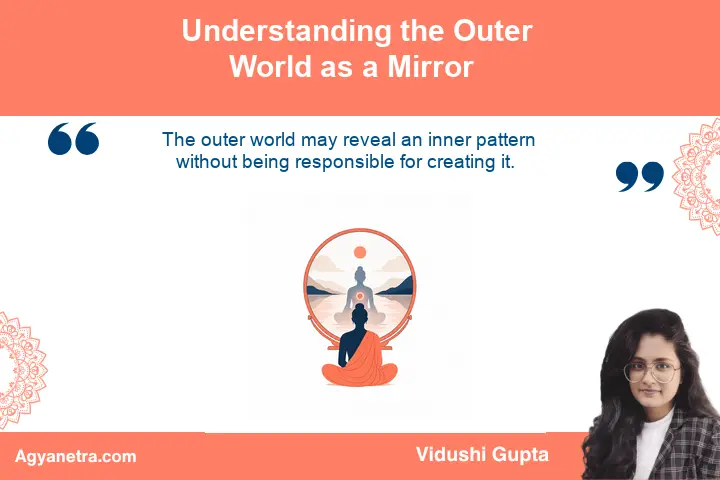
The outer world may reveal an inner pattern without being responsible for creating it.
A delayed message may expose your fear of being forgotten. Someone else’s confidence may awaken envy because you have denied your own wish to be visible. A firm boundary may uncover the belief that love requires constant access.
The reflection can also be positive. You may admire another person’s freedom, honesty or creativity because those qualities exist as neglected possibilities within you.
None of this means every perception is a projection. People can be dishonest, careless or unkind. The mirror becomes useful when you examine both the external facts and your internal response without confusing one for the other.
Why a Present Trigger Can Feel Much Larger
A trigger begins in the present, yet the intensity may come from more than the immediate situation. A current event can resemble an earlier experience closely enough to activate an old protective response.
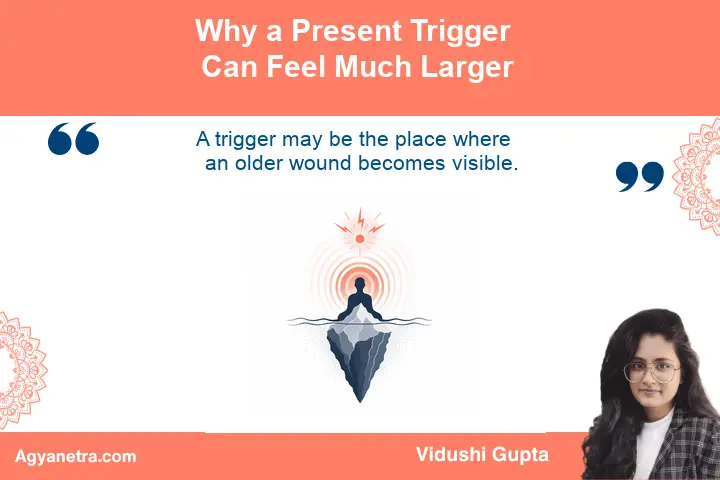
A trigger may be the place where an older wound becomes visible.
Imagine that someone becomes quiet during a disagreement. Their silence is happening now, but your body may respond as though every previous rejection is happening again. Your chest tightens, your thoughts race and you feel an urgent need to chase, withdraw or demand reassurance.
The event still matters. The silence may be inconsiderate, manipulative or simply a need for space. Shadow work asks you to investigate before deciding what it means.
Notice the scale of your reaction. If a small change produces overwhelming fear or anger, gently ask what the situation resembles. You may discover a younger part of yourself expecting abandonment, criticism or humiliation.
This is not a reason to dismiss your feelings. It is a way to understand why they arrived with such force and what kind of care they require.
Projection Without Self-Blame
Healthy self-examination asks what belongs to you; it does not declare everything your fault.
Projection happens when unrecognized material within you influences how you see another person. You might condemn someone’s need for attention while refusing to acknowledge your own need to be appreciated.
You may judge another person’s assertiveness because you were taught to hide anger. You may idealize someone who lives freely because you have not given yourself permission to make independent choices.
Projection does not prove that your observation is false. A controlling person may genuinely be controlling. The useful question is whether your reaction also carries fear, desire or judgment from your own history.
Try replacing “I must be imagining everything” with “What part of this experience is mine to understand?” That wording creates room for personal responsibility without erasing another person’s actions.
Relationships as Mirrors, Including Twin Flame Connections
Close relationships tend to reach places that casual contact does not. Love, uncertainty and separation can expose attachment patterns that remain quiet when little is emotionally at stake.
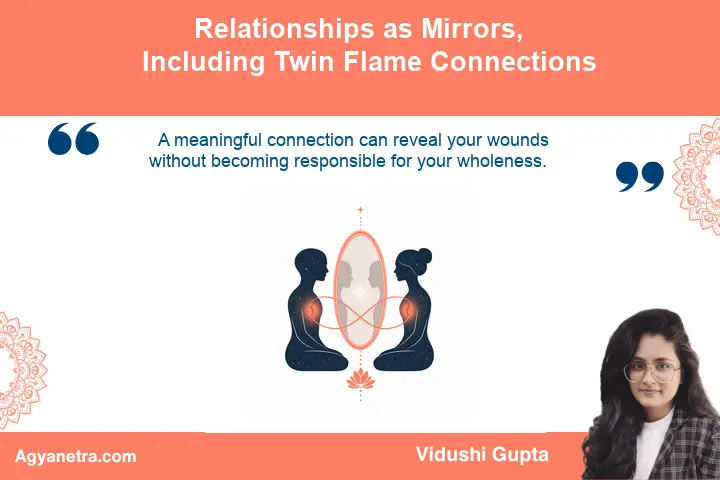
A meaningful connection can reveal your wounds without becoming responsible for your wholeness.
One common pattern begins when one person seeks closeness and the other seeks distance. Increased pursuit feels like pressure to the person withdrawing. Greater distance then feels like abandonment to the person pursuing, so each reaction strengthens the other.
Neither person has to be cruel for the cycle to become painful. Two protective strategies can collide until both people feel unseen.
Some people interpret an unusually intense bond through the spiritual idea of a twin flame. That language may help describe the sense of recognition and inner exposure, but it should not be used to justify obsession, disrespect or repeated harm.
The practical value of the mirror lies in what the connection reveals. Does longing contain a demand for certainty? Does the wish for union include a hope that someone else will repair your self-worth? Does surrender mean openness, or are you abandoning your needs?
No spiritual label removes another person’s right to choose distance. A relationship can matter greatly and still require boundaries, a different form or an ending.
What Anger, Longing and Love Can Reveal
Strong emotions become teachers when you listen to their message without letting them control your behaviour.
Anger may signal that a boundary was crossed or that something valuable needs protection. It may also serve as armour over fear, grief, helplessness or the expectation of being left.
Before expressing or suppressing anger, pause and ask what it is defending. The honest answer may be “I feel dismissed,” “I am frightened of losing this relationship,” or “I have ignored my own limit for too long.”
Longing deserves the same attention. Wanting closeness is human, yet longing can become painful when another person’s presence is treated as proof of your worth.
Love offers a demanding mirror. Can you care without possessing? Can you remain open while using discernment? Can you respect another person’s separate life without interpreting every independent choice as rejection?
Mature connection does not require two people to erase their individuality. It allows affection and commitment to exist alongside personal responsibility.

Shadows
Meeting The Darkness Within
Shadows explores the parts of ourselves we often reject, hide or project onto others. Through shadow work, wounded inner parts, emotional triggers and conscious integration, the book follows the journey from fragmentation toward inner union and wholeness.
A Practical Way to Ask What Belongs to You
Separate observable facts, personal interpretations and emotional history before choosing your response.
When you are triggered, avoid solving the entire relationship while your body is overwhelmed. Begin with a short inquiry that distinguishes the other person’s responsibility from your own.
- Name the observable event. Describe what happened without assigning motive. For example, “They did not answer today” is more precise than “They are trying to punish me.”
- Notice your bodily response. Identify tightness, heat, shaking, numbness or restlessness. This helps you recognize activation before it turns into impulsive action.
- Name the feeling and urge. You may feel afraid and want to chase, or feel angry and want to withdraw. An urge is information, not an instruction.
- Identify the story. Ask what you immediately assumed. Common stories include “I am unwanted,” “I have no control” or “I must prove my value.”
- Look for an older resemblance. Consider whether this feeling has appeared in earlier relationships, family experiences or periods of exclusion.
- Choose one grounded action. You might request clarification, set a limit, wait until you are calmer or decide that the pattern is no longer acceptable.
Their words and decisions remain theirs. Your interpretation, healing and next action remain yours. Holding both truths protects inner authority without denying relational responsibility.
Making Space Between Feeling and Action
Integration does not mean that triggers disappear or that you become emotionally detached. It means you are less likely to be completely directed by the first wave of fear, anger or longing.
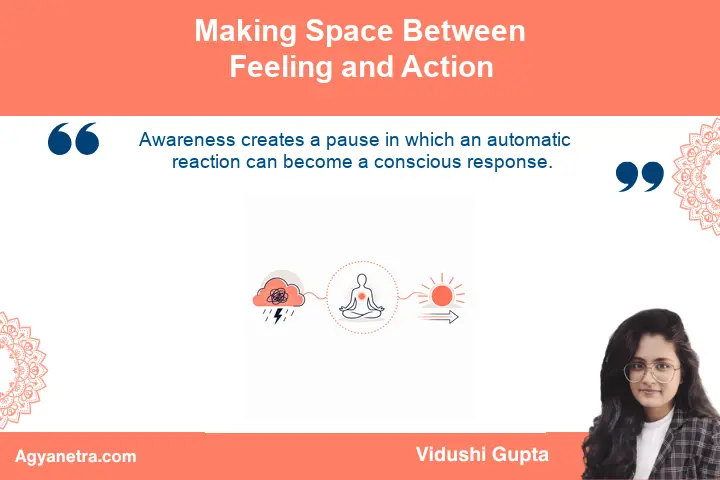
Awareness creates a pause in which an automatic reaction can become a conscious response.
When activation rises, take a few slow breaths and feel your feet against the floor. Name what is present in simple language: “Fear is here,” or “Part of me expects rejection.”
This wording creates a little distance between your identity and the emotion. You are experiencing fear; you are not only fear. You can witness the wounded part without allowing it to send a message, make an accusation or end a relationship on your behalf.
Once the body settles, return to the facts. Decide whether the moment calls for communication, patience, repair, a boundary or disengagement. Conscious response includes firm action when firm action is needed.
When the Mirror Calls for a Boundary
Turning inward should increase discernment, not train you to tolerate mistreatment.
Shadow work can become harmful when every painful interaction is treated as a lesson you must endure. Sometimes repeated dishonesty, contempt, coercion or disregard is evidence that a relationship is unhealthy.
You can examine your abandonment fear and still leave. You can recognize your projection and still disagree with someone. You can understand another person’s protective pattern without accepting its impact on your life.
A boundary may involve limiting contact, refusing a particular behaviour, seeking support or ending the relationship. It is not a failure of love to acknowledge that a connection cannot continue in the form you wanted.
The mirror is useful only when it returns you to honest awareness. If a spiritual interpretation keeps you trapped in blame, fantasy or danger, step back and attend to observable reality.
Final Words
The purpose of The Mirror of the Outer World is not to make you endlessly analyse other people. Its invitation is to notice what their presence brings forward within you and meet that material with honesty.
Some people will be companions, some will be catalysts and others will simply be human beings carrying unfinished stories of their own. You do not need every reflection to feel pleasant. You need enough awareness to see clearly.
Each time you recognize a projection, comfort a frightened part or choose a boundary instead of an automatic reaction, a hidden fragment becomes easier to reclaim. The mirror has served its purpose when your attention returns home.
FAQs
What does the outer world as a mirror mean in shadow work?
It means that people and situations can reveal hidden fears, needs, judgments or protective patterns within you. They may expose inner material without causing all of it.
Does being triggered mean the problem is only within me?
No. A present event may be genuinely hurtful while also activating an older wound. Examine both the external behaviour and your internal response.
How can I tell whether I am projecting onto someone?
Look for unusually intense certainty, repeated judgments or qualities you strongly condemn or idealize. Then ask whether the same quality, need or desire is unrecognized within you.
Can a twin flame relationship be a mirror?
Some people use the twin flame idea to interpret an intense relationship that exposes attachment and fear. The label should never be used to excuse obsession, violated boundaries or harmful behaviour.
What should I do when a relationship triggers abandonment fear?
Pause before reacting, identify the observable event and name the story your mind created. Regulate your body first, then seek clarification or set a boundary based on the facts.
How do I practise shadow work without blaming myself?
Ask what belongs to the other person and what belongs to you. Take responsibility for your interpretation and response while holding others accountable for their choices.

Vidushi Gupta is a spiritual coach, energy healer, and emotional wellness counselor with over 10 years of experience guiding people through spiritual signs, emotional healing, and inner transformation. She is the founder of Agyanetra and a published author of nearly ten novels, reaching over 20 million readers worldwide. Her approach is grounded, fear-free, and focused on helping readers understand spiritual experiences with clarity and emotional balance.