
The Sacred Marriage Within is the inner union of complementary qualities such as strength and tenderness, reason and intuition, action and stillness. It is not about biological sex or rigid gender roles. It is a spiritual and psychological path through which opposing energies learn to cooperate instead of competing for control.
Many inner struggles begin when we identify with one side of ourselves and reject the other. We may value discipline but fear softness, trust feelings but avoid decisions, or pursue achievement while losing contact with meaning.
Wholeness develops when these divided qualities become partners. We do not erase their differences; we help them serve a shared purpose.
What the Sacred Marriage Within Means
The sacred marriage is a symbolic union within human consciousness.
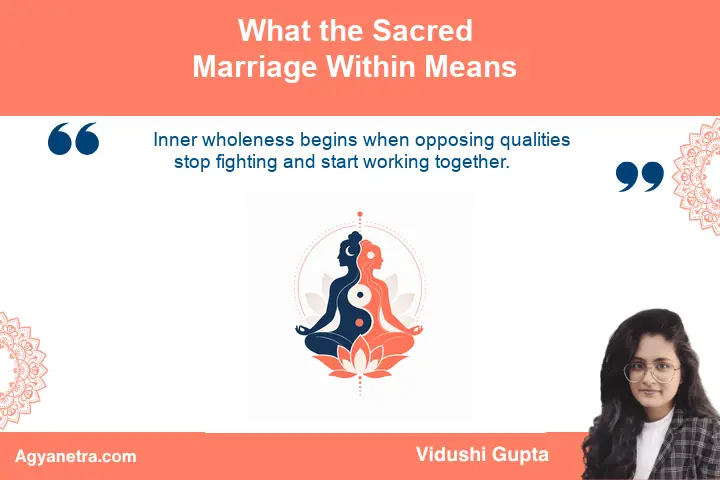
Inner wholeness begins when opposing qualities stop fighting and start working together.
The expression is related to the ancient idea of hieros gamos, or sacred union. In inner work, however, it does not describe a literal marriage. It points to reconciliation between energies that appear opposite but are deeply interdependent.
Clarity needs compassion. Receptivity needs discernment. Creative freedom benefits from structure, while disciplined effort needs moments of rest and renewal.
This union does not produce a personality with no tension or difference. It produces a more spacious consciousness capable of holding complexity without immediately choosing one extreme.
Vidushi Gupta presents this inner marriage as a movement from fragmentation toward communion. A related exploration of individuation and the inner marriage of self can help place this process within the wider journey of psychological integration.
The Healthy Masculine and Feminine Within
Masculine and feminine energy are best understood as symbolic patterns available to every person.
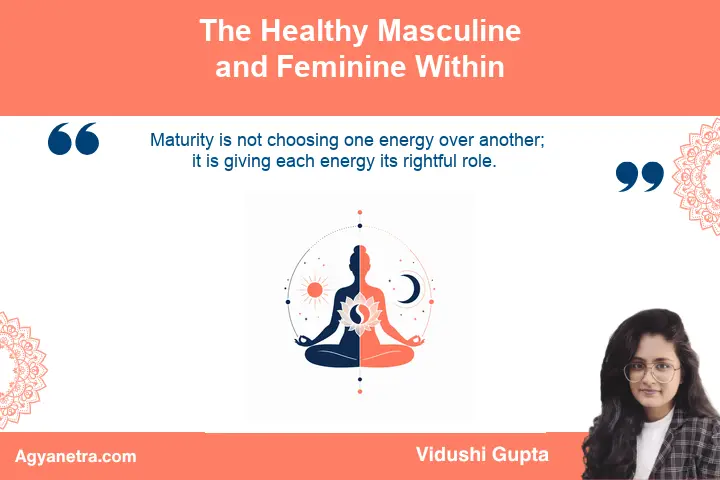
Maturity is not choosing one energy over another; it is giving each energy its rightful role.
The healthy masculine offers direction, responsibility, courage, focus and boundaries. It helps us identify what matters, make decisions and continue acting when comfort or motivation fades.
Its strength is not domination. Mature masculine energy creates a reliable container, much like riverbanks give water a direction without denying its natural movement.
The healthy feminine offers intuition, compassion, creativity, adaptability and connection. It helps us feel what is alive, receive experience honestly and notice what cannot be understood through analysis alone.
Its receptivity is not weakness. Mature feminine energy can remain open without abandoning self-respect, and it can surrender to life without surrendering personal responsibility.
These qualities are not assigned by gender. A balanced person needs both the capacity to act and the capacity to listen, regardless of identity, culture or social role. This is the foundation of genuine masculine and feminine energy balance.
How Inner Energy Becomes Wounded
A healthy quality becomes harmful when fear turns it into an extreme.
Masculine energy becomes wounded when direction hardens into control. Discipline becomes perfectionism, protection becomes possessiveness, confidence becomes aggression, and logic is used to dismiss emotion.
Behind this pattern is often a fear of vulnerability. Walls are built for safety, but those same walls eventually prevent trust, intimacy and honest self-awareness.
Feminine energy becomes wounded when receptivity loses its boundaries. Compassion turns into chronic self-sacrifice, sensitivity becomes overwhelm, love becomes dependency, and patience becomes avoidance.
In this pattern, preserving connection may feel more urgent than preserving dignity. A person may continually accommodate others while becoming disconnected from personal needs and worth.
Families and cultures can reinforce both wounds. Some people are rewarded only for productivity and toughness; others are encouraged to remain agreeable, emotionally available or dependent.
Recognizing the pattern is not about blaming gender. It is about reclaiming capacities that conditioning taught us to distrust.
The Essential Rhythm of Doing and Being
Doing gives intention a form, while being ensures that the form remains connected to life.
A practical way to understand inner balance is to observe the relationship between doing and being. Doing plans, chooses and moves forward. Being listens, receives and inhabits the present moment.
Too much doing can create impressive results without inner meaning. Life becomes a series of targets, and rest may feel uncomfortable because identity has become tied to productivity.
Too much being without grounded action creates a different imbalance. Insight remains unexpressed, important decisions are postponed, and surrender can become a spiritual explanation for avoiding responsibility.
Breathing offers a simple image of cooperation. Inhalation receives and exhalation releases. Neither phase can replace the other, and health depends upon their continuing rhythm.
Before acting, pause long enough to sense what is true. After reflecting, choose one concrete step. This small movement between awareness and action trains the two energies to trust one another.
Ardhanarishvara and the Union of Shiva and Shakti
Ardhanarishvara offers one of the clearest spiritual images of inseparable opposites.
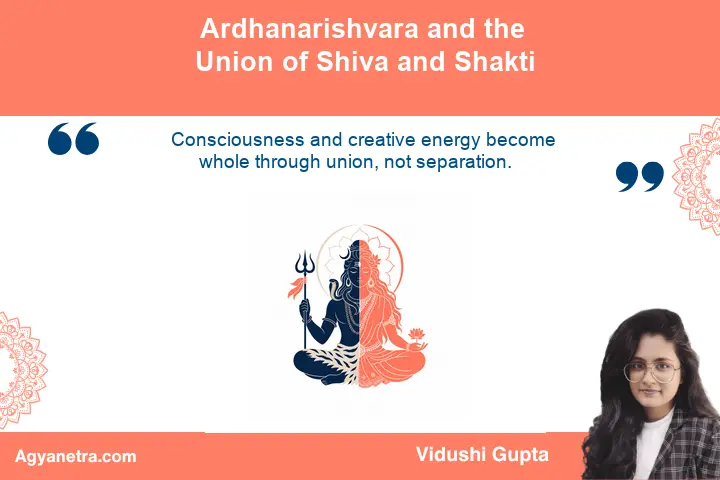
Consciousness and creative energy become whole through union, not separation.
In this form, Shiva and Parvati appear as one being. The image reveals a reality that cannot be reduced to masculine alone or feminine alone.
Shiva represents consciousness, awareness and still presence. Shakti represents energy, movement, creation and manifestation. Awareness without energy remains unexpressed, while energy without awareness lacks conscious direction.
Psychologically, this symbol reminds us that wisdom needs love and that compassion needs strength. Boundaries without tenderness become cold, but tenderness without boundaries becomes fragile.
The aim is not to imitate a deity or force ourselves into an abstract ideal. The image can instead become a mirror: Where is awareness disconnected from action? Where is energy moving without clarity? The answers reveal where integration is needed.
Readers who want deeper symbolic context can explore what Shiva and Shakti represent in spiritual life.
How to Practise the Inner Marriage
Integration grows through ordinary choices rather than one dramatic spiritual experience.
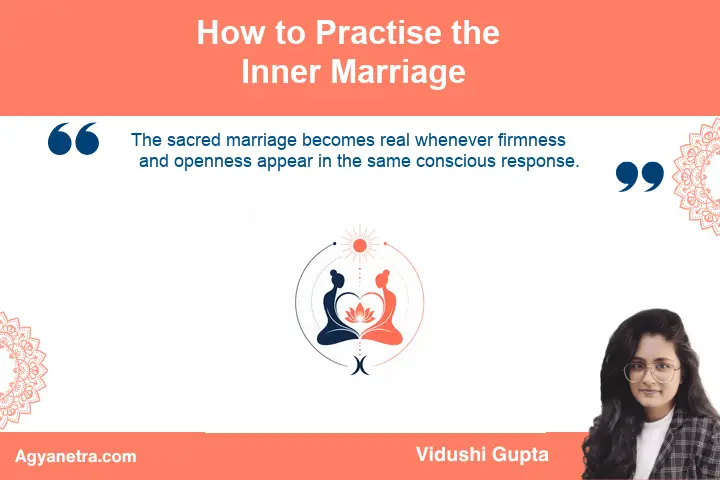
The sacred marriage becomes real whenever firmness and openness appear in the same conscious response.
Begin by noticing which qualities feel familiar and which feel threatening. If you are comfortable with action but uneasy with receptivity, practise listening without preparing an answer. If you reflect endlessly, choose a small action with a clear deadline.
Use paired questions
When facing a difficult situation, ask questions from both sides of your nature:
- What is true, and what needs to be felt?
- What action is required, and what needs time to unfold?
- Where is a boundary needed, and how can it remain compassionate?
- What can I influence, and what must I stop trying to control?
Do not rush to make the answers agree. The practice is to hear both forms of intelligence before deciding.
Build a container without forcing an outcome
Create enough structure to support what matters. Set a time for creative work, define a respectful boundary or make a realistic plan. Then leave room for adjustment, feeling and unexpected insight.
This prevents structure from becoming rigidity and openness from becoming disorder.
Review your response
At the end of the day, consider one meaningful interaction. Did you become forceful, passive, emotionally flooded or overly detached? Imagine how the missing quality could have joined the response.
The purpose is not self-criticism. It is to expand your range so that strength, intuition, compassion and responsibility become available when life calls for them.
How Inner Wholeness Changes Relationships
A partner can support your growth, but cannot permanently carry the qualities you refuse to develop.
People often look for someone who embodies their undeveloped capacities. A person disconnected from strength may idealize a powerful partner, while someone cut off from tenderness may expect another person to provide endless emotional care.
Attraction itself is not the problem. Difficulty begins when another person is expected to complete an inner task that belongs to us.
As integration develops, relationships become less transactional. We can receive support without demanding rescue, express needs without making another person responsible for our identity, and offer love without disappearing into self-sacrifice.
Healthy love is therefore not the meeting of two flawless people. It is the meeting of people willing to take responsibility for their own inner development. Understanding the difference between healthy and codependent love can clarify where connection ends and emotional dependency begins.
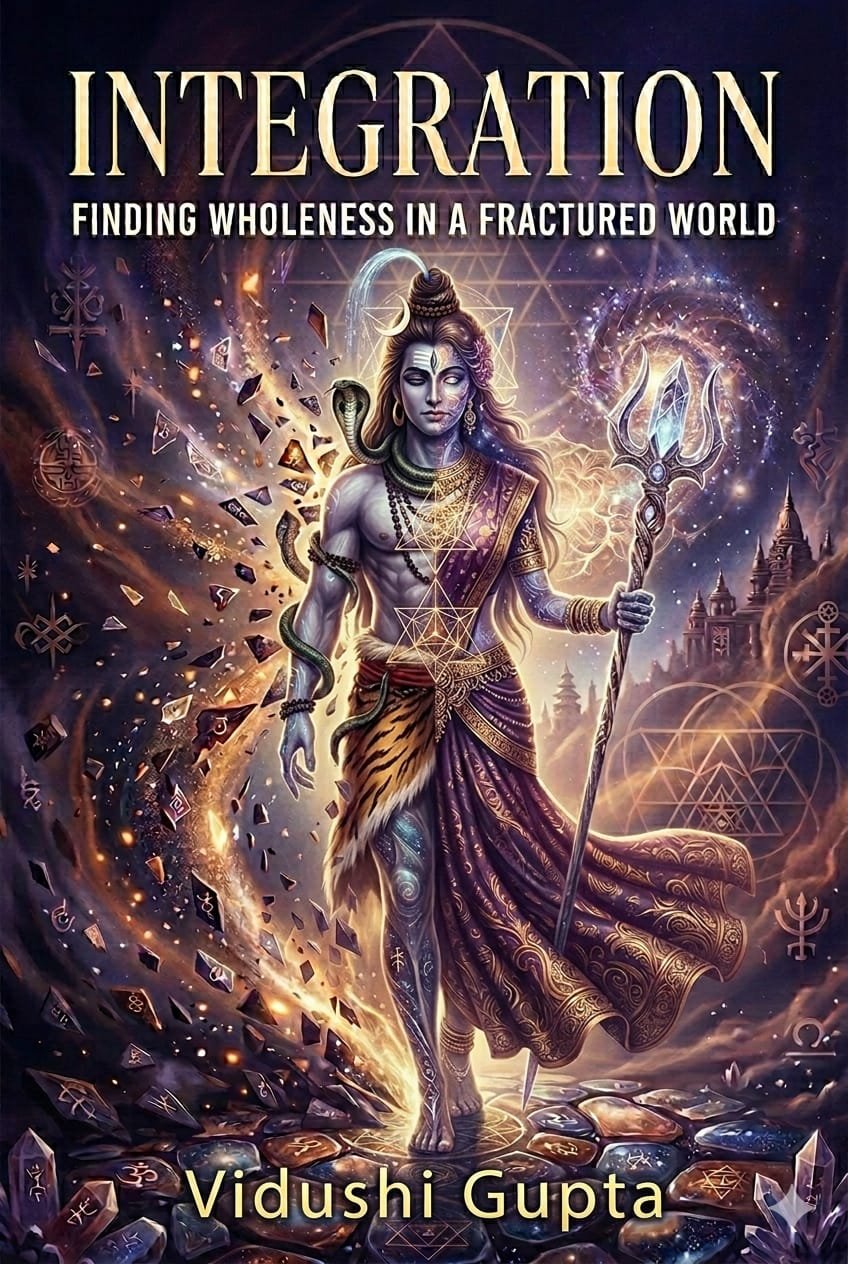
Finding Wholeness in a Fractured World
Integration explores inner fragmentation, emotional healing, shadow work, self-awareness and the journey towards inner wholeness. It is written for readers who want to understand themselves more deeply and bring spiritual awareness into everyday life.
Uniting Spiritual Life with the Ordinary World
Spiritual integration is complete only when awareness enters the body, work and relationships.
The sacred marriage reaches beyond masculine and feminine symbolism. It also heals the apparent division between spirit and matter, soul and body, contemplation and daily responsibility.
Spirituality can become another form of fragmentation when the body is treated as inferior or ordinary life is viewed as an obstacle. Integration asks us to bring consciousness into the world rather than using spiritual ideas to escape it.
Work can express integrity. Rest can become reverence for the body. A difficult conversation can become a practice of courageous compassion. Even routine tasks can carry presence when they are performed without inner resistance or unconscious haste.
The sacred is not limited to exceptional experiences. It becomes visible whenever inner awareness and outward participation meet.
Final Words
The Sacred Marriage Within does not ask one side of the personality to defeat the other. It asks strength to listen, tenderness to stand firmly, action to receive guidance and stillness to become embodied.
This work continues throughout life. Each honest boundary, compassionate decision and grounded act of surrender brings the divided self into deeper cooperation.
When inner opposites become partners, power can serve love, creativity can receive direction, and spiritual awareness can take practical form. Wholeness is not uniformity. It is the living communion of everything within us that was never meant to remain separate.
FAQs
What is the sacred marriage within?
The sacred marriage within is the psychological and spiritual union of complementary qualities such as action and receptivity, strength and tenderness, or reason and intuition. It describes inner integration rather than a literal marriage.
Is the sacred marriage only about men and women?
No. Masculine and feminine are symbolic terms for universal qualities present in every person, regardless of sex, gender or relationship status.
How do I know if my inner masculine energy is wounded?
Common signs include controlling behaviour, rigid perfectionism, aggression, emotional dismissal and fear of vulnerability. Healthy masculine energy provides direction and boundaries without domination.
How do I know if my inner feminine energy is wounded?
Signs can include weak boundaries, emotional overwhelm, passivity, dependency and repeated self-sacrifice. Healthy feminine energy remains receptive and compassionate without abandoning self-worth.
How can I balance doing and being?
Pause to sense what is true before taking action, then choose one practical next step instead of remaining in reflection. Alternate focused effort with deliberate periods of rest, listening and presence.
What does Ardhanarishvara represent in inner healing?
Ardhanarishvara represents Shiva and Shakti as one reality. Psychologically, the image points to the integration of consciousness with energy, wisdom with love, and strength with compassion.
Can inner integration improve a relationship?
Yes. It reduces the pressure on a partner to supply your missing strength, security or tenderness. This makes it easier to communicate needs, maintain boundaries and love without dependency.

Vidushi Gupta is a spiritual coach, energy healer, and emotional wellness counselor with over 10 years of experience guiding people through spiritual signs, emotional healing, and inner transformation. She is the founder of Agyanetra and a published author of nearly ten novels, reaching over 20 million readers worldwide. Her approach is grounded, fear-free, and focused on helping readers understand spiritual experiences with clarity and emotional balance.