I have always found that the deepest spiritual truths do not arrive as fixed ideas. They arrive as movement. A season ends.
A belief breaks. A silence opens. Something within dies, and something more alive begins to appear.
That is why the image of Shiva as the cosmic dancer has never felt decorative to me. It feels exact.
When I contemplate the spiritual meaning of the cosmic dance of Shiva, I do not see only a beautiful symbol from Hindu tradition. I see a living teaching about how existence itself works.
Nothing stands still for long. Creation arises, form stabilizes, illusion builds, destruction comes, and consciousness keeps dancing through all of it. The image of Nataraja carries this mystery with extraordinary power.
In my experience, it speaks not only about the universe but also about the inner life of every seeker.
We are all being moved through cycles of birth, preservation, dissolution, concealment, and awakening.
The real question is whether we resist that dance or learn to recognize its wisdom.
The Spiritual Meaning of the Cosmic Dance of Shiva: Nataraja reveals the universe as movement, not stillness
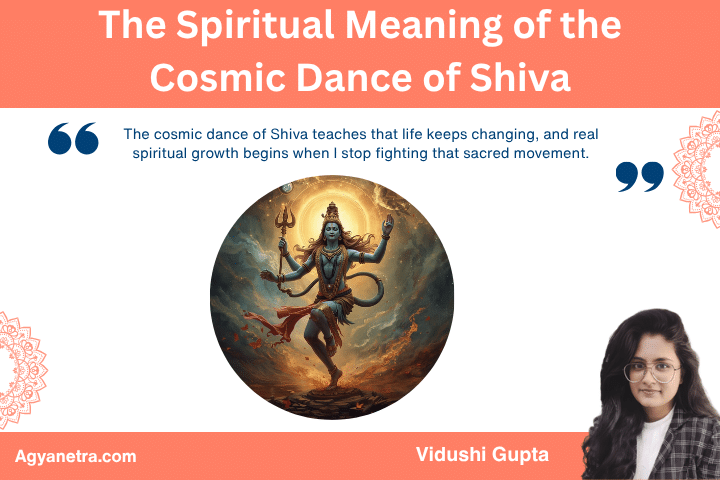
In Hindu spiritual thought, Nataraja is Shiva as the Lord of the Dance.
This form is especially rich in Shaiva and Tantric understanding because it shows that reality is not static. It is rhythmic, alive, pulsing with intelligence.
The dance of Shiva is not random movement. It expresses what many traditions understand in different ways: existence is dynamic.
In the image of Nataraja, Shiva dances within a circle of fire. That ring is not merely ornament.
It represents the universe itself — the endless movement of manifestation, time, change, energy, and dissolution.
In one hand, Shiva holds the damaru, the small drum. To me, this is the pulse of creation, the first vibration, the sound from which form begins.
In another hand, he holds fire, which symbolizes destruction. Already the teaching is clear: creation and destruction are not enemies. They belong to the same sacred rhythm.
In Kashmir Shaivism, consciousness is never separate from its power of expression. Shiva is not an absent witness sitting outside the cosmos.
Shiva is consciousness alive as the cosmos. Shakti, the dynamic force, moves as the dance itself.
I have seen many seekers try to force spiritual life into something rigid, linear, and predictable. But consciousness does not unfold like a straight line.
It moves more like music. There are crescendos, pauses, ruptures, returns. Nataraja reminds me that spiritual life is not a static perfection. It is a living rhythm that must be felt, not merely explained.
Shiva does not dance to decorate the universe. Shiva dances because existence itself is movement.
Free PDF Book
Awakening Maya To Moksha
Integration of the final soul lessons and transcendence of physical identity into pure awareness.
Why destruction is not the opposite of grace
One of the hardest truths on the path is that grace does not always look gentle. Sometimes grace removes. Sometimes it burns.
Sometimes it takes away the structure I was clinging to because that structure had become too small for truth.
This is where the fire in Shiva’s dance becomes deeply important. In spiritual life, destruction is not always punishment.
Very often, it is purification. The false self resists this because it wants comfort more than truth. But the soul knows better.
I often explain this to seekers with a simple image. A tree does not become healthy by keeping every dead branch.
It grows by allowing what is lifeless to fall away. Spiritual destruction works in the same way. Shiva’s fire does not exist to harm what is real. It clears what no longer carries life.
In Buddhism, the insight of anicca — impermanence — points toward the same truth. Everything conditioned changes.
Suffering deepens when I cling to what is already passing. In Sufi teaching, the movement of fana also reflects this sacred dissolving of false identity in the fire of divine reality.
I have learned this lesson more than once, and not always gracefully. There were times when I called something “my path” long after it had become fear wearing spiritual language.
When life broke it open, I suffered. Later I could see the mercy in that breaking. What fell away had stopped serving the truth.
The cosmic dance of Shiva teaches me that destruction is not outside the sacred. Destruction is one of the sacred’s most honest movements.
What Shiva burns is not my essence. It is what keeps my essence hidden.
Read More: What Shiva and Shakti Represent in Spiritual Life?
How the cosmic dance lives inside meditation and inner practice
If Nataraja remains only an outer symbol, I miss half the teaching. The deeper question is this: where is this dance happening in me right now?
In meditation, I can observe the whole cosmic rhythm in miniature. A thought arises. It stays for a while.
It dissolves. An emotion comes. It intensifies. It passes. An identity gets activated. Awareness sees it. Something loosens. Something ends. Something new opens. The dance is constant.
This is one reason I respect the Yoga Sutras of Patanjali so much. They teach me to notice the fluctuations of the mind without becoming trapped in them.
But I have also learned that stillness does not mean the dance stops. It means I stop confusing myself with every movement in it.
A simple practice I use is this. Sit in silence for ten minutes. Watch one thing arise in awareness — a memory, a sensation, a feeling, a desire. Do not interfere. Simply ask:
- What is appearing?
- What is disappearing?
- What in me remains while this changes?
That last question matters. It introduces me to the Shiva principle as witnessing consciousness.
But the appearance and disappearance I am observing belong to Shakti, to life-force, to movement. Both are present.
One thing I learned the hard way is that many seekers want meditation to become blankness. They think silence means nothing should move. But that is not how real practice unfolds.
Sometimes meditation becomes more alive, not less. The point is not to stop the dance.
The point is to recognize the dancer, the dance, and the awareness in which both are known.
What I have observed in seekers when life begins to dismantle an old self
In my years of spiritual counseling, I have seen a pattern that repeats with almost painful consistency.
A seeker reaches a threshold where life begins dismantling an old identity, and the first interpretation is almost always fear.
They assume they are regressing. They assume the path has gone wrong. They assume peace has left them.
What I usually see is something else entirely. I see Shiva dancing.
A man once came to me after losing both a relationship and a professional identity in the same year. He said, “Everything I built is collapsing, and I do not know who I am without it.”
That sentence itself contained the doorway. He had mistaken his constructed self for his essential self. Life was not destroying him. Life was destroying what he had used to avoid deeper truth.
It took time. These processes do. But once he stopped treating collapse as failure, his whole relationship to the experience changed.
He became quieter, more sincere, less performative in his spirituality. What emerged was humbler and far more real than what had fallen away.
I have also watched seekers resist this movement by trying to glue their old self back together with spiritual concepts.
They read more, affirm more, ritualize more, but they do not surrender. And the suffering continues until they do.
In Awakening Maya to Moksha, I write about this stage as the point where the path stops flattering the ego and starts freeing the soul. That is often the real beginning of spiritual adulthood.
The symbolism most people miss in the image of Nataraja
A lot of people know the general image of Shiva dancing, but they do not slow down enough to read its details. The details matter. They are not decorative. They are teaching.
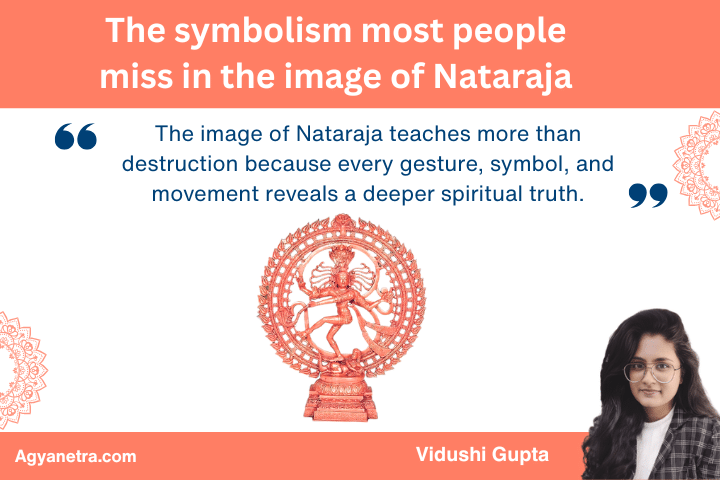
The raised foot of Nataraja symbolizes liberation. Even while the dance of life continues, freedom remains possible.
I find that deeply consoling. Spiritual freedom is not waiting at the end of all movement. It is present within the movement.
One hand is raised in abhaya mudra, the gesture of fearlessness. That tells me something profound.
The universe is changing constantly, forms are dissolving constantly, but I do not need to live in terror of change. Fearlessness is part of awakening.
Beneath Shiva’s foot lies Apasmara, the dwarf of forgetfulness or ignorance. This is a subtle teaching that many people overlook.
Ignorance is not destroyed through aggression. It is subdued by awakened consciousness. The ego’s confusion is not the center of the dance. It is beneath it.
Then there is the hair flying outward. To me, this has always symbolized a consciousness so vast it cannot remain neatly contained. Spiritual life is not sterile. It is alive.
I also want to clear one misconception. Many people think Shiva’s cosmic dance is mainly about destruction.
It is not. It is about the whole cycle — creation, preservation, dissolution, concealment, and grace.
In Shaiva Siddhanta and related traditions, these five acts are central. That means Nataraja is not a god of endings only. He is the full rhythm of existence itself.
How I live the teaching of the cosmic dance in ordinary life
For me, this teaching becomes real in very human moments. It becomes real when I stop calling every ending a mistake.
It becomes real when I allow a season to close without trying to resurrect it through fear. It becomes real when I let grief move honestly, instead of turning it into an identity.
Some days this looks simple. I notice a pattern in myself that has become stale and stop feeding it.
I let a conversation end cleanly instead of prolonging it with ego. I release a belief that once served me but now blocks growth. Those are small tandavas too.
Other days, the teaching asks for more. It asks me to stand inside uncertainty without trying to control the next form before it arrives.
That is not easy. I still learn this again and again. The mind wants guarantees. The dance offers rhythm instead.
What helps me most is remembering that Shiva’s dance is not chaos. It is intelligent movement.
That changes how I meet change. I do not have to like every ending. But I can trust that endings are not outside the sacred order.
When I live this way, spiritual life becomes less rigid and more truthful. I become less interested in preserving appearances and more willing to stay aligned with what is actually alive. That is how the dance becomes guidance, not just symbolism.
Conclusion
The spiritual meaning of the cosmic dance of Shiva reaches far beyond mythology. It reveals a living truth about existence and about the inner journey: consciousness does not grow through fixed certainty.
It grows through rhythm, surrender, purification, and the courage to let old forms fall away.
Nataraja teaches me that creation and destruction are part of one sacred movement. What arises will one day dissolve. What dissolves makes space for what is more true.
When I stop resisting that rhythm, spiritual life becomes less about control and more about participation in a wisdom already moving through everything.
The dance never really stops. The real shift happens when I begin to recognize it, trust it, and live in step with it.
FAQs
What is the spiritual meaning of the cosmic dance of Shiva?
The cosmic dance of Shiva represents the sacred rhythm of creation, preservation, destruction, concealment, and liberation. In the form of Nataraja, Shiva shows that life is not static but constantly moving through cycles of change. In spiritual life, this teaches me that endings are not separate from grace. They are often part of how truth makes space for a deeper beginning.
What does Nataraja symbolize in Hindu spirituality?
Nataraja symbolizes Shiva as the Lord of the Dance and the living intelligence behind the movement of the universe. The drum represents creation, the fire represents destruction, the raised hand gives fearlessness, and the lifted foot points toward liberation. The image is not only artistic or mythological. It is a complete spiritual teaching about how consciousness moves through life and change.
Why is Shiva’s dance connected with destruction?
Shiva’s dance is connected with destruction because destruction is one essential part of spiritual renewal. In Hindu symbolism, Shiva does not destroy what is real. He destroys illusion, ego attachment, and forms that can no longer hold life. That is why the cosmic dance of Shiva is not about violence. It is about sacred transformation through necessary endings.
How does the cosmic dance of Shiva relate to personal transformation?
In personal transformation, Shiva’s dance shows up whenever an old identity, belief, or pattern begins to fall apart. Many people think this means something has gone wrong, but in my experience it often means consciousness is clearing space for truth. The cosmic dance teaches me that personal change is not random chaos. It is part of a deeper rhythm of spiritual growth.
What does the raised foot of Nataraja mean?
The raised foot of Nataraja symbolizes liberation and spiritual freedom. It reminds me that even while life continues moving through challenge, change, and uncertainty, awakening is still possible. This part of the image is deeply comforting because it teaches that freedom is not somewhere outside life. It is found in the midst of the dance.
What does the dwarf under Shiva’s foot represent?
The dwarf under Shiva’s foot is called Apasmara, and it represents ignorance, forgetfulness, and spiritual unconsciousness. The image shows that ignorance is not the ruler of life. It is something awakened consciousness can hold down and move beyond. For a seeker, this means confusion and ego are not the final truth.
How can I apply the teaching of Shiva’s cosmic dance in daily life?
I apply it by learning not to panic every time life changes form. When something ends, I ask whether it was meant to continue or whether Shiva is clearing space for something more honest. A practical way to work with this is to reflect on one thing in your life that feels complete, exhausted, or no longer true. Then ask what you are trying to preserve out of fear.
Is Shiva’s cosmic dance only about destruction?
No, and this is one of the biggest misunderstandings people have. The cosmic dance of Shiva includes creation, preservation, destruction, concealment, and grace. It is a complete picture of how life moves, not just a symbol of endings. Once I understand that, Shiva stops looking like a force of fear and starts revealing himself as the intelligence behind sacred change.
More:
Five South Indian Temples That One Must Visit
Abrahamic Religions of the World

Vidushi Gupta is a spiritual coach, energy healer, and emotional wellness counselor with over 10 years of experience guiding people through spiritual signs, emotional healing, and inner transformation. She is the founder of Agyanetra and a published author of nearly ten novels, reaching over 20 million readers worldwide. Her approach is grounded, fear-free, and focused on helping readers understand spiritual experiences with clarity and emotional balance.