
The Trap of Staying Above begins when spiritual peace becomes a place to hide rather than a foundation for conscious living. After touching stillness, expanded awareness, or deep inner connection, ordinary responsibilities and emotional conflicts may feel heavy, distracting, or somehow less sacred.
Wanting to preserve a higher state is understandable. The problem appears when transcendence becomes avoidance—when spiritual language protects us from necessary action, honest emotion, difficult conversations, or practical responsibility.
Awakening is not only about rising beyond familiar patterns. It is also about bringing greater awareness back into the body, relationships, work, choices, and imperfect conditions of everyday life.
Why Transcendence Can Become a Spiritual Trap
A profound spiritual experience can change how we see ourselves and the world. Yet the contrast between inner spaciousness and ordinary stress may create a strong desire to remain untouched by human complexity.
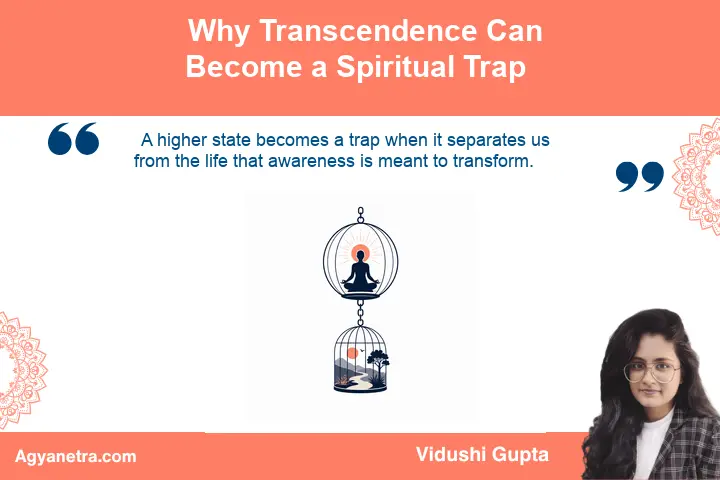
A higher state becomes a trap when it separates us from the life that awareness is meant to transform.
Inner peace can feel clean and expansive, while unresolved relationships, deadlines, financial concerns, and family patterns feel chaotic. We may start treating one state as spiritual and the other as an interruption.
This division can lead us to withdraw while calling it detachment. We may postpone decisions in the name of divine timing, avoid speaking honestly because we want to protect our peace, or suppress anger because it appears spiritually unacceptable.
Some people also experience a sense of distance from daily reality during periods of inner change. Understanding why spiritual awakening can feel disconnected from reality can help distinguish genuine spaciousness from ungrounded withdrawal.
Transcendence itself is not the problem. Its value depends on whether it makes us more available to life or less willing to meet it.

Ascension & Descension
The spiritual journey does not end when consciousness rises. It becomes complete when wisdom returns to life.
Ascension & Descension explores the movement from spiritual awakening toward embodiment. Through Kundalini, shadow work, Twin Flame experiences and the return from Crown to Root, the book explores what happens when spiritual insight enters the body, relationships, responsibility and everyday human life.
Signs You May Be Staying Above Your Life
Spiritual avoidance is often subtle because it can resemble calmness, surrender, or wisdom. The clearest test is not how elevated an experience feels, but how it affects your behaviour.
Look at what your spirituality helps you face, not only at what it helps you feel.
You may be staying above your life if spiritual ideas repeatedly replace direct communication or practical action. Another sign is feeling irritated when ordinary needs, emotions, or responsibilities disturb your preferred inner state.
- You call withdrawal detachment without explaining your needs.
- You wait for signs instead of making a necessary decision.
- You dismiss pain as low vibration rather than listening to it.
- You idealize a relationship while ignoring its actual behaviour.
- You use forgiveness to avoid setting a boundary.
- You feel spiritually superior to people focused on ordinary life.
These patterns do not mean your awakening is false. They show where insight has not yet become embodied choice.
Ask a simple question: “Is this belief helping me respond with greater honesty, compassion, and responsibility?” If the answer is no, pause before calling the response spiritual.
True Detachment Does Not Require Withdrawal
Detachment is sometimes misunderstood as emotional distance or indifference. In practice, mature detachment means caring fully without demanding that life, another person, or a particular outcome obey your preferences.
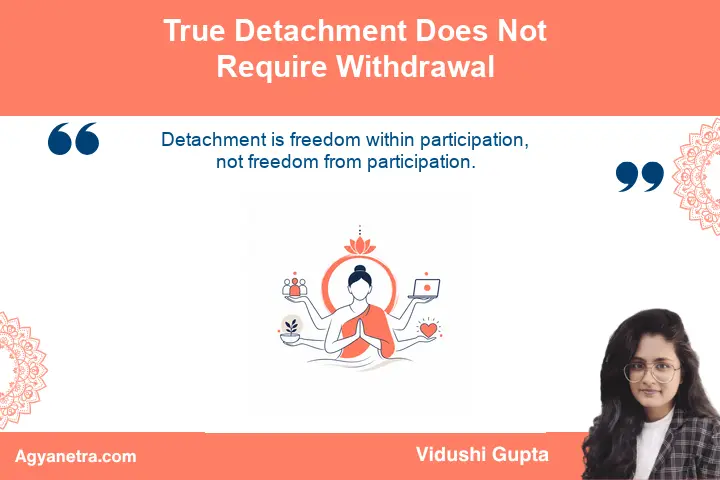
Detachment is freedom within participation, not freedom from participation.
You can love someone without managing their path. You can pursue meaningful work without turning achievement into your identity, and you can experience failure without treating it as proof of personal worthlessness.
Withdrawal says, “I will remain safe by not engaging.” Detachment says, “I can engage sincerely without allowing fear, control, or possession to govern me.”
This form of freedom includes boundaries. Staying present does not mean tolerating harm, remaining in every relationship, or saying yes to every demand.
Sometimes the most conscious response is a clear refusal, an honest conversation, or a practical departure. The difference is that the action comes from discernment rather than a need to appear untouched.
Making Ordinary Life Part of the Practice
Integration begins when spiritual awareness is no longer reserved for meditation, ritual, or exceptional experiences. Daily life becomes the place where inner understanding is tested and strengthened.
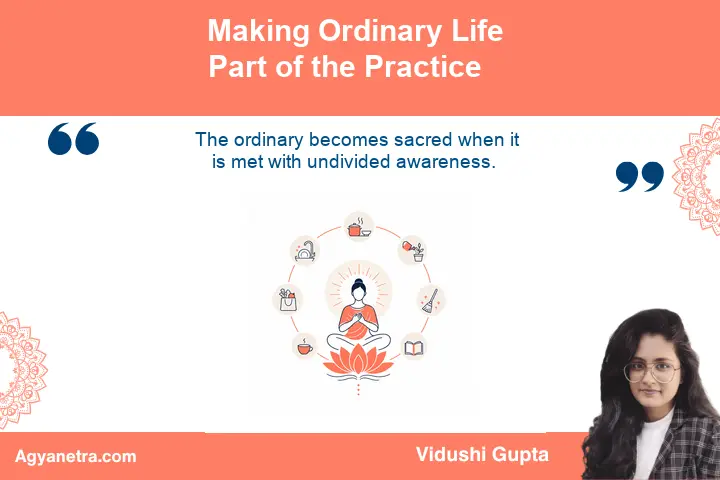
The ordinary becomes sacred when it is met with undivided awareness.
Preparing food can become a practice of presence. Answering a message can reveal impatience, avoidance, or care. A disagreement can show whether you can listen without immediately defending your identity.
This does not require making every task mystical. It means bringing attention to the way you perform simple actions and noticing what happens inside you while life unfolds.
- Pause before replying during conflict.
- Feel an emotion before explaining it away.
- Complete one avoided responsibility with full attention.
- Rest without turning exhaustion into a spiritual test.
- Apologize clearly when your actions cause harm.
- Notice when control disguises itself as concern.
The spiritual awakening integration process is less dramatic than a peak experience, but it is what allows insight to become stable, useful, and visible.
Frustration can also become a teacher. It reveals the conditions you secretly place on peace, such as needing other people to agree, behave predictably, or recognize your growth.
Love and Twin Flame Ideas Must Enter Real Life
Intense spiritual connections can inspire healing and self-discovery, but their mystical meaning should not replace attention to how two people actually relate. Synchronicity alone cannot create trust, consent, communication, or mutual responsibility.
A sacred connection should deepen your humanity, not excuse you from reality.
Instead of asking only whether a bond is destined, ask what it is teaching you to practise. Are you becoming more truthful, compassionate, emotionally responsible, and respectful of the other person’s freedom?
Love is transformative when it helps you remain present without abandoning yourself. It should not require turning another person into a saviour, spiritual authority, or perfect symbol.
The relationship between love and spiritual awakening becomes meaningful when inner change affects the way you listen, speak, repair conflict, and honour boundaries.
It is also important to separate spiritual significance from fixation. A bond may feel extraordinary while still requiring distance, clear limits, or acceptance that the other person has chosen a different path.
Respecting freedom is not a failure of love. Sometimes it is the most honest expression of love available.
When Spiritual Identity Feeds the Ego
The ego does not seek recognition only through wealth, achievement, or social status. It can also build an identity around being unusually awakened, energetically advanced, specially chosen, or part of a uniquely destined connection.
Spiritual superiority is the ordinary ego wearing sacred language.
This identity may appear humble while quietly depending on comparison. It needs other people to seem unconscious so that the spiritual self can feel exceptional.
A useful warning sign is contempt. If spiritual practice makes you less patient with ordinary people, dismissive of emotion, or unwilling to admit mistakes, insight may have been absorbed into self-importance.
Surrender can therefore include releasing the need to make your journey special. Your experience does not lose value when it is no longer used to prove your importance.
Humility does not mean denying genuine awakening. It means allowing insight to make you teachable, responsible, and more aware of the humanity you share with everyone else.
How to Bring Higher Awareness Back Down
Coming back down does not mean losing spiritual clarity. It means allowing that clarity to guide your nervous system, decisions, communication, habits, and treatment of other people.
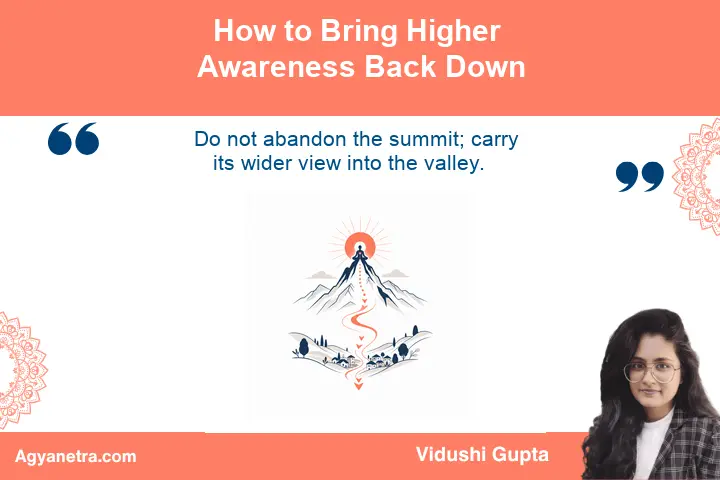
Do not abandon the summit; carry its wider view into the valley.
Begin with the body
Notice your breathing, posture, hunger, fatigue, and physical surroundings. The body offers immediate feedback when spiritual intensity has moved beyond your present capacity to process it.
Simple grounding can be more useful than searching for another peak experience. Walking, eating regularly, sleeping, doing household tasks, and spending time in nature can restore contact with the present.
Name what you are avoiding
Write down one conversation, emotion, responsibility, or decision you have been spiritualizing. Describe it in plain language without using terms such as destiny, vibration, signs, or divine timing.
Then identify one proportionate action. You may need to send a message, make an appointment, state a boundary, complete a task, or admit that you do not know what will happen.
Practise awareness during discomfort
Presence is easiest when nothing challenges us. The deeper practice is staying aware while disappointed, criticized, uncertain, or unable to control an outcome.
Pause long enough to feel the first reaction without immediately acting from it. This creates space for a response that is honest but not needlessly harmful.
Use practical grounding support
If you feel scattered, overstimulated, or detached, these methods for grounding yourself during spiritual awakening can help reconnect inner awareness with physical and emotional stability.
Grounding is not a retreat from spirituality. It is what makes spiritual insight safe enough to inhabit and consistent enough to influence daily life.
Measure transformation by conduct
Ask whether your practice is making you more reliable, compassionate, courageous, and capable of repair. These changes are quieter than mystical experiences, but they show that awareness is taking root.
Final Words
The Trap of Staying Above is not solved by rejecting meditation, transcendence, or higher states of consciousness. It is resolved by understanding that these experiences are invitations to participate more consciously in human life.
Vidushi Gupta’s image of returning from the summit points toward a grounded form of awakening: we rise to see more clearly, then descend so that clarity can shape the way we live.
The real measure of spiritual growth is not how far you can move beyond ordinary life. It is whether awareness can enter your conversations, responsibilities, emotions, boundaries, relationships, and smallest daily choices.
Enlightenment becomes useful when it can make tea, face uncertainty, speak truth, respect freedom, and remain compassionate without abandoning discernment.
FAQs
What does The Trap of Staying Above mean?
It describes using spiritual states or ideas to remain distant from emotions, responsibilities, relationships, and practical reality. Transcendence becomes a trap when it prevents conscious participation in life.
How can I tell the difference between detachment and avoidance?
Detachment allows you to engage without being controlled by an outcome. Avoidance uses distance, silence, or spiritual explanations to escape an action, feeling, or conversation that needs attention.
Is wanting to stay peaceful a form of spiritual bypassing?
Not by itself. It becomes spiritual bypassing when protecting your peace repeatedly prevents you from acknowledging pain, setting boundaries, accepting responsibility, or addressing conflict.
How do I ground myself after an intense spiritual experience?
Return attention to your body and immediate environment. Eat regularly, rest, walk, complete simple tasks, limit overstimulation, and take one practical action related to your current life.
Can a twin flame connection encourage spiritual avoidance?
Yes, especially when destiny, signs, or energetic experiences replace attention to consent, communication, boundaries, and real behaviour. A meaningful connection should support greater honesty and responsibility.
What is embodied spiritual awakening?
Embodied awakening is awareness expressed through daily conduct. It becomes visible in how you communicate, regulate emotions, respect boundaries, fulfil responsibilities, and respond to uncertainty.

Vidushi Gupta is a spiritual coach, energy healer, and emotional wellness counselor with over 10 years of experience guiding people through spiritual signs, emotional healing, and inner transformation. She is the founder of Agyanetra and a published author of nearly ten novels, reaching over 20 million readers worldwide. Her approach is grounded, fear-free, and focused on helping readers understand spiritual experiences with clarity and emotional balance.