
The Whitening: The Return of Light describes a quiet phase of spiritual renewal that becomes possible after we have honestly faced our inner darkness. It is not a return to spiritual excitement, constant positivity, or an idealized version of ourselves. It is the emergence of clearer awareness.
This light does not erase grief, uncertainty, or longing. Instead, it helps us experience them without being completely defined or directed by them.
The result is a more grounded form of awakening. We become less interested in appearing spiritual and more capable of bringing consciousness, love, and discernment into ordinary life.
What Is the Whitening in Spiritual Transformation?
In spiritual alchemy, the Whitening is often called Albedo: a phase of clarification that follows an encounter with inner darkness.
The Whitening begins when awareness remains after familiar identities and spiritual stories have fallen away.
Vidushi Gupta presents this stage as a return of light, but not the dazzling light of peak experiences. It is a quieter illumination that helps us see ourselves without as much projection, urgency, or self-deception.
During difficult inner periods, beliefs that once provided certainty may stop working. A relationship may not unfold as expected, an identity may dissolve, or a spiritual experience may no longer provide reassurance.
That loss of certainty can initially feel empty. Yet the emptiness may reveal something more stable beneath our changing stories: the ability to notice, feel, breathe, love, and remain present.
This is why the Whitening is not about creating a superior self. It is a process of recognizing what remains when the need to construct such a self begins to soften.
Why Darkness Changes Our Understanding of Light
Before a difficult descent, light can seem synonymous with bliss, synchronicity, expansion, or relief. These experiences may be meaningful, but they do not automatically produce maturity.
True light does more than make us feel elevated; it helps us see what is actually happening within us.
Inner darkness exposes the fears and attachments that can hide beneath spiritual language. It may reveal a need to control outcomes, receive validation, preserve a special identity, or interpret every event as a sign.
Once these patterns become visible, light takes on a different function. Rather than lifting us away from discomfort, it allows us to stay conscious while discomfort is present.
This understanding complements a grounded view of spiritual awakening and enlightenment. Awakening is not measured only by extraordinary states, but also by our capacity to meet ordinary human experience honestly.
Darkness, then, is not automatically a failure of the path. When approached carefully, it can remove illusions and prepare us for a clearer, less performative relationship with consciousness.
Signs the Returning Light Is Becoming Embodied
The return of light is often subtle. It may appear through small changes in how we respond to emotions, relationships, and uncertainty.
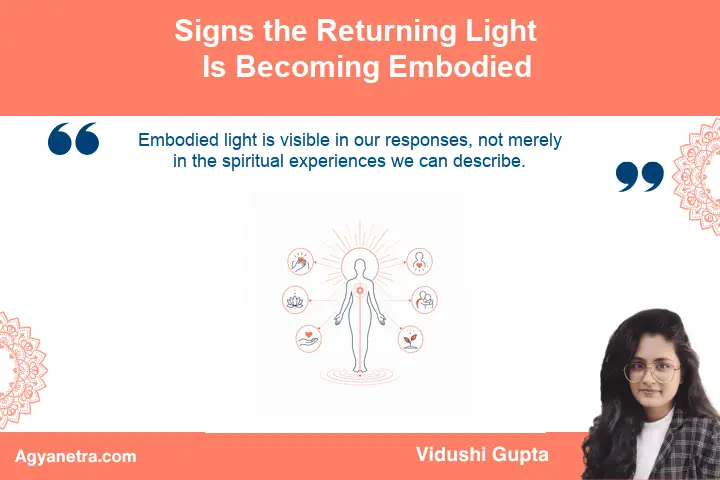
Embodied light is visible in our responses, not merely in the spiritual experiences we can describe.
You may be entering this phase when you begin to notice changes such as:
- You can feel sadness without assuming that sadness defines your whole life.
- You recognize an old pattern before automatically acting from it.
- You can remain uncertain without urgently searching for signs or predictions.
- You allow another person to make choices without treating their freedom as personal rejection.
- You find meaning in simple presence rather than constantly seeking intense experiences.
These changes do not mean that all wounds have healed. They show that awareness is becoming strong enough to hold pain without turning pain into identity.
This stage is closely connected with the spiritual awakening integration process. An insight becomes transformative when it changes how we listen, communicate, rest, choose, and relate to difficult feelings.
Progress may still be uneven. Old reactions can return, but seeing them clearly gives you a pause in which a different response becomes possible.
Discernment Is the Central Gift of the Whitening
Clear awareness helps us distinguish experiences that can feel similar on the surface but arise from very different inner motives.
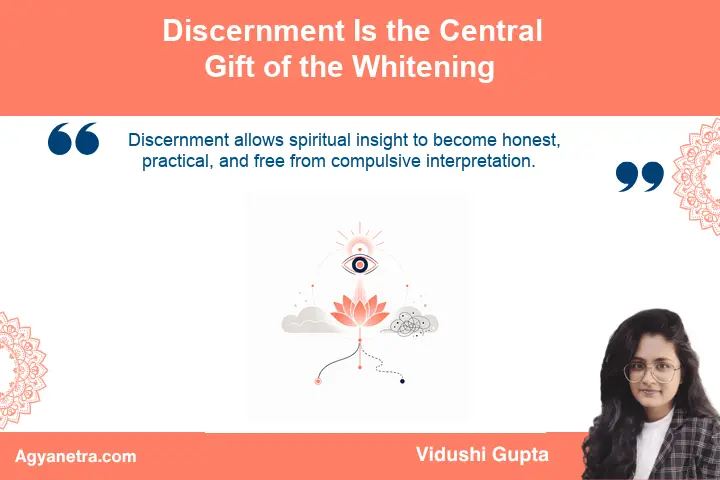
Discernment allows spiritual insight to become honest, practical, and free from compulsive interpretation.
For example, intuition may feel quiet and spacious, while desire often carries pressure for a preferred outcome. Surrender allows reality to unfold, whereas resignation shuts down because hope feels unsafe.
Love also differs from attachment. Love can respect another person’s freedom; attachment tries to secure emotional safety by controlling their response, availability, or role in our story.
- Intuition or desire: Am I receiving a clear impression, or repeating what I want to be true?
- Surrender or avoidance: Am I accepting reality, or refusing to take a necessary action?
- Love or possession: Can I care without demanding ownership of the outcome?
- Awareness or identity: Am I living consciously, or trying to appear spiritually advanced?
Discernment does not require suspiciously analyzing every thought. It asks for enough inner quiet to observe the emotional need beneath an interpretation.
This is especially useful when an experience feels spiritually significant. Meaning can be honored without forcing every coincidence, emotion, or relationship into one fixed explanation.
Loving Without Controlling the Outcome
The Whitening can transform how we understand intense spiritual relationships, including those described as Twin Flame connections. Attention gradually moves from predicting the relationship’s future to noticing its inner effects.
Love becomes freer when care no longer depends on controlling another person’s path.
A connection may remain deeply meaningful even when its outcome is uncertain. Its value can lie in what it reveals about longing, fear, projection, self-worth, boundaries, and the ability to love responsibly.
Releasing control does not mean becoming indifferent. It means caring without requiring another person to provide certainty, complete an identity, or validate a spiritual interpretation.
The connection between love and spiritual awakening becomes healthier when love expands awareness rather than reinforcing obsession. Genuine care leaves room for truth, consent, boundaries, and individual growth.
A practical question can help: “What is this relationship asking me to understand within myself?” This redirects attention from speculation toward the part of the journey where meaningful change is possible.
Bringing Spiritual Light Into Everyday Life
The returning light becomes trustworthy when it can enter ordinary moments rather than appearing only during meditation, ritual, or mystical experience.
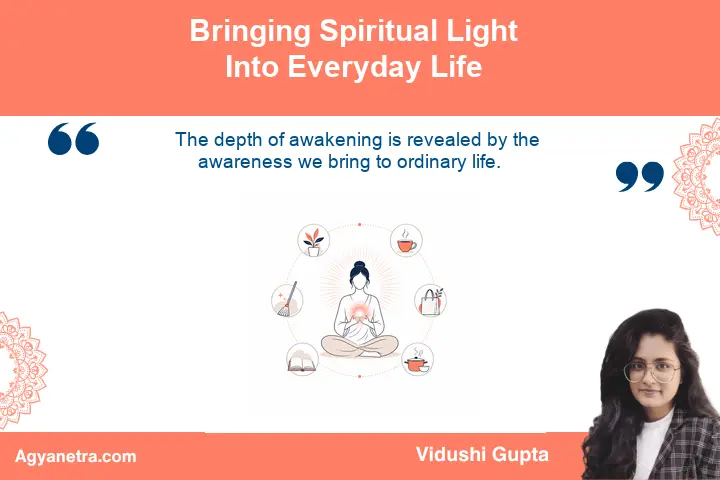
The depth of awakening is revealed by the awareness we bring to ordinary life.
A quiet morning can become an opportunity to notice the breath. A walk can restore contact with the body, while a difficult conversation can reveal whether we are able to listen without immediately defending ourselves.
Instead of asking whether you feel spiritually elevated, consider more practical questions:
- Can I pause before reacting when I feel disappointed?
- Can I acknowledge fear without allowing it to make every decision?
- Can I stay respectful when another person disagrees with me?
- Can I remain present when I do not know what happens next?
- Can I care for my body while exploring spiritual experience?
Simple grounding supports this embodiment. Regular meals, sleep, movement, time outdoors, honest conversation, and reduced overstimulation can help awareness settle into daily life.
If spiritual experiences leave you scattered, practical guidance on how to ground yourself during spiritual awakening can help you reconnect with the body and immediate surroundings.
A Simple Daily Practice
At the end of the day, recall one emotionally charged moment. Name what you felt, what you wanted to happen, how you responded, and what a more conscious response might have looked like.
The purpose is not to judge yourself. It is to strengthen the ability to witness your patterns clearly and carry that awareness into the next ordinary moment.
When Light Becomes Another Form of Escape
The return of peace and clarity can create a new attachment. We may begin protecting calmness so strongly that anger, grief, conflict, responsibility, and embodied life are treated as spiritually inferior.
Light becomes a hiding place when we use peace to avoid the unfinished realities of being human.
This pattern can look refined because it uses words such as purity, detachment, and transcendence. Yet beneath those ideas may be a fear of being disturbed, challenged, vulnerable, or fully involved in life.
Watch for signs such as:
- Avoiding necessary conversations because they feel energetically uncomfortable.
- Using positive ideas to dismiss grief, anger, or legitimate concerns.
- Believing that grounded responsibilities interfere with spiritual development.
The answer is not to reject light. It is to let clarity accompany us back into relationships, work, bodily needs, limitations, and imperfect circumstances.
Mature awakening does not require us to remain above human experience. It prepares us to meet life more fully, without losing awareness whenever reality becomes uncomfortable.
Final Words
The Whitening is a gentle return to what remains when false certainty and spiritual performance begin to fall away. Its light is quiet, discerning, and increasingly embodied.
You do not need to eliminate every wound before living consciously. Wholeness grows as you learn to hold pain, love, uncertainty, and ordinary responsibilities without abandoning awareness.
The deepest purpose of returning light is not to escape the world. It is to help you enter the world with clearer sight, freer love, and a steadier presence.
FAQs
What does the Whitening mean spiritually?
The Whitening, or Albedo, is a phase of clarification after an encounter with inner darkness. It involves recognizing stable awareness beneath changing emotions, identities, and spiritual stories.
Is the Whitening the same as spiritual awakening?
It can be understood as one phase of awakening rather than the entire process. Its emphasis is on purification, discernment, integration, and bringing awareness into ordinary life.
How do I know if I am experiencing the return of light?
You may notice less urgency, greater comfort with uncertainty, clearer recognition of emotional patterns, and a growing ability to stay present during difficult experiences.
Does embodied light mean painful emotions disappear?
No. Embodied light changes your relationship with painful emotions, allowing you to feel them without treating them as your complete identity or letting them control every response.
What is the role of discernment during the Whitening?
Discernment helps you distinguish intuition from desire, surrender from avoidance, and love from attachment. It reduces the need to force spiritual meaning onto every experience.
Can spiritual light become a form of avoidance?
Yes. Light becomes avoidance when peace, positivity, or transcendence is used to escape grief, conflict, bodily needs, relationships, or practical responsibilities.

Vidushi Gupta is a spiritual coach, energy healer, and emotional wellness counselor with over 10 years of experience guiding people through spiritual signs, emotional healing, and inner transformation. She is the founder of Agyanetra and a published author of nearly ten novels, reaching over 20 million readers worldwide. Her approach is grounded, fear-free, and focused on helping readers understand spiritual experiences with clarity and emotional balance.