
There are times in spiritual life when effort alone is not enough. I have seen seekers do the right practices, read the right books, and still feel inwardly unstable. Something is missing.
The mind wants growth, but the heart wants safety, grace, and support. This is where the symbolism of Vishnu and Lakshmi becomes deeply relevant.
When I reflect on what Vishnu and Lakshmi represent in spiritual life, I do not see only divine figures from Hindu mythology.
I see a living teaching about how consciousness is sustained, how dharma is protected, and how abundance becomes sacred only when it rests on inner balance. Vishnu holds order.
Lakshmi brings grace, beauty, nourishment, and flow. Together, they reveal a spiritual truth that many people learn slowly: life does not grow well through force alone. It grows when stability and blessing move together.
I want to explore that truth here through Hindu symbolism, inner practice, and what I have observed in real spiritual work with people who are trying to live more consciously.
What Vishnu and Lakshmi Represent in Spiritual Life?
In Hindu spiritual understanding, Vishnu is the preserver, the sustainer of cosmic order. He protects dharma and restores balance when life moves too far into chaos.
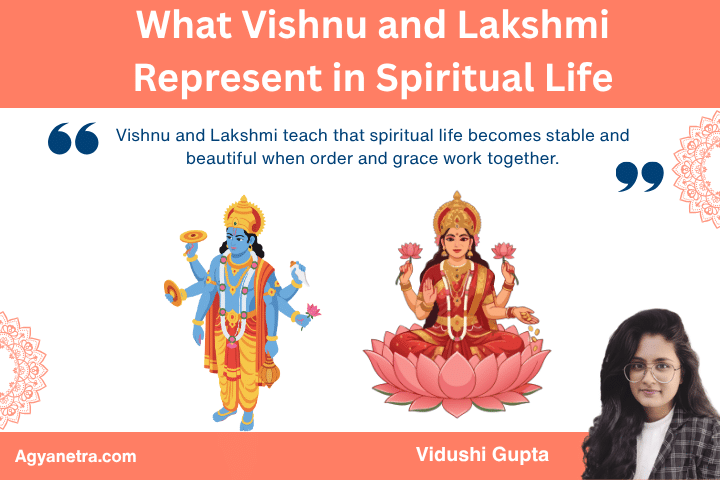
Lakshmi is the goddess of prosperity, beauty, abundance, harmony, and auspicious flow. When I place them together in spiritual reflection, I see more than preservation and wealth. I see the union of order and grace.
Vishnu, in this sense, represents the principle that keeps life aligned. He is not restless creation like Brahma, and he is not dissolution like Shiva. He is maintenance, rhythm, continuity, and sacred responsibility.
Lakshmi represents what blossoms when life is held well. She is not mere money or worldly gain. She is the refinement, nourishment, radiance, and blessing that enter a life built on truth.
The symbolism becomes very practical when I look inward. A person may want abundance, peace, love, or spiritual sweetness, but if there is no inner Vishnu — no steadiness, no dharma, no discipline, no preservation of what is sacred — then Lakshmi does not stay. Flow without structure scatters. Grace without grounding gets wasted.
In Vaishnava devotion, Lakshmi is inseparable from Vishnu because true prosperity does not stand apart from divine order. I think this is one of the most important spiritual lessons hidden in plain sight.
Grace stays where there is alignment. Abundance stays where there is inner order.
Why Lakshmi is not just wealth and Vishnu is not just protection
One of the biggest misunderstandings I see is the reduction of Lakshmi to money and Vishnu to external protection. That reading is too small. It misses the inward power of these archetypes.
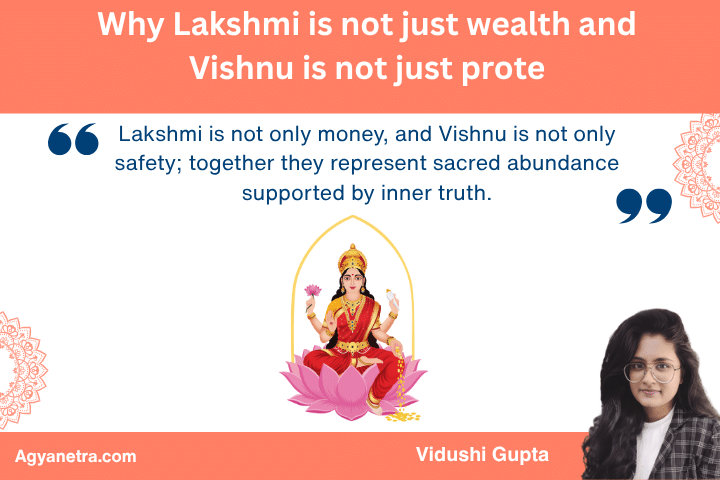
Lakshmi certainly includes material well-being in traditional Hindu thought, but her deeper force is sri — sacred radiance, auspicious beauty, blessedness, and the harmony that allows life to flourish.
She is the quiet elegance of a life not wasted in confusion. She is the feeling of inward richness that makes generosity natural. She is also refinement. A mind full of greed cannot hold Lakshmi well, even if it temporarily holds money.
Vishnu, similarly, is not just a divine protector who saves devotees from outside danger. In spiritual life, I experience Vishnu as the intelligence that preserves what is true.
He is the force that helps a seeker remain aligned when distraction, fear, temptation, or emotional disorder try to pull the path apart.
I sometimes explain this to students with a simple image. Vishnu is like the riverbank. Lakshmi is like the fertile water.
Without the bank, the water floods and loses direction. Without the water, the bank holds only dryness. Together, they create life.
This is why I do not read their symbolism as something distant. I read it as instruction. If I want real prosperity in spiritual life, I must ask two questions at once: what am I being asked to preserve, and what in me is ready to receive grace?
Read More:
- Spiritual Evolution and Source Consciousness
- What Brahma and Saraswati Represent in Spiritual Life
- Higher Dimensions in Spirituality
- From Individual Self to Universal Consciousness
How this teaching shows up in daily spiritual practice
This symbolism becomes real only when I apply it. Otherwise it remains beautiful mythology with no living effect.
In daily practice, Vishnu asks for steadiness. That means regularity in what supports consciousness.
It means returning to prayer, meditation, mantra, ethical living, and inner honesty even when emotion is unstable or inspiration is low.
Lakshmi enters when that steadiness stops being dry duty and becomes a vessel for presence. She is the sweetness that arrives when discipline is no longer harsh.
I have found one practice especially helpful here. At the end of the day, I sit quietly for a few minutes and ask:
What did I preserve today that was worth protecting?
Where did I leak energy through disorder, reactivity, or unconscious speech?
What blessing entered my life today that I failed to notice?
That last question matters more than people think. Many seekers are so focused on what is missing that they become blind to Lakshmi already present in their lives.
Gratitude sharpens perception. It does not create false positivity. It trains the heart to recognize sacred support.
In Bhakti Yoga, devotion to Vishnu and Lakshmi can become a powerful way of balancing effort and receptivity.
In Karma Yoga, this same teaching appears as right action offered with humility, while remaining open to grace rather than control.I have learned that both are needed. Effort without grace becomes rigid. Grace without effort becomes fantasy.
Spiritual life matures when I learn not only how to strive, but also how to receive.
What I have observed in seekers who struggle with stability and abundance
In my years of working with seekers, I have noticed a repeating pattern. Some people are sincere, devoted, and spiritually hungry, but their lives remain scattered.
They pray for peace, prosperity, or loving support, yet their inner world is unstable. Their routines break easily.
Their energy leaks through emotional chaos, unclear boundaries, compulsive speech, or ungrounded desire. In simple terms, they long for Lakshmi without cultivating Vishnu.
I once worked with a woman who felt deeply blocked around both spiritual intimacy and material flow. She believed she was cursed in some way because good things never seemed to stay.
But as we worked together, the issue became clearer. Her life had almost no preserving force. Sleep was irregular. Finances were avoided. Her devotional life was sincere but inconsistent.
Her relationships were intense and unstable. She had beauty in her heart, but no structure around it.
The moment she began building simple order — one regular prayer time, cleaner money habits, fewer reactive conversations, more conscious rest — everything changed.
Not instantly. But visibly. Her energy became less porous. Opportunities began arriving. Relationships softened. She stopped chasing grace and became someone who could hold it.
This is the insight I wish more seekers understood. Abundance is not only attracted. It must be sustained. And sustaining it is a spiritual act.
In my own life, I have also seen that the moments where grace flowed best were not the moments where I was trying hardest.
They were the moments where I was inwardly aligned enough not to resist what was already trying to nourish me.
Free PDF Book
Awakening Maya To Moksha
Integration of the final soul lessons and transcendence of physical identity into pure awareness.
The deeper meaning of Leela in the heart of Vishnu and Lakshmi
The chapter title speaks of the heart of Leela, and I think that is important. Leela means divine play — the sacred unfolding of life as the expression of the Divine.
But divine play is not randomness. It is alive, intelligent movement. Vishnu and Lakshmi show me that this play has rhythm, order, beauty, and blessing within it.
Without Vishnu, life feels unstable and unheld. Without Lakshmi, life feels dry and deprived of grace.
Together, they reveal that the divine play is not chaos. It is living order. It contains support. It contains timing. It contains hidden tenderness.
I think many people misunderstand spiritual surrender because they imagine it means giving up structure. It does not. Real surrender happens inside alignment.
That is where Leela becomes visible. When I stop fighting life through egoic insistence, I begin to see the subtle intelligence already moving.
Vishnu sustains that intelligence. Lakshmi softens it with beauty and nourishment.
In Vaishnava traditions, devotion to Vishnu and Lakshmi is not only about asking for favors. It is about entering a relationship with cosmic order and divine grace.
Even outside formal devotion, the teaching is powerful. I can ask myself every day: am I living in a way that honors the order of truth and the grace of life, or am I living in a way that resists both?
That question opens a lot.
How I live the Vishnu-Lakshmi teaching in ordinary life
For me, this teaching becomes real in very ordinary ways. I protect what matters. I keep returning to what steadies me. I take care of my energy, my speech, my work, and my inner state with more respect.
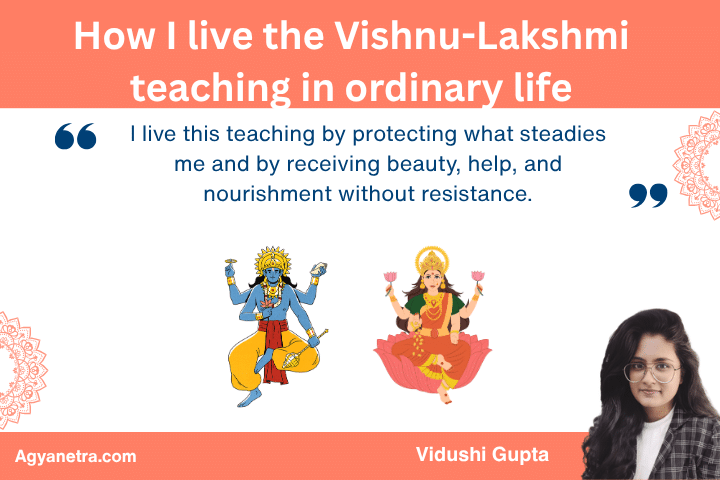
That is my way of honoring Vishnu. Then I pay attention to beauty, gratitude, generosity, rest, tenderness, and receptivity. That is how I make space for Lakshmi.
Some days this looks very simple. I clear one unresolved tension instead of letting it linger. I sit for prayer even when the mind is noisy. I speak more gently. I receive help without false pride.
I allow beauty into a tired day. I stop treating nourishment as an interruption to discipline.
I have learned that many seekers overdevelop one side. They become deeply disciplined but inwardly dry. Or they become very receptive and heart-centered but too unstructured to hold what is given.
The harmony matters. A balanced life is not always dramatic, but it is deeply spiritual.
This is one reason I return often to sacred symbolism in my own contemplation and in my book Awakening Maya to Moksha.
These divine pairs are not ornaments to me. They are mirrors. They help me see where my life has lost rhythm, where grace is already present, and where I need to become a better steward of what is sacred.
Conclusion
Vishnu and Lakshmi represent something deeply needed in spiritual life: the union of preservation and blessing, order and grace, dharma and abundance.
Vishnu teaches me to protect what is true, to stabilize what matters, and to stay aligned with sacred responsibility.
Lakshmi teaches me to receive beauty, nourishment, prosperity, and inner richness with humility and care.
When I hold their symbolism inwardly, I stop treating spirituality as effort alone. I begin to understand that real growth requires both steadiness and sweetness.
A life becomes spiritually fertile not only when it seeks the Divine, but when it becomes capable of holding what the Divine gives.
FAQs
What do Vishnu and Lakshmi represent together in spiritual life?
Together, Vishnu and Lakshmi represent the balance of stability and blessing. Vishnu holds order, dharma, and preservation, while Lakshmi brings grace, beauty, nourishment, and abundance. In spiritual life, this teaches me that growth does not last through effort alone. It lasts when what is sacred is protected and also lovingly supported.
Is Lakshmi only connected to money and material wealth?
No, Lakshmi is much deeper than money. She represents inner richness, harmony, beauty, fertility, generosity, and the kind of abundance that makes life feel blessed rather than merely full. I have seen people with financial success who still lived far from Lakshmi because their lives lacked peace, gratitude, and refinement. True Lakshmi includes outer support, but it begins as inner alignment.
Why is Vishnu important for a spiritual seeker?
Vishnu matters because he represents the force that sustains what is true. A seeker may receive insight, devotion, or grace, but without steadiness, those openings fade quickly. In my experience, Vishnu’s energy shows up as discipline, continuity, and the willingness to protect what supports spiritual life. He teaches that preservation is also sacred work.
How can I apply the Vishnu and Lakshmi teaching in daily life?
I apply this teaching by looking at two things every day: what I am protecting and what I am receiving. Protecting means caring for my peace, my practice, my speech, and my energy. Receiving means noticing beauty, help, nourishment, and grace without pushing them away. When both are present, life feels more balanced and spiritually alive.
Why do some people struggle to hold abundance even when they pray for it?
In many cases, the issue is not lack of blessing but lack of inner structure. I have seen seekers ask deeply for support, love, or prosperity, while their lives remained full of disorder, emotional leakage, or inconsistency. Abundance needs a container. When the inner world becomes steadier, what is given can finally stay.
Are Vishnu and Lakshmi only outer deities, or do they also represent inner energies?
They can be approached both ways. In devotion, they are divine beings worthy of prayer, reverence, and surrender. In inner spiritual work, they also reflect living principles within consciousness: Vishnu as sustaining order and Lakshmi as flowing grace. I find this dual understanding very powerful because it allows both devotion and self-reflection to deepen together.
How can I invite more Lakshmi into my life in a spiritual way?
I begin by creating cleanliness and respect in the spaces where I live, speak, work, and pray. Gratitude, generosity, beauty, and mindful use of resources all strengthen Lakshmi’s presence. I also watch whether I am rejecting support through pride, fear, or unconscious habits. In my experience, Lakshmi enters more easily where there is appreciation, refinement, and care.
What is a common misconception about Vishnu and Lakshmi in spiritual life?
A common misconception is that Vishnu is only about protection and Lakshmi is only about wealth. That reading is too narrow and keeps the teaching superficial. Spiritually, they reveal a deeper truth: life flourishes when truth is preserved and grace is welcomed. Once I understand that, their symbolism becomes deeply relevant to inner growth, not just outer worship.

Vidushi Gupta is a spiritual coach, energy healer, and emotional wellness counselor with over 10 years of experience guiding people through spiritual signs, emotional healing, and inner transformation. She is the founder of Agyanetra and a published author of nearly ten novels, reaching over 20 million readers worldwide. Her approach is grounded, fear-free, and focused on helping readers understand spiritual experiences with clarity and emotional balance.