
Awakening the Serpent is not only an image of spiritual energy rising toward higher consciousness. It can also describe a complete cycle in which awareness expands, returns to the body and becomes visible in relationships, choices, work and ordinary life.
The rising serpent is often associated with Kundalini moving from the Root toward the Crown. Yet a serpent does not travel like an arrow; it coils, curves and returns, suggesting that transformation may be spiral-shaped rather than linear.
This wider view helps us distinguish an awakening experience from an integrated life. Reaching an expanded state can reveal new possibilities, but the deeper work is learning how to embody that awareness without rejecting our humanity.
What Awakening the Serpent Represents
At its simplest, the serpent represents a potential within us that is no longer dormant.
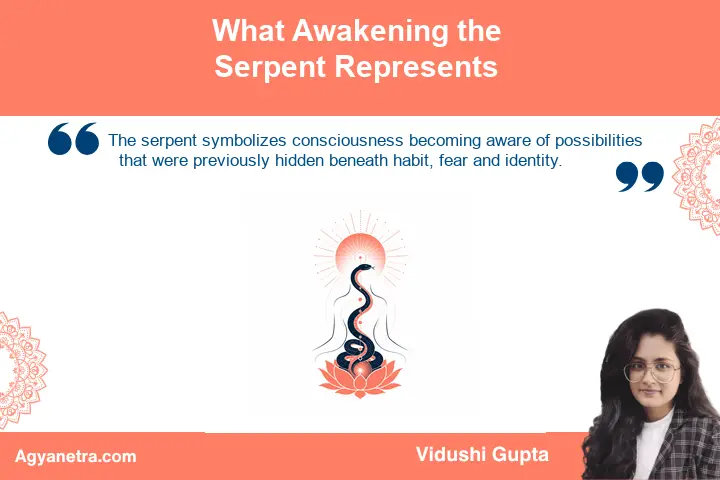
The serpent symbolizes consciousness becoming aware of possibilities that were previously hidden beneath habit, fear and identity.
In traditional descriptions of Kundalini yoga, energy is symbolized as a serpent resting near the base of the spine. Its upward movement through the chakras points toward an expansion of consciousness.
Symbolically, the lower centers are connected with foundational human experiences such as survival, desire, emotion and personal power. The higher centers introduce love, expression, perception and a sense of spiritual unity.
This does not make the lower aspects of life inferior. They are the ground from which awareness develops and the places where spiritual understanding must eventually become practical.
The image can therefore be read as an inner shift. Instead of being completely controlled by reactions and inherited identities, we begin to observe them, question them and respond with greater awareness.
Why the Journey Is More Than an Upward Ascent
A higher state of consciousness is not the end of the journey if it remains disconnected from the life we actually live.
It is natural to imagine awakening as steady upward progress. The Root becomes the starting point, the Crown becomes the destination and every intense spiritual experience seems to confirm that we are moving higher.
This model contains a meaningful truth: awakening can loosen our identification with the limited self. It may bring spaciousness, stillness, unity, love or a direct sense that individual identity is only one layer of being.
However, an upward-only model can quietly turn spirituality into escape. We may begin to regard the body, practical responsibilities or difficult emotions as obstacles rather than parts of the path.
The serpent offers another possibility. Because its movement is curved and cyclical, awakening can be understood as ascent followed by return: awareness rises beyond conditioned identity, then descends to illuminate it.
Readers interested in the traditional upward framework can explore how Kundalini awakening through the chakras is commonly understood. The essential point here is that movement through the centers must eventually affect the whole person.
Awakening and Integration Are Different
A powerful experience can open consciousness quickly, while integration usually unfolds through repeated choices over time.
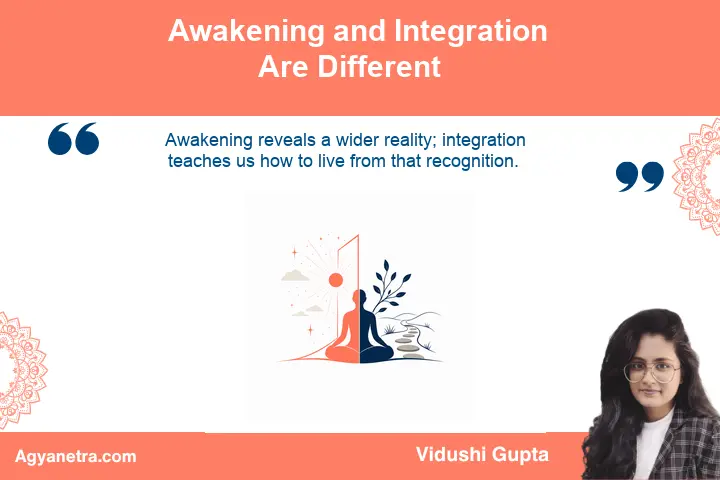
Awakening reveals a wider reality; integration teaches us how to live from that recognition.
A person may experience profound inner silence and still struggle to communicate honestly. Someone may feel universal love during meditation yet become defensive when a close relationship exposes an old wound.
These contradictions do not automatically make the awakening unreal. They show that insight and embodiment develop at different speeds.
Awakening can reveal what lies beyond the familiar self. Integration brings that clarity into the nervous habits, emotional patterns and everyday situations where the familiar self continues to operate.
This is why ordinary life becomes important rather than spiritually inconvenient. Conflict, intimacy, money, work, family and responsibility show whether awareness has become stable enough to shape action.
The spiritual awakening integration process is less about preserving a special state and more about allowing insight to mature through grounded living.
When Spiritual Heights Become a Form of Avoidance
If spirituality repeatedly removes us from the body, honest relationship and responsibility, it may be functioning as avoidance.
Expanded states can be beautiful and deeply meaningful. The difficulty begins when we decide that these states are more sacred than ordinary consciousness and must be maintained at any cost.
We may then chase energetic intensity while ignoring exhaustion, meditate instead of addressing conflict or speak of unconditional love without developing patience, boundaries and listening.
Another sign is discomfort with anything considered low, dense or negative. Anger, desire, grief and fear may be pushed away before their message or underlying pattern has been understood.
Healthy transcendence creates more capacity to meet life. It does not require pretending that pain, limitation or disagreement has disappeared.
This distinction is especially valuable in relationships. The connection between love and spiritual awakening becomes practical when expanded love is expressed through honesty, repair and respect.
What the Descent of Kundalini Means
Descent does not mean losing awareness or falling away from spiritual truth.
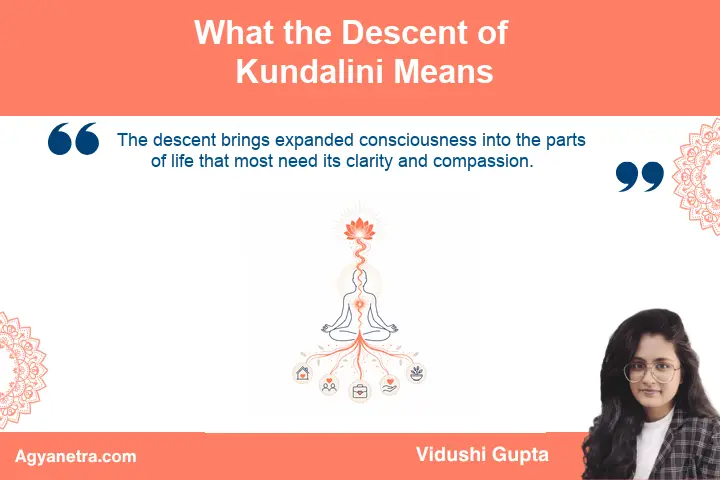
The descent brings expanded consciousness into the parts of life that most need its clarity and compassion.
In this symbolic understanding, the returning serpent carries the insight of the Crown toward the Root. Spirit is not kept separate from matter; awareness is invited into the body and its most immediate concerns.
The descent may include feeling emotions without becoming ruled by them, relating to desire without either worshipping or condemning it, and meeting material responsibilities without believing they define our worth.
It may also mean revisiting aspects of ourselves that seemed resolved during an elevated state. Old wounds can reappear, not necessarily because awakening has failed, but because they are now available for conscious attention.
Embodiment can be observed in simple areas:
- How we speak when we are frustrated.
- Whether we respect the body’s need for rest.
- How honestly we approach intimacy and boundaries.
- Whether our spiritual values influence work and money.
- How we respond when life does not feel sacred or luminous.
Returning to these areas is not a retreat from spirituality. It is how spiritual awareness becomes humanly useful.
A Practical Way to Integrate the Serpent’s Movement
Integration does not require forcing energy downward or trying to reproduce a previous experience.
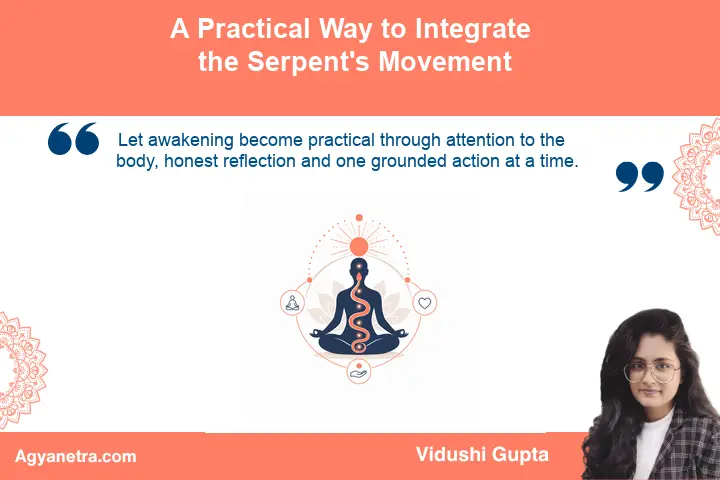
Let awakening become practical through attention to the body, honest reflection and one grounded action at a time.
Begin with the body
Notice your breathing, physical tension, hunger, fatigue and contact with the ground. This shifts attention from abstract interpretation toward present experience.
Name what is actually happening
Ask whether you are feeling fear, excitement, grief, anger or longing. Clear language can prevent every emotional or physical change from being treated as a mystical sign.
Identify the life area asking for attention
Consider whether the experience is pointing toward a conversation, boundary, rest, practical decision or unresolved pattern. Insight becomes useful when it meets a real part of life.
Choose one embodied response
Take a small, proportionate action. You might apologize, pause before reacting, keep a commitment, eat a nourishing meal or speak clearly about a need.
Allow the process to remain cyclical
You may feel expanded one day and ordinary the next. Do not assume that contraction erases growth; it may be the phase in which insight settles into the personality.
If spiritual experiences leave you scattered or disconnected, gentle Kundalini awakening grounding techniques can support a safer return to the body and immediate environment.
The Serpent as a Living Circuit
The sacred movement is complete not when we remain above life, but when expanded awareness circulates through the whole of it.
A ladder suggests that we leave the lower rungs behind. A circuit suggests relationship, circulation and return.
Seen this way, awakening resembles breathing. There is expansion and contraction, discovery and embodiment, ascent and descent. Neither movement is complete without the other.
We rise beyond the limited self and discover a larger field of consciousness. We return to individual life and recognize that the finite person was never excluded from that larger reality.
This interpretation also honors the earthbound nature of the serpent. Its rising does not erase its origin, and its return does not cancel what was discovered above.
Transformation can therefore revisit the same themes many times. Each return may bring deeper honesty, greater capacity and a more integrated response rather than a perfectly final resolution.
Final Words
Awakening the Serpent becomes a fuller spiritual image when rising and returning are held together. The ascent reveals that we are more than our conditioned identity; the descent asks us to live that realization as embodied human beings.
Vidushi Gupta’s sacred spiral offers a grounded reminder: awakening is not an invitation to stop being human. Its value is revealed when consciousness enters the body, relationships and responsibilities with greater honesty, compassion and presence.
The serpent rises, but it also returns. Between those movements, spiritual insight gradually becomes a life.
FAQs
What does Awakening the Serpent mean spiritually?
It refers to dormant Kundalini energy or deeper human potential becoming active. Symbolically, it describes awareness moving beyond automatic reactions and limited identity.
Does Kundalini only move upward?
Kundalini is commonly pictured as rising through the chakras. As a spiritual metaphor, its return can represent expanded awareness becoming integrated into the body, relationships and daily responsibilities.
What is the difference between awakening and integration?
Awakening is the opening into a wider state of consciousness. Integration is the gradual process of allowing that insight to influence emotions, behavior, relationships and practical choices.
Does returning to ordinary consciousness mean an awakening has failed?
No. Ordinary consciousness can provide the conditions in which spiritual insight is tested, grounded and embodied rather than merely experienced as a temporary state.
How can I ground myself after an intense spiritual experience?
Attend to breathing, rest, food, physical surroundings and simple routines. Avoid forcing another intense experience, and focus on one practical responsibility or honest conversation at a time.
Can spiritual practice become a form of avoidance?
Yes, if it is repeatedly used to escape emotions, conflict, bodily needs or responsibility. Grounded practice should increase the capacity to meet life with clarity rather than withdraw from it.

Vidushi Gupta is a spiritual coach, energy healer, and emotional wellness counselor with over 10 years of experience guiding people through spiritual signs, emotional healing, and inner transformation. She is the founder of Agyanetra and a published author of nearly ten novels, reaching over 20 million readers worldwide. Her approach is grounded, fear-free, and focused on helping readers understand spiritual experiences with clarity and emotional balance.