
The Sacred Spiral offers a grounded way to understand spiritual growth: we expand, return to familiar parts of life, integrate what we have learned, and begin again with greater awareness. Instead of measuring progress by how high we rise, this perspective asks how consciously we can live after returning to ordinary experience.
Many people imagine awakening as a direct journey from confusion to clarity. They expect difficult emotions, attachments, and fears to disappear once a higher state of consciousness has been experienced.
Real transformation is rarely so linear. A familiar lesson may return, but we do not necessarily meet it as the same person. What appears to be repetition can become a deeper opportunity for healing, choice, and embodiment.
Understanding The Sacred Spiral
A spiral combines movement around a center with movement toward a new level. As a spiritual symbol, it helps explain why growth can involve both progress and return.
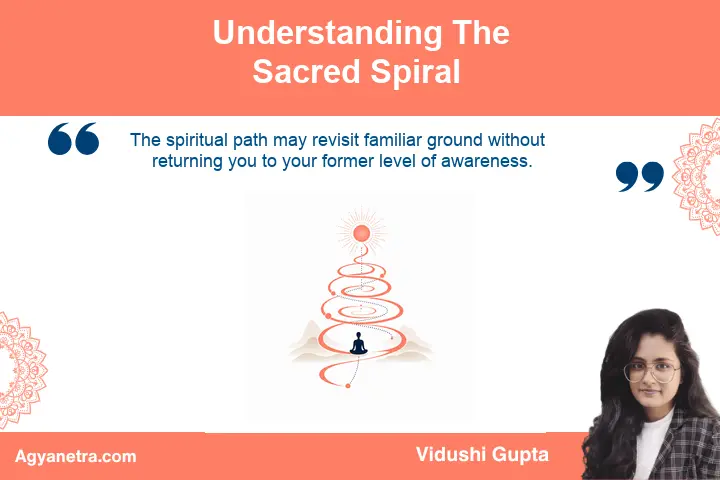
The spiritual path may revisit familiar ground without returning you to your former level of awareness.
A straight line suggests that every stage should be left behind permanently. A spiral allows an experience to return while recognizing that our relationship with it may have changed.
The coiled serpent is especially meaningful here. Kundalini is traditionally represented as serpent energy, and its symbolic movement suggests development that is curved, inward, and upward rather than rigidly direct.
This does not mean every emotional cycle should be interpreted as a mystical event. The spiral is best used as a reflective framework for noticing how awareness changes through repeated encounters with life.
The important question is not simply, “Why is this happening again?” A more useful question is, “What can I now see, understand, or choose that I could not see before?”
Readers exploring the serpent as a symbol of consciousness may also find Awakening The Serpent helpful for understanding its place in the awakening journey.
Why Returning Is Not Going Backward
A returning lesson becomes growth when you meet it with greater honesty, awareness, and freedom.
After a powerful spiritual experience, ordinary reactions can feel discouraging. Anger, desire, fear, grief, or attachment may create the impression that awakening has been lost.
Yet the presence of an emotion does not prove that consciousness has disappeared. Progress may be visible in how quickly you recognize the emotion, how gently you hold it, and whether you can respond without being controlled by it.
Consider a recurring fear of rejection. At first, it may silently shape your behavior. Later, you may notice it only after an argument. With practice, you may recognize it while it is arising and choose not to abandon your needs.
The fear may still appear, but your relationship with it is no longer identical. Recognition has replaced complete identification, and conscious response has begun to replace automatic reaction.
This view avoids two extremes. It does not label every setback as failure, but it also does not use spiritual language to excuse harmful patterns. Returning is meaningful when it produces responsibility, insight, or a wiser choice.
Ascent Needs Descent
Ascent opens consciousness to unity, meaning, and expanded perception. Descent brings those insights into the body, relationships, responsibilities, and choices of everyday life.
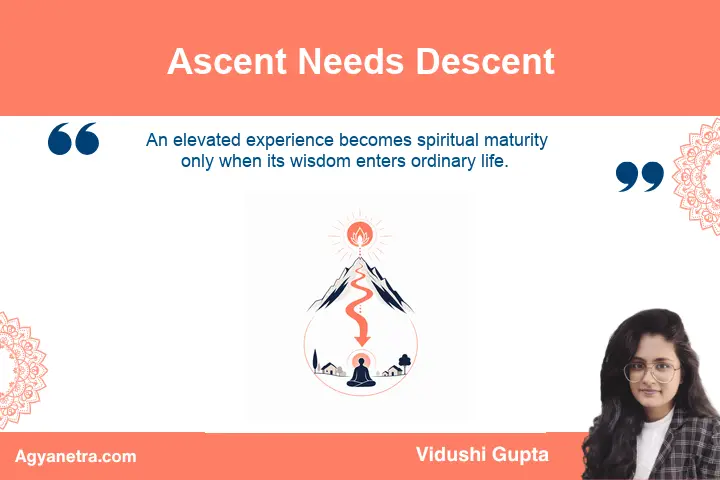
An elevated experience becomes spiritual maturity only when its wisdom enters ordinary life.
Moments of transcendence can reveal that life is interconnected. Integration then asks whether we can express that understanding through patience, honesty, compassion, and respect for the person in front of us.
It is easier to feel universal love in meditation than to remain considerate during conflict. It is easier to speak about oneness than to listen without defensiveness when another person disagrees.
This is why descent is not the opposite of awakening. It is the movement through which spiritual insight becomes conduct rather than remaining a memorable inner experience.
The higher centers may reveal a wider reality, while the Root brings attention back to safety, the body, livelihood, home, and relationship. Both movements are necessary for a stable path.
The spiritual awakening integration process offers further practical guidance for bringing unusual or expansive experiences into a balanced daily rhythm.
Healthy integration may look simple: sleeping regularly, keeping commitments, repairing a relationship, caring for the body, or making an honest decision. These actions are not distractions from spiritual life. They are where spiritual understanding becomes visible.
How Healing Moves in Layers
Some wounds return because healing is layered. A person may understand a pattern intellectually long before the body, emotions, habits, and relationships fully reflect that understanding.
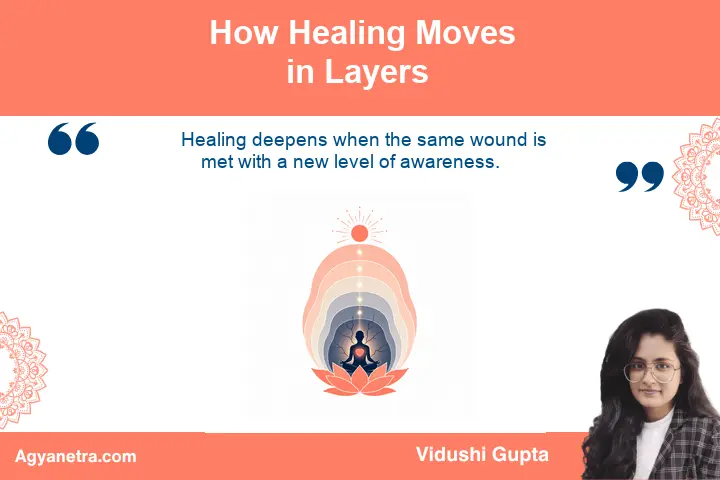
Healing deepens when the same wound is met with a new level of awareness.
The first encounter with a wound may be almost entirely unconscious. You may react, withdraw, cling, or attack without understanding what has been activated.
During a later encounter, you might recognize the pattern after it happens. With more awareness, you may notice the bodily tension, thought, or impulse while the reaction is unfolding.
Eventually, a small space can appear between the trigger and your response. That space does not erase the past, but it creates room for a different action.
To identify movement within a recurring lesson, ask practical questions. Did you notice the pattern sooner? Did you communicate more honestly? Did you recover more gently? Did you respect a boundary that you previously ignored?
If the answers are yes, the return may represent refinement rather than defeat. If nothing is changing, additional support, firmer boundaries, or a different practice may be needed.
Spiritual language should never pressure someone to remain in abuse, danger, or repeated manipulation. The spiral supports conscious participation; it does not require endless tolerance of harm.
The Spiral in Love and Twin Flame Experiences
A spiritual connection should lead you toward wholeness, not require the loss of your identity.
Intense relationships often move through cycles of closeness, distance, hope, uncertainty, and surrender. Such cycles can expose attachment, fear of abandonment, idealization, and the wish to find completion through another person.
The deeper work begins when attention shifts from securing a particular outcome to understanding the self. Can you care deeply without neglecting your body, responsibilities, friendships, values, or emotional safety?
This question is especially useful in twin flame experiences. The label should not become a reason to chase someone, disregard consent, accept mistreatment, or place personal life on hold.
A connection can be meaningful while its form remains uncertain. Honoring that meaning does not require making another person the center of your identity.
The purpose of the cycle is not necessarily reunion. It may reveal where love is being confused with dependence, where hope has become fixation, or where self-abandonment has been mistaken for devotion.
For a fuller exploration of this relational mirror, read Twin Flame Connection Explained Through The Sacred Reflection.
The most grounded measure is wholeness. A spiritually significant relationship should invite greater truth, self-respect, compassion, and responsibility, regardless of whether the relationship continues in the desired form.
How to Work With the Spiral in Daily Life
The spiral becomes practical when it helps you respond to recurring situations with curiosity instead of shame. The following steps can turn a familiar cycle into conscious practice.
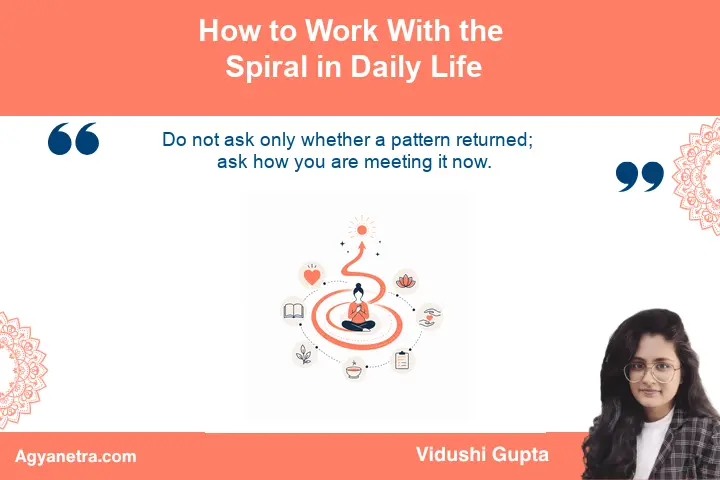
Do not ask only whether a pattern returned; ask how you are meeting it now.
Pause before naming the experience
Avoid immediately deciding that you have failed or lost your awakening. First notice what is happening in your thoughts, emotions, body, behavior, and environment.
Identify the familiar theme
Name the central issue in simple terms, such as control, rejection, insecurity, resentment, avoidance, or the need for approval. A clear name is more useful than a dramatic spiritual explanation.
Look for what has changed
Compare your current response with earlier experiences. Notice whether you have more awareness, choice, emotional capacity, honesty, or willingness to seek support.
Bring the insight into one action
Choose a grounded response. You might state a boundary, apologize without defending yourself, rest before making a decision, complete an avoided task, or ask directly for what you need.
Return to the body
Slow breathing, walking, eating nourishing food, sleeping, and feeling your feet on the floor can restore contact with the present. These basic actions help insight settle into lived experience.
If spiritual intensity is making daily life feel unstable, learning how to ground yourself during spiritual awakening can support steadiness without denying the experience.
Review without self-punishment
After the situation passes, reflect on what happened and what you want to practice next time. Honest review supports growth; harsh self-judgment often strengthens the very pattern you are trying to change.
A short written record can make subtle progress visible. Note the trigger, your first reaction, the moment awareness appeared, the action you chose, and what you learned afterward.
Signs That Awakening Is Becoming Embodied
Embodied awakening is measured less by extraordinary states and more by conscious participation in life.
Integration does not mean remaining calm, joyful, or detached at all times. It means becoming more capable of staying present when life does not match your preferences.
You may notice that difficult emotions no longer define your entire identity. You can feel anger without becoming cruel, desire without surrendering discernment, and fear without allowing it to make every decision.
Your relationships may become more honest because you are less interested in appearing spiritually advanced. You can admit mistakes, recognize limits, hear uncomfortable feedback, and leave situations that repeatedly violate your wellbeing.
The body may also become an ally rather than an obstacle. Its fatigue, tension, pleasure, and need for safety can be treated as information instead of something to transcend.
Most importantly, ordinary life regains value. Work, family, health, money, rest, and service become places where consciousness is practiced rather than lower concerns that must be escaped.
Final Words
The Sacred Spiral removes the pressure to reach a final spiritual summit and remain there forever. It allows awakening to be alive, rhythmic, and responsive to the realities of being human.
You may rise into clarity and later return to an old fear, relationship, or responsibility. The return does not erase what you discovered; it asks you to express that discovery through a new way of living.
Growth is not proven by never entering darkness again. It is revealed by carrying more awareness into the darkness, more wisdom into the familiar, and more compassion into the life already in front of you.
FAQs
What does The Sacred Spiral mean spiritually?
The Sacred Spiral represents growth through repeated cycles of expansion, return, integration, and renewed expansion. Familiar lessons may reappear, but they can be met from a deeper level of awareness.
Why do old patterns return after a spiritual awakening?
Insight does not always transform emotions, habits, and relationships immediately. An old pattern may return so that another layer can be recognized and addressed through conscious action.
Does returning to fear or attachment mean I am going backward?
Not necessarily. Notice whether you recognize the pattern sooner, respond more wisely, recover more gently, or make a healthier choice than before.
What is the difference between spiritual ascent and descent?
Ascent refers to expansion, insight, and experiences of higher consciousness. Descent is the process of embodying those insights through the body, relationships, responsibilities, and daily choices.
How does The Sacred Spiral relate to Kundalini?
The coiled serpent associated with Kundalini symbolizes movement that is inward, upward, and cyclical. It suggests that awakening develops through deepening and integration rather than through a single straight ascent.
How can I work with a recurring spiritual lesson?
Name the pattern clearly, notice what has changed in your response, and choose one grounded action. Reflection, bodily awareness, healthy boundaries, and appropriate support can help turn repetition into growth.
Can The Sacred Spiral explain twin flame cycles?
It can provide a reflective framework for cycles of closeness, distance, attachment, and surrender. However, no spiritual label justifies chasing, ignoring consent, accepting harm, or abandoning your own wellbeing.

Vidushi Gupta is a spiritual coach, energy healer, and emotional wellness counselor with over 10 years of experience guiding people through spiritual signs, emotional healing, and inner transformation. She is the founder of Agyanetra and a published author of nearly ten novels, reaching over 20 million readers worldwide. Her approach is grounded, fear-free, and focused on helping readers understand spiritual experiences with clarity and emotional balance.