
Reclaiming the Shadow is the process of welcoming back the qualities you once hid to remain accepted, protected, or emotionally safe. It is not permission to act without awareness; it is a grounded way to recover your voice, vitality, boundaries, creativity, and capacity for honest self-expression.
Many rejected parts began as natural responses to life. Confidence may have been mistaken for arrogance, anger punished as disobedience, curiosity dismissed as foolishness, or sensitivity treated as weakness.
When these experiences repeat, you may build an acceptable identity around what other people tolerate. The hidden energy remains present, however, waiting to be expressed in a wiser and more conscious form.
What Reclaiming the Shadow Really Means
Shadow integration begins when you stop treating every uncomfortable part of yourself as a flaw that must be removed.
The shadow often holds not only pain, but also the abilities and life energy you learned to hide.
The shadow contains thoughts, emotions, needs, and capacities excluded from your conscious identity. Some feel difficult, while others are valuable qualities that became associated with rejection or danger.
You may insist that you are not creative, assertive, playful, sensual, ambitious, or courageous. Yet such statements can describe adaptation rather than your true potential.
Before attempting to reclaim anything, learn to recognize the shadow you habitually refuse. Notice which qualities provoke strong judgment, embarrassment, envy, fear, or fascination.
Signs that a quality may be hidden
- You admire it in others but believe it is unavailable to you.
- You strongly criticize people who express it openly.
- You remember being shamed or corrected for showing it.
- You feel a surge of energy when imagining yourself embodying it.
- Your identity depends on being the opposite of that quality.
Reclaiming does not mean copying another person or exaggerating a trait. It means discovering the mature form of an energy that has been missing from your life.

Finding Wholeness in a Fractured World
Integration explores inner fragmentation, emotional healing, shadow work, self-awareness and the journey towards inner wholeness. It is written for readers who want to understand themselves more deeply and bring spiritual awareness into everyday life.
Begin with Safety and Honest Recognition
A hidden part becomes easier to meet when it is approached with curiosity rather than pressure.
Shadow work can stir old shame, fear, or grief. Begin slowly, especially when the hidden quality is connected to trauma, punishment, or a relationship in which expressing yourself had serious consequences.
Create a few quiet minutes and name what you notice without immediately explaining it. You might write, “A part of me wants to speak,” or “I feel anger when my time is treated as unimportant.”
If this practice is unfamiliar, a gentle introduction to shadow work for beginners can help you establish realistic expectations and avoid turning self-exploration into another demand for perfection.
Ask what the feeling protects, what it needs, and what healthy action it could support. The purpose is not to obey every impulse, but to listen for the intelligence beneath it.
Reclaim Personal Power Without Controlling Others
Healthy power is the ability to remain aligned with your truth without taking away another person’s freedom.
Personal power is often rejected because it has been confused with aggression, superiority, or domination. In its integrated form, power is simply your capacity to choose, act, and take responsibility.
A person disconnected from power may constantly seek permission, over-explain decisions, agree while feeling resentment, or wait for others to define what is acceptable. Reclaiming power changes these patterns through small, consistent choices.
Practise power in ordinary moments
- Pause before automatically saying yes.
- Express a preference without apologising for having one.
- Decline requests that exceed your time or capacity.
- Make one delayed decision using your own considered judgment.
- Accept the consequences of a choice without attacking yourself.
Power becomes trustworthy when it remains connected to humility. You do not need to become forceful; you need to stop disappearing whenever your truth differs from someone else’s expectations.
Turn Anger into Clear and Conscious Action
Integrated anger protects what matters; it does not need to humiliate, punish, or destroy.
Anger often appears when a boundary has been crossed, an injustice ignored, or an important need repeatedly dismissed. Suppressing the signal does not resolve the underlying issue.
At the same time, feeling anger does not justify harmful behaviour. Integration creates enough space between emotion and action to choose a response that protects dignity on both sides.
A simple anger process
- Pause before sending the message, making the accusation, or raising your voice.
- Notice where the energy is held in your body.
- Name the specific event instead of condemning the whole person.
- Identify the value or boundary that needs protection.
- Choose a direct, proportionate, and non-destructive response.
For example, “I need notice before plans change” is clearer than silent resentment or a personal attack. Anger then becomes information and courage rather than a weapon.
If anger feels overwhelming, frightening, or linked to traumatic experiences, professional support may be appropriate. Spiritual practice can deepen awareness, but it should not be used to bypass the need for emotional safety.
Reclaim Sexuality with Awareness and Respect
Sexuality can carry layers of inherited shame, social control, fear, longing, and confusion, making it especially important to approach this area without simplistic rules.
Reclaiming sexuality means developing a conscious relationship with life energy, embodiment, intimacy, consent, and desire.
Repression disconnects you from the body, while compulsion allows desire to direct life without reflection. Integration avoids both extremes by bringing choice, responsibility, and self-respect into the relationship.
Sexual energy can also appear as warmth, imagination, devotion, attraction, creative movement, and a desire for deep connection. It cannot be reduced to physical activity alone.
Begin by noticing whether you inhabit your body with kindness or treat it as an object to judge. Practise listening to comfort, discomfort, attraction, hesitation, and personal limits without forcing an immediate conclusion.
Tantric perspectives can regard the body as part of spiritual awakening rather than an obstacle to it. This does not remove the importance of consent or discernment; it makes conscious relationship even more essential.
Invite Creativity Back into Daily Life
Creativity returns when expression becomes more important than approval or perfect results.
Creativity is not reserved for professional artists. It appears whenever you bring a fresh response into life through writing, cooking, teaching, parenting, gardening, building, problem-solving, or attentive listening.
Many people stopped creating after their early ideas were mocked, compared, or corrected too quickly. Because visibility became risky, the creative part learned to remain hidden.
Choose one small activity with no demand for public recognition. Write for ten minutes, rearrange a room, make a simple meal differently, hum a melody, or solve a familiar problem through a new approach.
Useful shadow work prompts for healing can also reveal whose criticism you still anticipate and what you might create if no one were grading you.
Do not measure early expression by excellence. The first task is rebuilding trust with the part of you that wants to experiment, play, and be seen.
Kali and Durga as Symbols of Integrated Strength
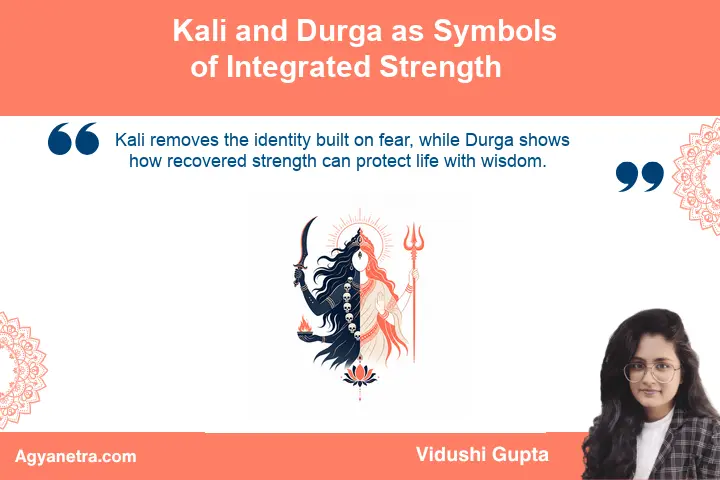
Kali removes the identity built on fear, while Durga shows how recovered strength can protect life with wisdom.
Within Hindu spiritual symbolism, Kali can represent the fierce force that cuts through illusion and attachment. Psychologically, she reflects the inner refusal to keep living through masks that require self-abandonment.
This fierce movement is not destruction for its own sake. It clears identities that have become prisons, such as always being agreeable, invisible, endlessly helpful, or afraid of disapproval.
Durga offers a complementary image of composed strength. She represents power guided by purpose: the ability to protect what is sacred without becoming consumed by hatred or conflict.
Together, these symbols illuminate two movements in integration. Something false must sometimes be released, and the recovered energy must then be directed with compassion, discipline, and clear boundaries.
Use these images as reflective symbols rather than labels for impulsive behaviour. Fierceness without awareness can injure, while compassion without boundaries can become self-erasure.
A Practical Practice for Reclaiming Lost Qualities
Choose one hidden quality, find its mature expression, and practise it in a small, responsible way.
Trying to reclaim every rejected part at once can become overwhelming. Work with one quality that feels relevant to your present life, such as confidence, playfulness, leadership, sensuality, curiosity, or courage.
- Name the quality: Write the trait you believe you lack or should not express.
- Trace the message: Recall where you learned that this quality was unsafe, unacceptable, or embarrassing.
- Separate essence from distortion: Confidence is not arrogance, anger is not cruelty, and sensuality is not compulsion.
- Find the healthy purpose: Ask how this energy could serve truth, love, protection, creativity, or connection.
- Choose one action: Speak once in a meeting, state a limit, begin a creative task, or ask directly for support.
- Reflect afterward: Notice fear, relief, energy, guilt, or resistance without declaring the practice a success or failure.
This approach shares the central aim of shadow work and Jungian healing: bringing unconscious material into a conscious relationship so it can be lived with greater responsibility.
Vidushi Gupta’s vision of integration is especially useful here because wholeness does not require inventing a superior self. It asks you to recover life energy that was already yours.
How to Recognise Genuine Integration
Integration makes you more honest and responsible, not more entitled to act on every impulse.
Real integration is usually visible in ordinary behaviour. You become clearer without becoming needlessly harsh, more expressive without demanding attention, and more powerful without trying to control everyone around you.
You may also notice less envy toward people who embody your hidden qualities. Their confidence, passion, freedom, or creativity no longer feels like evidence of your inadequacy.
- You can feel anger without immediately suppressing or discharging it.
- You set boundaries with less explanation and guilt.
- You tolerate being seen, misunderstood, or respectfully disagreed with.
- You allow pleasure and creativity without abandoning discernment.
- You recognise both strength and vulnerability as parts of yourself.
Integration is not a final state in which inner conflict disappears. It is a continuing relationship with yourself in which fewer parts must be exiled for you to feel worthy.
Final Words
Reclaiming the Shadow does not turn you into someone new. It allows the silent voice, protective anger, creative impulse, embodied wisdom, and steady power within you to participate in life again.
Move slowly and choose mature expression over reaction. Each time power serves love, anger protects truth, creativity becomes visible, and desire meets awareness, another divided part of the self is welcomed home.
Wholeness is not achieved by presenting only what appears peaceful or acceptable. It grows as you meet rejected energies with honesty and give them a conscious place within your life.
FAQs
What does reclaiming the shadow mean?
It means consciously recovering emotions, needs, abilities, and qualities you previously rejected or hid. The goal is to express their healthy form rather than suppressing them or acting them out impulsively.
How do I know which shadow quality to reclaim first?
Notice qualities that trigger strong envy, admiration, embarrassment, or judgment. Begin with one that affects your present relationships, boundaries, creativity, or sense of personal power.
Is reclaiming anger the same as expressing it freely?
No. Reclaiming anger means listening to its message and choosing a proportionate response. It never excuses intimidation, cruelty, violence, or destructive behaviour.
How can I practise shadow integration safely?
Work slowly with one quality at a time, observe your bodily and emotional responses, and use small real-life actions. Seek qualified professional support if the process activates trauma, severe distress, or unsafe impulses.
How long does it take to reclaim the shadow?
There is no fixed timeline. Shadow integration is an ongoing practice, but small changes can appear as you communicate more honestly, set clearer boundaries, and allow healthy self-expression.

Vidushi Gupta is a spiritual coach, energy healer, and emotional wellness counselor with over 10 years of experience guiding people through spiritual signs, emotional healing, and inner transformation. She is the founder of Agyanetra and a published author of nearly ten novels, reaching over 20 million readers worldwide. Her approach is grounded, fear-free, and focused on helping readers understand spiritual experiences with clarity and emotional balance.